Being born during a war may spare you its memories, but not its events. I learned this through the silence of my home, so different from the world outside.
As a child, I listened to my classmates speak of the war. They talked of their parents, fighters in the KLA, as heroes. They sang songs of Albania and flew the flag high, especially on national holidays. My family’s story is different.
We held a more complex identity. At home, we cherished Turkish and Bosnian languages, and by extension, their cultures. To know a culture is to live it: you study it, you practice it, and in time, you absorb it. I became all of them, and at the same time, an Albanian like any other.
Perhaps because of this, I never developed intense feelings about the Kosovo War. My fascination lay instead with the Albanian Renaissance — its poets, writers, and the anti‑fascist and anti‑imperialist fighters of the World Wars. Raised in a multilingual, non‑nationalist family in Prizren, I learned to view the world more through culture than through politics or national symbols.
As a child, I believed that the right to narrate the war, to speak of its nature, belonged solely to those who fought it and suffered most from it. It took me time to realise that a country is a cultural project, built on oral history, shared struggle, and the mobilisation of a community toward national liberation. I finally understood: a country, like a war, is a common struggle. I turned my gaze inward, becoming more comfortable speaking about my family and how this dark period led their lives through irregular, precarious and deeply traumatic paths.
I see so many wars on the news, and I wonder what it means for a community to live inside a war zone. I start to make sense of the scattered morsels of histories — oral histories that form “re‑pasts,” pasts retold and remade — that my parents shared with me over the years, intimately, without planning. It helps me gather these offcuts into something legible, a story that tied us to Sarajevo long before we settled in Prizren, a story still blurred within our family — honest, unverified, unwieldy, cross‑hatched like my own image of the war. A story that I now share with you.
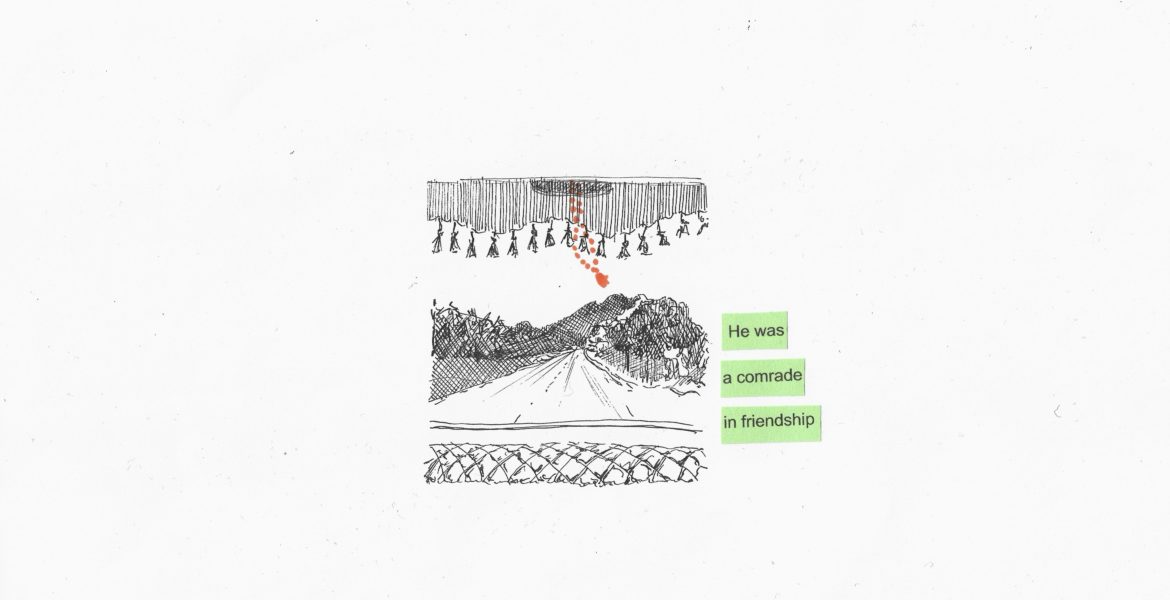
It was the ’90s, wars raged through Bosnia and Croatia, and my parents began to feel danger nearing our homeland. My father, who owned a bus and truck company, had a close friend from Brezovica, near Prizren — a Serbian man who was not just a colleague but a comrade in friendship and in drinking rakija after work.
Sometime toward the end of a decade that felt like apartheid in Kosovo, my father went to visit him. His dear friend’s eyes met his with a cold, shivering disquiet. “What’s wrong?” my father asked. “The KLA murdered my mother in an accidental encounter in the mountains,” he replied.
My father, shocked, tried to console him. His friend accepted the comfort, but as they said goodbye, he let fall words like stone, like blade: “The next time we meet, I will have to murder you, my friend.”
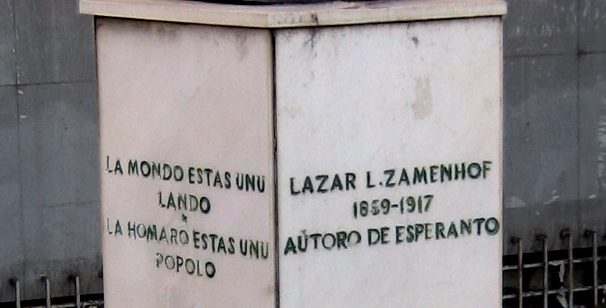
This threat, combined with the growing oppression from Serbian authorities, forced my parents to leave the country. Just seven months after I was born, we set out for Sarajevo — a city that, for us, could also feel like home because of our family connections. My great-grandfather, Ali, had been a watch repairer with a shop in the old quarter, and my uncle and cousin had studied there.
The plan was for my mother, my older brother and me — a baby in her arms — to take a bus to Sarajevo via Prizren. My father would follow after completing some final errands. Two buses were scheduled; my mother took the second one.
Upon arriving in Sarajevo, she learned of a nightmare. The first bus, carrying another mother with a baby in her arms, just like my own, had been stopped on the road. The baby was stabbed and murdered by Chetniks.
If I close my eyes, I can see my mother sharing this story, the realization that I could have been that baby — that sadness, that misery, that child.
After some time in Sarajevo, my father decided that my grandfather, after whom I am named, would be better off living with us until the war came to an end. My grandfather came and cherished the company of his son and family. Life, as they say, went on.
Then, during a casual stroll through the streets of Sarajevo, a car accidentally struck and killed him. It was another layer of anguish piled upon my family, a tragedy befitting the traumatic decade they were living through.
Our traditions require that the deceased be returned home for burial. By then, 1998 had arrived, and the war in Kosovo was intensifying. My father went from funeral home to funeral home, searching for someone willing to drive him through the conflict zones.
Every Bosniak he asked refused, fearing that Albanians would mistake them for Serbs because of their shared language. Finally, one Bosnian Serb agreed. To my father’s surprise, he insisted on explaining that he had not taken part in the Bosnian War and had never harmed anyone, ever.
They began their journey in the undertaker’s car: the Serb man driving, my father beside him and my grandfather’s body in the back. They arrived in Prizren, where the war was relatively milder than in the besieged areas of Drenica, Deçan and Gjakova. My father performed the full Islamic burial ritual for his dad.
Our family welcomed the Serb undertaker — our newfound friend who had honored us so profoundly — as a guest of honor in our home in Prizren. He stayed for two days before beginning, alone, his journey back to Sarajevo. Days later, after embracing his brother — my uncle, who had spent all that time hiding in our basement to escape the Serbian forces — my father also made his way back to Sarajevo.
Terrible news awaited him there. The family of our Serb friend started threatening him, demanding to know what he had done to their relative. He never returned to Sarajevo.
My father tried to calm them, promising that he would find out what had happened to him. He discovered that the man had been shot somewhere between Prizren and Gjakova, where his undertaker’s vehicle was found. This loss had a tremendous impact on my family. It planted a heterotopic feeling — the sense of something lodged in the wrong, abnormal location — in the background of our family’s collective consciousness. It became a lasting elephant in the room, throwing everything off balance, the most prolific, hardly named relic of our post‑war Kosovar family.
With NATO’s intervention, the war in Kosovo finally ended. As we prepared to return home, my father tried to get his trucking business back on its feet. While he was traveling through Montenegro, however, Serbian authorities confiscated — or rather, stole — his two trucks, his main source of income built through years of hard work.
But our story, fortunately, didn’t end there. After the war, we returned safely to the sunny garden of our family house in Prizren. There, we once again found the kadife roses — deep red and silky — blooming brightly, and the love of our cousins who, like my uncle, had survived the war from the basement.
I share this story as part of our collective history, because every voice matters. When we bring our raw truths into spaces of trust, we begin to truly hear one another and to comprehend the deep, lasting wounds that war inflicts.
I believe my mother and father deserved a better decade — one in which their youth and the best years of their love and marriage could have been nurtured rather than stolen. I feel this deeply within me. I am grateful that, even so, life did go on for my family and the people I love.
I write this tearfully, as I pray for all the unheard victims of genocide in Palestine, Congo and beyond.
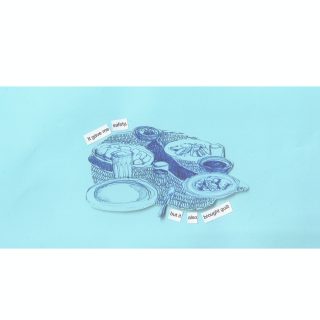
Illustration: Emilia de Haën / Pro Peace
Ismail Myrseli is a multidisciplinary artist, producer, music researcher and booking agent pursuing an MA in Cultural Studies in Ljubljana. His practice spans publishing, music, performance, contemporary art and film, exploring the tension between the absurd and the intimate, where personal memory intersects with collective history. His work has been presented at Documenta 14, Guest Room Maribor and MuseumsQuartier Vienna. In 2023 and 2024, Ismail also served as an arts mediator at the National Gallery of Kosovo.
This blog is part of the Bridges of Memory series. Discover more stories here.