Lendrit Qeli – RTV Prosperiteti
Survivor Bashkim Ramadani’s Account of the 14 Ashkali and Egyptian Victims Missing Since the Krusha e Madhe Massacre
On March 26, 1999, just two days after NATO launched its bombing campaign against Serbian targets, the village of Krusha e Madhe, located approximately 11 kilometers from Rahovec, became the scene of one of the most devastating massacres of the Kosovo war. During three days of systematic violence carried out by Serbian forces, 241 Albanian civilians were killed and massacred, while 64 people remain missing to this day.
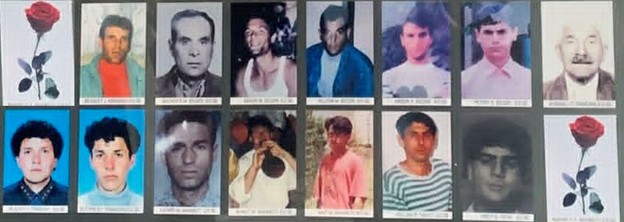
Among the victims were 14 members of the Ashkali and Egyptian communities who, according to survivor testimonies, refused to leave the village and remained alongside their Albanian neighbors until the final moments of their lives. More than two decades later, their families continue to live with pain, uncertainty, and the hope for justice, as their remains have never been found.
Many of the witnesses from that time are no longer alive. Along with them, important accounts of the crimes and the victims’ final moments have also faded away. Yet the memories preserved by families and survivors remain a living testimony to that tragedy.
One of those who survived the massacre is Bashkim Ramadani. He managed to escape, but lost his father and two brothers, who were executed during the tragic events of March 1999. Even today, 26 years later, the family still does not know where their remains lie.
“We lived through hard work and sweat. We did not have much, but we had respect and care for one another. We were like family with our Albanian neighbors. In times of joy and in times of mourning, we were always together,” Ramadani recalls.
But everything changed within a matter of hours.
With the beginning of the NATO bombing campaign, fear spread throughout the village. Residents were forced to flee to the mountains to escape attacks by Serbian forces. From a distance, the sounds of tanks and gunfire could be heard drawing closer and closer.
“After staying in the mountains until evening, I took the risk of approaching the village to see what remained of our home. All I could see was fire and smoke. The whole of Krusha was in flames. It felt as though our entire life was burning together with our houses,” he recalls.
Families spent the night hiding in the mountains, surrounded by uncertainty and fear. The following day, shelling and gunfire came even closer.
In those moments of panic, Bashkim urged his father to leave with the family and move to a safer area. His father refused. Shortly before their final separation, Bashkim asked his father to remove his white plis, fearing it would make him more easily identifiable to Serbian forces. His father’s response remained forever engraved in the family’s memory: “I was born with a plis, and with a plis I want to die.”
Those were the last words Bashkim ever heard from him.
As the situation deteriorated and fears grew that Serbian forces would discover their hiding place, family members and villagers decided to split into smaller groups, hoping that at least some would survive. The idea was not to remain together in one location, fearing they could all be executed if captured by Serbian paramilitary units.
After the groups separated, Bashkim’s father and his two brothers remained together with several other men. According to testimonies from surviving women who were present at the time, they too fell into the hands of Serbian forces. The paramilitaries immediately ordered the men to separate from the women and children, while the women and children were instructed to leave without looking back.
“Keep walking and do not dare turn your heads back. Keep your hands up,” the paramilitaries shouted as the men were detained behind them.
Moments later, bursts of gunfire were heard. From that day on, the Ramadani family never saw Bashkim’s father or his two brothers again. But the ordeal did not end there. Bashkim Ramadani himself, along with dozens of other civilians, was later captured and taken to the village mosque, which during those days had been transformed into a site of torture, beatings, and executions.
For nearly 24 hours, trapped inside the mosque, they lived through fear, screams, and the constant expectation of death.
“The mosque no longer looked like a mosque. It was like hell. There was blood everywhere, screams, and fear. Every few minutes they would take someone outside, and then we would hear gunshots,” he recalls. He remembers the faces of terrified people, especially young boys only 14 or 15 years old—still children—crying in fear while waiting for their fate.
“The boys kept asking me, ‘Father, are they going to kill us?’
We tried to calm them down, but in the end, I lost hope myself.
” According to him, after hours of psychological torture and violence, no one inside the mosque believed they would leave alive. “ We had no hope left. We were simply waiting for our turn.
” The following day, Serbian paramilitaries and police officers forced the civilians out of the mosque and ordered them to run.
“They told us, ‘Go! Run!’ And while we were running, they fired their weapons at us from all directions. People scattered in panic, each trying to escape however they could,” Ramadani recalls.
Even today, he cannot fully understand how they survived. “I still do not know how we managed to escape. We just ran toward the main road from Krusha e Madhe to Prizren, through fear, screams, and bullets.”
The Missing Ashkali and Egyptians of Krusha e Madhe:
Skënder M. Beqiri (1941) – 58 years old;
Mahir S. Beqiri (1964) – 35 years old;
Kujtim S. Beqiri (1971) – 28 years old;
Arben S. Beqiri (1976) – 23 years old;
Petrit S. Beqiri (1978) – 21 years old;
Xhemali O. Ramadani (1930) – 69 years old;
Milaxhim Xh. Ramadani (1968) – 31 years old;
Blerim Xh. Ramadani (1976) – 23 years old;
Mahmut A. Mahmuti (1939) – 60 years old;
Fatmir M. Mahmuti (1965) – 34 years old;
Xhavit M. Mahmuti (1969) – 30 years old;
Nahit M. Mahmuti (1971) – 28 years old;
Asllan R. Sahiti (1966) – 33 years old;
Ymer B. Iseni (1975) – 24 years old.
They were not merely names on a list.
They were fathers, sons, brothers, and neighbors who refused to abandon their village and chose to share the fate of their Albanian fellow villagers until the final moments of their lives.
For the families of Krusha e Madhe, the war has never truly ended. It continues in the silence of missing graves, in the ongoing search for justice, and in memories that time cannot erase. Because in Krusha e Madhe, the names of the victims are not simply part of history—they remain open wounds in a community still waiting for peace for the souls of its missing.
Full article in Albanian: https://rtv-prosperiteti.com/me-plis-kam-le me-plis-dua-te-vdes-rrefimi-i-te-mbijetuarit-bashkim-ramadani per-14-ashkalinjte-dhe-egjiptianet-e-zhdukur-ne-masakren-e krushes-se-madhe
***
This article is a product of the Academy on Reporting on Dealing with the Past and Conflict-Sensitive Journalism, implemented by Pro Peace – Program in Kosovo and the Association of Journalists of Kosovo (AGK). The views expressed in this article are the responsibility of the author and do not necessarily reflect the views of Pro Peace and AGK.