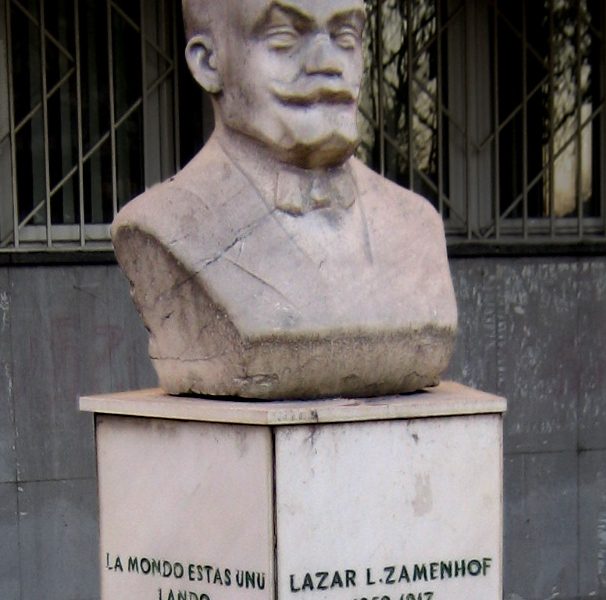
In the center of Prilep there is a bust that few people notice. The bust is of Ludwig Lazar Zamenhof, unknown to many in our country, otherwise known as the founder of Esperanto. On the pedestal there is a very important message of the Esperanto movement, written in Esperanto: “The world is one country, humanity is one people”.
How inspiring is this stance, how inspiring could it be! And, yet, it is not. Perhaps, it has not been given the chance to be. So, we’ll ask the question: why is this the case? Why are such stances not present in our public discourse, in fact, they are absent to the extent that many who will read this text may be encountering such a statement for the first time?
The reason behind this is largely in the degree of penetration, shaping, and domination of our thoughts and worldview by nationalist ideology. It, the nationalist ideology, is translucent in a double sense: the manipulation it performs is very tawdry, but at the same time its translucency allows it to not be easily identifiable.
This translucency can be seen in the concealment of nationalism behind the fig leaf of patriotism, its close, yet, not identical, ideology. This is the very pattern of every nationalism. As with many other ideologies, these two also share the conceptualization of their own group of affiliation and a group that does not belong to them, “us” and “them”. Since patriotism is focused on one’s own country, on the homeland (patria), the patriots’ group of affiliation is made up of their countrymen, of those who live in the same country as them. On the other hand, since nationalism is focused on one’s own nation, the nationalists’ group of affiliation is made up of their conationals, of those with the same ethnic identification as them.
If we take this into consideration, in any multi-ethnic country one can easily distinguish the patriot from the nationalist who claims to be a patriot. In the example of our country, for a Macedonian patriot, the Albanians who live in the same country as them, as their countrymen, would be part of their group of affiliation, while for a Macedonian nationalist they would be outside of their group of affiliation. Consequently, no ethnic Macedonian could claim to be a patriot if they did not see their countrymen Albanians as part of their group of affiliation. And yet we have many such cases: they are othering the Albanians of our country, that is, they perceive them as someone outside of their own group of affiliation, and at the same time they want to build an image of themselves as patriots, not nationalists. An act worthy of contempt… if one sees and understands the translucency of nationalism.
The translucency of nationalism can also be observed in the perception of humanity. One of the starting theses of nationalism is that humanity has been divided into different peoples, usually on the basis of different native languages. But, note the translucency of this statement: nationalism tries to smuggle this thesis of its own as an axiomatic truth. That is, nationalism tries to elevate something that is an opinion, an assertion, something that can be accepted or not, to a status of an indisputable fact of the same order as the fact that 2 and 2 are 4. But, wait a minute. Why do we have to agree that we should divide humanity in the first place, and why, if we are going to divide it at all, should we not divide it into exploiters and exploited, but into different peoples? People here and on the opposite side of the planet feel joy about the same things, they feel sorrow about the same things, they love their children the same, they do not want to be humiliated and oppressed, they suffer the same dehumanization from capitalism. And now, we were supposed to set aside everything that unites us as people and accept the claim of nationalism that we should see ourselves divided into ethnic herds just because we express the same feelings of joy and sorrow in a different language!?
Yes, some, the nationalists, may think that this should be the case. But those who believe that nationalism is a harmful ideology make a huge concession to the nationalists when they themselves treat the nationalists’ thesis about our division into ethnic herds as an indisputable fact. And they begin their fight against nationalism from the point that, well, since we have been indisputably divided into ethnic herds, what we are supposed to do is to respect each other’s differences, customs, etc. Starting the fight from that point guarantees that nationalism has already achieved significant success, that it has already built a wall between us and forced us not to see the many things we have in common and instead to exaggerate the little things that are different.
Humanity is one people, and the world is one country. Only in this way can our ethnic identity not be abused by nationalists, through its presentation as our supreme, and even sole identity. Here again we see the translucency of nationalism in action. Every person is a wealth of identities. A human being, a resident of a certain country, a member of a certain ethnic group, of a certain class, a resident of a certain city or village, with a certain gender and sexual orientation, performing a certain occupation, engaging in a certain hobby, perhaps a member of a certain political party or adherent of a certain ideology, etc. Their ethnic identity is part of their overall identity and there is no rule that ranks identities from more important to less important, with ethnic identity being the most important. And yet, nationalists claim exactly that, selling it as an absolute truth. However, notice that someone would has to be an exceptionally die-hart nationalist to dare to claim that they were first Macedonian, Turk or Estonian, and only then a human being. And in any case, their imprudence to defend this ridiculous claim will inevitably expose them – as a nationalist fanatic. Of course, it would be ridiculous to claim that any of our partial identities comes before our universal human identity.
Humanity is one people, and the world is one country. It is only by advancing to this awareness that we can avoid the trap of othering. And to place other people, those who are not part of our ethnic herd, beyond our interest and our concern. In such a case of othering, their suffering is degraded to a lower level, and we provide, in front of ourselves and others, with an excuse not to undertake what we as people, that is, as human and humane beings, are obliged to do. Concretely speaking, if we perceive ourselves first and foremost as people and if we see other people first and foremost as people, then the suffering of the people in Gaza, upon whom the Israeli dehumanized regime is committing genocide, because it believes that their “wrong” ethnicity makes them subhuman, will touch us much deeply and more profoundly. For if we do not other, if we see the people in Gaza as people and ourselves as people, then we realize that genocide is being committed against some of our own. And that realization hurts more and differently, it motivates us more deeply in the solidarity and in the perception of our own responsibility to take measures to stop that suffering.
Today, our human identity is suppressed under the influence of nationalist ideology. We are othering the people who are not part of our ethnic herd. Under the influence of the individualistic ideology of capitalism, we are also othering those who are part of our ethnic herd. And in doing so, alone and lonely and stuck in the provincialism of nationalism, we are unable to grasp neither the breadth nor the depth of Rosa Luxemburg’s statement: “I am at home wherever in the world there are clouds, birds and human tears”.
And why is the perception and acknowledgement of our human identity today not only desirable, but essentially needed a well? This is so, because we live today in the context of climate disruption, which will not magically disappear even if the centers of power produce ten times more denials and distractions than they do. Confined in our ethnic herds and individualized to the extreme, we are only marginally or even not at all affected by the suffering of other people (and the rest of the living world) on all sides of our planet, which are caused by increasingly frequent and extreme weather events. And, consequently, we fail to break through to the realization that our atmosphere is also one and the same and that what we do and do not do here in the context of the already significantly disrupted climate of our planet has consequences for people (and the rest of the living world) where our eyes do not reach, but where our hearts should reach. And we need to be aware that our present individualism and egoism has a price. The price is that of the victims who are not the first to be affected, which the Lutheran priest Martin Niemöller depicted perfectly in the context of the Nazi atrocities. He was silent when they came for the Communists, because he was not a Communist. He was also silent when they came for the next three categories of people. So when they came for him, there was no one to raise their voice for him.
At one of the protests in solidarity with the people of Gaza, small in size (which says a lot about our fall), an old Albanian grandfather said to me: “We need to be humans”. I agreed. This statement about our today’s imperative is as clear as it gets!
Zdravko Saveski