“My work really started with him when I made it clear to him that I recognized his non-existence. He made the remark that over the years all the good work done with him had been futile because it had been done on the basis that he existed, whereas he had only existed falsely.” Donald W. Winnicott, 1984
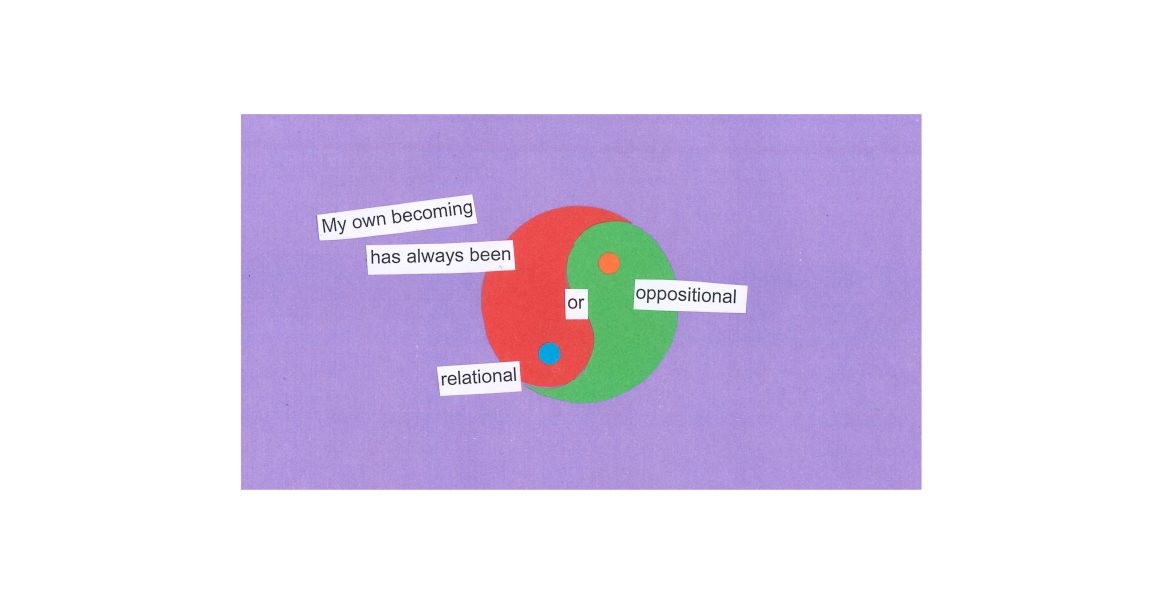
My fascination lies not with the affirmation of existence, the evidence of memory. Rather, I am drawn to non-existence, to the traces that are left behind when identity falters. I don’t pursue this out of intellectual exercise. On the contrary, it comes from realizing that my own becoming has always been relational — I exist because you exist — or oppositional — I am because I am not what you say I am; never the solitary triumph of a being confident in its own absolute existence.
Growing up, I have gotten caught in an endless search for the unchanging-undying within me: that which remains after all else is gone. After many years of searching, I am still unsure whether there is a real-true, authentic kernel of an “I” inside this living body, made of society’s vestiges of honor and shame.
This tentativeness has taken many forms in my mind. At times, it gave contours to my identity against the bellowing of reality; at times, it gave language to my response to trauma. At other times, it appeared as a kind of spirituality: an understanding of no-self, the absence of a fixed “I” beyond breath and spirit — beyond, if you will, the shape of God within each of us.
I am harrowed by this feeling; it could be my first memory as well as my last. No matter how much depth I have reached, or how many successes I once thought impossible and then achieved, the morning after I still — more often than not — feel like my old self. A version of myself from before, resisting my efforts at deliberate change, an amalgamation of encrusted remnants of behavior that try to keep me small and wary.
Each time I encounter this self, I am shocked, especially as I watch it regurgitate body-memories day after day, no matter how much I insistently forget them. I call them memories, but I cannot tie them to factual events. They are intrusive thoughts instead, feelings of shame, sediments of hypervigilance, shards of not-good-enough that bind me to inaction.
Whether because of Hashimoto’s disease, a general vitamin deficiency or something else, I forget the origin of these fragments. Yet somehow, I have come to make this forgetfulness my own. Recently, an acupuncturist, while placing their twenty‑third lightweight needle into my body, asked whether I had experienced something traumatic at the age of twelve. I could not reply, even after they followed up with: “Did you happen to feel used?”
“Yes!” my body was answering, as if to say, “I know well what it means to be used!” But I cannot remember even yesterday in any linear or material way; my memory is purely emotional. The puritans will tell you to move more, eat better, sleep well. But rather than optimization, I am more inclined toward acceptance, toward the weak, half‑assed, broken and marginal ways of being.
Every day my mother hands me new commands: “Put cream on your face,” “Dress up nicely, you look awful,” “Don’t be lazy, liven up.” At times, it feels as though my very being has become a counter‑response to others’ reality, rather than an autonomous, authentic emergence.
Twice I have felt and known what it means to live with no memory, no sense of self — my body an extension of the roots in the ground, timelessness the anchor. Twice in my life I was struck, once in one of my earliest memories: lying on the couch, at the age of eight, perhaps. I seemed to remember and revisit what came before birth, a kind of peaceful emptiness, a being held in not‑knowing.
I am truly fascinated by people and their simplistic language, those who say things like “just be,” “you are enough” or “be present!” How can certain words occupy so much space in public discourse, and how can so many people claim to understand or resonate with them? I am a kind of synthesizing thinker, and I cannot yet understand what it means to be present. The only presence I know is when I am with others, when our proximity births the awareness that I am there, close to them.
At some point in my life, I acquired an almost unconscious habit: seeking refuge in a bird’s‑eye view — a certain impartiality, constantly searching for justification in any behaviour. I felt an equally constant unease; few of the things laid out before me seemed to truly represent me or speak to me. The need to remain outside of something — of everything — left me in a posture of negation, an attitude of over‑criticism.
Instead of producing or creating, I became caught up in untangling the dualities and paradoxes of public discourse. I reached out for something that was not, as always, a counter‑response. I wanted to discover the coming‑togethers of opposite truths.
I became convinced that, while preaching agency and imagination, society had in fact, bit by bit, stripped us of both, caging us in circular struggles of contraries. All this noise persuaded me that most things are not as they are said to be, that what we call meaning is often only a symbol adjacent to words. I learned to continuously question myself, my truth, my memory.
At times, I spend more time in Belgrade than in my hometown, Gjakova, and the faces gathered in peacebuilding and reconciliation workshops seem unable to grasp my choices. In a recent discussion, I was told that, when in Serbia, a Kosovar must properly represent their country by insisting that Serbia does not recognize Kosovo and by advocating firmly against this.
Suddenly, I found myself reacting — objecting to being labeled a quasi‑apologist — simply because I can sit across from a Serb who says, “You Albanians ruled us out of Kosovo.” I hardly dare to imagine persuading the demagogues of transitional justice to listen to my positive stories of life among Serbs, no matter how much funding has been poured into these very exchanges.
I am not an apologist; I am not a fatalist. I am simply not radicalized. I do my best to witness people in their way of being people, without summoning the language of the army, the state or world politics. Soon after, the conversation ended with the conclusion that this was my “defense mechanism” and that I should examine where it comes from.
I do not have the experiences that others do, nor do they have mine. I do not resonate with much of the language used in public discourse — affirmative, half‑delusional, half‑paradoxical in relation to lived reality. To me, so many of the roundtables, the academic articles, the public presentations do not so much educate or “awaken” as construct faux narratives in service of our superegos — those parts of the mind that speak with the voice of society, the mother, the father, the state, dictating what can and cannot, should and should not be done.
My frequency is such that I know I will find little room for radical honesty, or for a voice-language of my own. Yet I believe one must dedicate a life to making space for it: broken speech, half‑memory, biased minds rewired toward unlearning.
Memory is violent, and speech is reductive. I do not wish to be reduced; I wish to find new words to better — if not fully — represent what I feel, or how I function so irregularly. I wish to let go of memory, which has taught me to feel small and wary of people, so that I may dream anew.
My memory is mine, but it is also not — a gaze from the outside looking in.
I have been seeking meaning all my life.
I type the keyword “memory” into a document I have made with all the poems I have written through the years. It appears:
“I saw my mother cry
That’s my first memory”
“The dead being memory
The living being everything outside which shows me how humble I can be”
“God is a memory
Sifting through the portals of lucidity”
“The dream creates the memory”
Illustration: Luca Tesei Li Bassi / Pro Peace
Diona Kusari is a multidisciplinary artist, writer, researcher and cultural mediator. Her art explores the materialization of the invisible, whether faith or ideology, and challenges the presumed boundaries between private and public. She is a member of Potpuri Collective, which engages in experimental research, self‑publishing practices and decentralized knowledge production. She writes experimental poetry, blogs, reviews, cultural reflections and critique, on the virtual and the symbolic, and theorizes on topics of so‑called public interest.
This blog is part of the Bridges of Memory series. Discover more stories here.