By Besian Beha
The database containing accurate statistics on victims of the last war in Kosovo, along with the missing persons, is expected to be finalized within this year.
This was stated by the Director of the Institute for War Crimes, Atdhe Hetemi.
He said that following the completion of the database on victims and missing persons, work is also underway on compiling a separate database documenting all massacres in Kosovo. So far, 27 massacres have been identified, and the work is ongoing.
“For us, it is very important to have a database that shows the number of people who died, whether as victims or those who lost their lives in other circumstances. I believe this database will be launched this year. Another very important database related to victims is the database of massacres. We are working on it,” the Institute’s director stated.
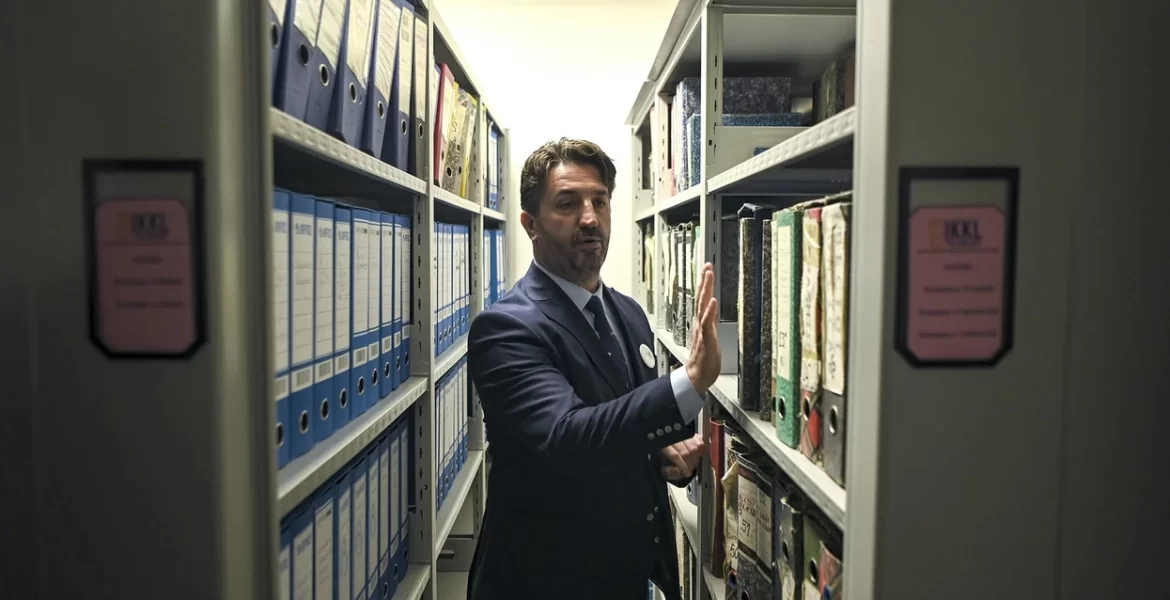
Hetemi also noted that the Institute for War Crimes has so far collected more than 400 meters of physical archival material, over 18,000 hours of video recordings documenting war crimes, and more than 1 million photographs.
“The Institute for War Crimes has now become a trusted address for people who possess evidence,” Hetemi said during the interview.
Full interview
At the beginning, could you describe the re-establishment of the Institute for War Crimes, considering that it previously existed but was later dissolved and functioned as a department within the Ministry of Justice?
Atdhe Hetemi: The Institute in its current form is being established for the first time. There were institutional initiatives in the past to deal with documenting war crimes, one of which was the Institute created within the Ministry of Justice, established by a ministerial decision. It functioned for about seven and a half years and was later dissolved by another ministerial decision. This means it did not have a proper legal framework and was therefore closed. The Institute for War Crimes committed during the war in Kosovo was established by law in November 2023, where I was appointed Director with a mandate to build the Institute based on the law approved by the Assembly.
What is the difference between how the Institute previously functioned and how it functions today?
Atdhe Hetemi: Today the Institute has financial stability, as it is established by law and has a dedicated budget line. It also has a proper legal framework, including its own law, internal regulations for functioning, and job systematization approved by the Prime Minister, since the Institute operates as an independent agency under the Office of the Prime Minister. During this period, we have also used a wide range of regulations, strengthening our methodological and ethical framework.
In parallel, we have developed the physical infrastructure of the Institute, including our office in Prishtina, located in the Kosovo Archives Agency building. Here we also have the Institute’s archival storage.
In addition, we have six regional offices across Kosovo. Our physical infrastructure has continually evolved over the past 2.5 years of our existence. We also have human resources—around 40 employees—although according to the systematization regulation, the Institute is planned to have 74 staff members. This year we had 46 approved positions through the budget, and we hope to increase this number.
Director, considering that the Institute was formed nearly 24 years after the war, how difficult was it to start from zero, given the challenges of documenting war crimes?
Atdhe Hetemi: It was not an easy process, and unfortunately, it still is not. However, the fact that there were previous attempts to document war crimes after the war, even if fragmented, helped us.
There had been institutional initiatives that were later shut down, as well as efforts by civil society organizations. The media also played a very important role by reporting and collecting materials available at the time.
The first challenge was rebuilding trust with families of victims and survivors in state institutions. When we approached people to request testimonies or materials and introduced ourselves as a state institution, their reaction was often: the state has not managed to do this properly so far, why should we trust this Institute?
The second challenge was initiating cooperation with all actors who had contributed to documenting war crimes and making it clear that the Institute’s role is to serve as a central repository where all materials are collected, and later as a reference point for researchers, journalists, academics, filmmakers, and others.
Despite these challenges, the Institute has established itself as an institution trusted by survivors, victims’ families, civil society, institutions, and the media. Progress has been modest, not solely due to the Institute’s staff.
However, their dedication has been significant, but also due to strong support from central institutions, the Government of Kosovo, and municipalities. The Institute has collected materials from 33 municipalities, as well as from survivors, families, media, NGOs, collectors, and individuals.
For someone unfamiliar with this field, what are the main objectives of the Institute—what do you actually do?
Atdhe Hetemi: First, it is important to emphasize that the Institute for War Crimes is a documentation and research institution, not an investigative one. Judicial institutions investigate war crimes.
The Institute’s mission is, first, to document all crimes committed during the war by the Yugoslav regime in Kosovo, including crimes against humanity, economic crimes, psycho-social crimes, environmental damage, and crimes against cultural and spiritual heritage.
Second, it is equally important to document the resistance of Kosovar society through the Kosovo Liberation Army and civilian resistance during the 1990s against a brutal regime.
Third, it is important to document humanitarian assistance and solidarity shown by international actors and neighboring countries during the 1990s, including support in preventing further escalation of genocide and assistance provided to refugees in neighboring countries such as North Macedonia, Montenegro, and Albania. This contributes to historical truth and regional relations.
Another important achievement is that our methodology is being used by other post-conflict countries. We have had delegations from Ukraine, and our methodology is also applied in Central European countries with institutes documenting communist-era crimes. This is a satisfaction for us, as Kosovo has moved from being a recipient of expertise to contributing to international practice. Documentation is the foundation of sustainable peace.
How do you collect materials on war crimes? Do people approach you, or do you reach out to them?
Atdhe Hetemi: In the beginning, this was one of the biggest challenges we mostly reached out to ourselves. Our methodology includes defined steps: identifying sources, approaching them, contacting them, informing them about the Institute’s work, and creating archival funds in the name of each source to show respect for those who collected materials when institutions did not exist.
So far, we have 1,037 or 1,038 sources, including individuals, institutions, media outlets, and organizations. For each material, we create an archival fund in the name of the source.
In the beginning, I personally went into the field. Even today, I still do, although staff members now have more regular contact. There were cases where I was turned away from homes and told that people did not trust such initiatives. We always respected that reaction.
Today, however, trust has significantly increased. People now come to us voluntarily to submit materials, knowing that the Institute has the legal obligation and infrastructure to preserve them properly. Our archive meets international standards for protection against fire, water, and
How much material does the Institute currently hold—videos, photos, documents?
Atdhe Hetemi: During the seven and a half years of the previous institution under the Ministry of Justice, only 12 meters of archival film material were collected. We inherited that.
In the last two years, the current Institute has collected over 405 meters of physical archival material. This comes from more than 1,037 sources across 15 countries.
In digital form, the previous institution had none. We now have over 21 terabytes of digital material, which corresponds to more than 18,000 hours of video footage documenting war crimes, and likely more than 1 million photographs.
These materials include evidence of massacres, destruction of infrastructure, forced expulsions, and more. Do people still hesitate to provide materials?
Atdhe Hetemi: To be honest, I understand them. Although it may sound harsh, we still need to work harder to convince people that this is the right institution. Their skepticism is understandable.
Some expect compensation, which we cannot provide. Others believe keeping the material makes them more “special,” or they want to publish books using it. We have included a clause allowing donors to specify restrictions: materials can be given solely for preservation, and access can be restricted without prior consent.
We also ensure that when researchers request access, they are put in contact with the original source for permission. This is part of how we build trust and human relationships.
Documenting war crimes is not only an administrative or academic process—it is deeply human.
Another issue: official statistics on the dead, martyrs, and missing persons. Is this also within the Institute’s mandate?
Atdhe Hetemi: Yes, and we have been working intensively on it for the past 15 months. We had to prioritize carefully, as expectations are very high. Our priority is to create a database of victims: those killed, those who died due to war-related injuries or circumstances, and the missing.
This database is in its final stages and we hope to launch it this year. How are you ensuring the credibility of this data, given the lack of official records?
Atdhe Hetemi: We decided that each victim must be confirmed by at least eight independent sources. In other databases, three sources are usually enough, but we chose eight to ensure credibility. Sources include databases such as the Humanitarian Law Center, books by academics, databases by other organizations, civil registry data, medical forensic institute data, death certificates, as well as video, audio, photographs, and family confirmations. We aim to be as accurate and cautious as possible.
Will the database include name, surname, municipality, and cause of death, as well as classifications such as martyr or victim?
Atdhe Hetemi: At this stage, we have three categories: those killed, those who died from war-related injuries or circumstances, and the missing.
Later, further classification will be made, such as martyr or hero.
The priority is to establish an accurate count of victims. For example, even deaths caused indirectly by war conditions, such as lack of medical care during childbirth, are considered war-related victims.
We are also working on a database of massacres, currently including 27 massacres, and later on mass graves.
Regarding public reactions to exhibitions and war statistics, does the lack of a unified database contribute to misunderstandings?
Atdhe Hetemi: The Institute uses a credible methodology. Individual initiatives remain their own responsibility. I do not see this as affecting the Institute’s credibility.
Can such data be used for legal cases, such as genocide charges?
Atdhe Hetemi: The Institute does not have an investigative mandate.
However, we operate on three pillars: First, educational and awareness-raising, making data accessible to increase societal understanding of war crimes and resistance.
Second, cultural cooperation, working with artists, filmmakers, and institutions to use our materials in creative works.
Third, cooperation with justice institutions, providing requested materials for investigations or legal processes.
If a genocide case is ever pursued, we are obliged to share all relevant materials with competent authorities.
Full link in Albanian: https://telegrafi.com/atdhe-hetemi-brendavitit-e-finalizojme-databazen-zyrtare-per-viktimat-e-luftes-dhe-tepagjeturit
This interview is a product of the Academy for Reporting in the field of Dealing with the Past (DwP) and Conflict-Sensitive Reporting, implemented by Pro Peace – Program in Kosovo, and the Association of Journalists of Kosovo – AGK. The views expressed in this article are the responsibility of the journalist and do not in any way reflect the views of Pro Peace and AGK.