Recollections of World War II in Kosovo.
During the first four months of 1945, Europe had turned into a massive battlefield and a continent of ruins. Allied armies from both sides were advancing, circling the German military, which was defending itself and its territories, including those it had occupied. The combined troops of the US, Canada, UK, Australia, New Zealand and France advanced from the west as Soviet troops advanced from the east, both intensifying their attacks on the German army with a shared goal of destroying Nazi Germany. In April, the Red Army, commanded by the Russian general Georgy Zhukov, surrounded Berlin, the German capital and the final stop of this war against the Third Reich.
In the first week of May 1945, after nearly six years of battle, the German Empire built by the Nazis and their leader, Adolf Hitler, collapsed after a decades-long reign. A further four months would pass, however, before the final pockets of fighting in the Pacific ended, only then allowing the Second World War to be declared truly finished. The war concluded on September 2, 1945, with Japan’s formal capitulation to the American army following the dropping of atomic bombs in Hiroshima and Nagasaki, which remains the first and only time such weapons have ever been used in history. It had all begun exactly six years and one day earlier, on September 1, 1939, when German troops launched an invasion of Poland. This long conflict, which resulted in the most destructive war in human history, both in terms of its extremely high number of victims and the scale of material damage, would come to be known as the Second World War (WWII).
This year, in 2025, the 80th anniversary of the end of WWII has been marked and commemorated from Washington to London and from Berlin to Moscow. Ceremonies honoring the victims; decorations for veterans; flowers and tributes at memorials; military parades; documentary exhibitions; new book publications; documentaries and films, as well as countless other events, have been organized to remember WWII.
But what about Kosovo?
What is the most famous image of Kosovo from the photographs of the WWII years? No shot of that time holds this epithet to date. After all, this war is not a historical topic that is particularly discussed or studied in Kosovo. Moreover, the photographic memory of people in Kosovo is filled and dominated by images from the last war, that of 1998–1999, a war densely documented by photographic and video recordings.
The 80th anniversary of WWII passed without notice or commemoration in the location that saw Europe’s final war of the 20th century. There were close to no scientific conferences on the known or unknown history of the war; no television programs or documentaries; no new publications or curated reprints for the occasion. This jubilee anniversary was not sufficient to bring WWII into the spotlight of Kosovo’s public discourse. Remembering this war in Kosovo seems like a completely peripheral act on the grand map of WWII histories — and just as peripheral a topic against those that hold a more central position in the public forums of Kosovar society.
But by relying on the few traces that remain of this war in monuments, archives and narratives, we can elaborate on some of the historical events of this period in Kosovo.
A missing image
In the absence of an iconic image of WWII in Kosovo, let us take a look at a photograph that was taken in the first half of 1944, somewhere in Mitrovica.
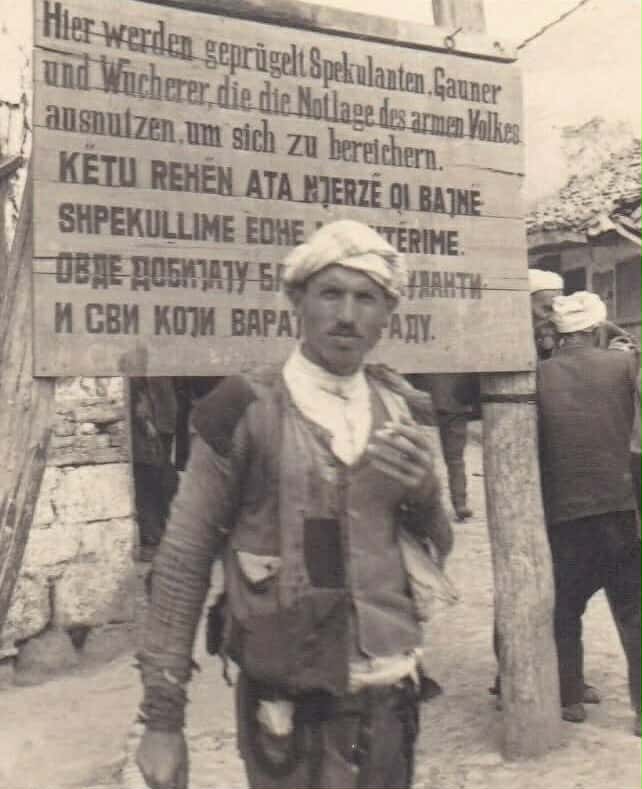
In the foreground of this photograph stands a middle-aged Albanian man, posing for the camera with a cigarette in hand, dressed in patched-up clothing and tjerq galana — traditional men’s trousers in brown wool adorned with black braided embroidery. The wooden board in the background, featuring a roughly identical warning notice in German, Albanian and Serbian, is more noticeable than the man himself. The German text reads: “Here, speculators and swindlers are beaten, as well as usurers who exploit the difficult plight of poor people to enrich themselves.” Below the German text, the Albanian notice is written in two rows, in capital letters, and reads: “Beaten here are those who speculate and deceive.”
The scene captured in this photograph is a glimpse of Kosovo in 1944, during Nazi German rule, which had, in a sense, occupied Kosovo twice: in April 1941 during the German invasion of the Kingdom of Yugoslavia, and in October 1944 during the occupation of the Kingdom of Albania.
In the autumn of 1912, during the First Balkan War, Kosovo was occupied by the Kingdom of Serbia, whose soldiers killed 25,000 men, 5,000 of whom were in the villages of Prishtina alone. At the time, European and American newspapers reported on such events, reports that are well known from their compilation in the book “Albanian Golgotha,” published in 1913 by the Austrian journalist Leo Freundlich. The developments of the First World War, when the allied Austro-Hungarian and Bulgarian armies occupied the current territory of Kosovo, dividing it into Austrian and Bulgarian zones, forced Serbia to partially and temporarily withdraw from Kosovo before returning to occupy it once again when the war ended.
From 1918, Kosovo existed merely as a geographical notion within the Kingdom of Serbs, Croats and Slovenes, which later became the Kingdom of Yugoslavia, an entity dominated by Serbia, under a Serbian king.
Within two decades, thousands were executed and massacred in Kosovo, while others were imprisoned arbitrarily in the thousands on political charges. In 1928, the dissident Serbian lawyer Rajko Jovanović published a brochure in Zagreb titled “Glavnjača Prison as a System” (“Glavnjača kao sistem”), where he denounced the crimes of the Kingdom of Yugoslavia, using Glavnjača as an example of state violence. Glavnjača was the name of the largest cell in the Belgrade city administration building, from which the entire structure would later take its name. According to Jovanović, from 1918 to 1928, Glavnjača saw 24 political death sentences, 600 political murders, 30,000 political arrests and 3,000 political dissidents forcibly exiled. The victims were mainly Croats, Albanians and Macedonians.
In 1930, in this context of oppression and violence, three Albanian Catholic priests — Gjon Bisaku, Shtjefën Kurti and Luigj Gashi — submitted a drafted memorandum to the League of Nations, the predecessor to the United Nations (UN), denouncing the crimes of the Serbian state against Albanians. This memorandum is a crucial record for Kosovo during the interwar period, which saw Albanians in the Kingdom of Yugoslavia endure intense oppression and state violence, making them one of the most persecuted ethnic communities in Europe at the time.
“Three days in Albania”
Due to the continuous oppression and state violence exercised against them by the Kingdom of Yugoslavia, the aerial bombardment and German occupation in April 1941 found the Albanians of Kosovo in a paradoxical and fragmented situation. Many experienced the occupation by Nazi Germany as a kind of liberation — a liberation from the state violence of Royalist Yugoslavia.
Following the invasion of Yugoslavia, the Germans divided its southern territories between their two allies: the Italians and Bulgarians. Most of today’s Kosovo and the western part of North Macedonia joined the Kingdom of Albania, which had been under Fascist Italian occupation since April 1939. Prishtina, which the Germans occupied on April 10, 1941, was given to the Italians, while its northern villages remained under German control.
After occupying all of Yugoslavia, the Germans yielded the eastern territories of Kosovo and Macedonia to their Bulgarian allies, including the districts of Preševo, Gjilan, Kaçanik, Vitia, Kumanovo and others. This division of territories between the Germans, Italians and Bulgarians was decided at a meeting in Vienna in mid-April 1941. There, the Germans kept for themselves Mitrovica, Vushtrri and Podujeva, along with the villages between them and several villages around Prishtina as well.
During the Italian occupation of Albania, Italian dictator Benito Mussolini, known as “Il Duce,” advocated in Rome for the return of Chameria and Kosovo to Albania; this stance was reportedly based on field reports suggesting that this expansion would bring economic benefits for Italy. The Italians called these territories “Liberated Lands,” using the expansion of the Kingdom of Albania’s occupied borders as propaganda for a united Albania, including territories that had been severed from the Albanian state two decades earlier.
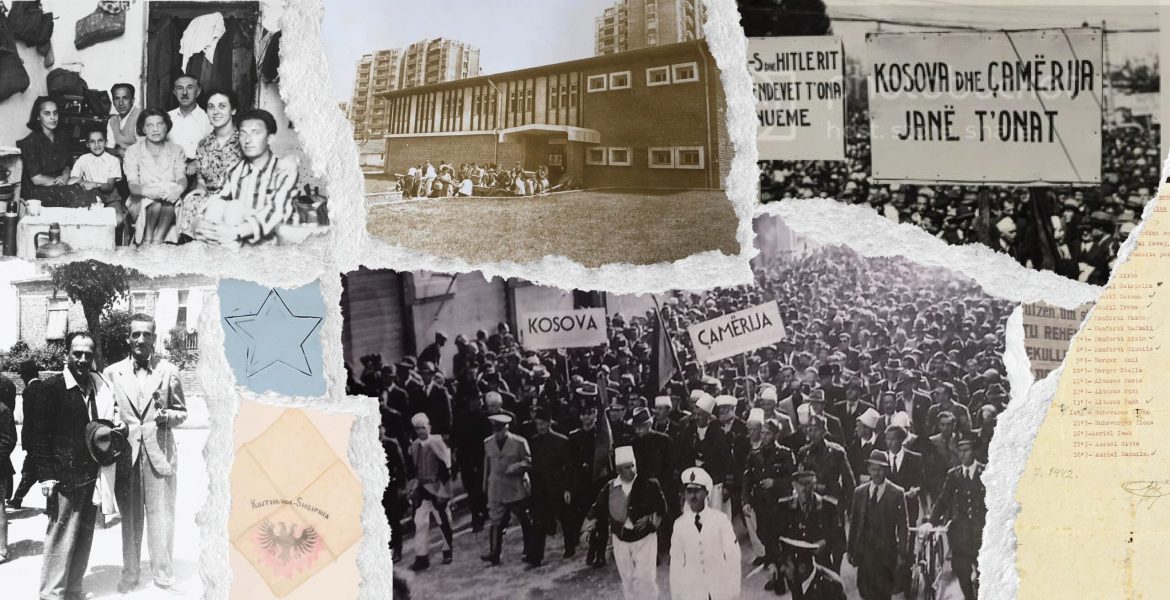
A 1941 photograph from a protest rally in Tirana perfectly illustrates the paradoxical political stance of Albanians during the peak of World War II, as evidenced by the two slogans it captures. One of them reads: “From Il Duce and Hitler we expect the freedom of our enslaved lands,” and the other, “Kosovo and Chameria are ours.” Meanwhile, Europe was shaken by the occupations and terror of Il Duce and Hitler.
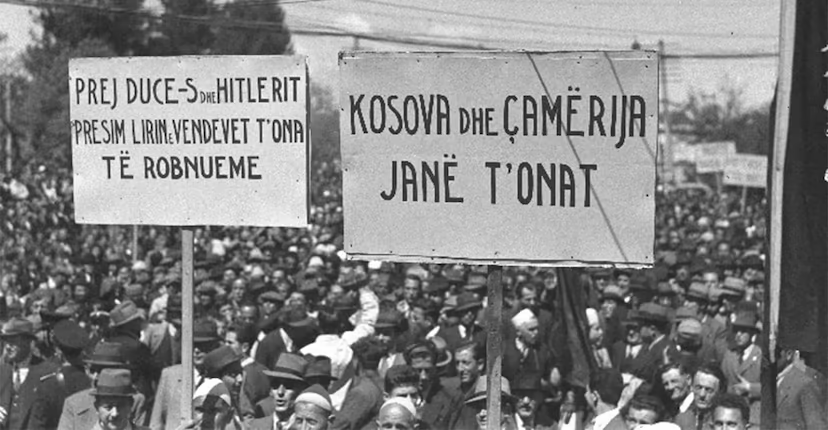
This state of affairs persisted for about two and a half years, until the beginning of September 1943, when Mussolini’s Italy capitulated. Italian troops withdrew, leaving a power vacuum, which the Germans immediately filled. On September 9, 1943, German troops began the invasion of Albania, taking it over while the Italians were still withdrawing. By the autumn of 1944 — exactly one year later — all Albanian-inhabited territories were under the administration of German occupiers.
Many Albanians initially experienced the most intensive three years of WWII — the period between 1941 and 1944, when Kosovo, Chameria and all of Albania were under Italian and German occupation — as a period of liberation, before launching an armed struggle against Nazi-Fascism. In this respect, Albania would become the first and only European country to liberate itself without Allied assistance at the end of November 1944.
The 1945 occupation of Kosovo by Serbia and its subsequent inclusion in Yugoslavia, against the wishes of the Albanian majority, led to the recurrence of state violence. The oppressive measures previously seen under Royalist Yugoslavia were reintroduced by Communist Yugoslavia, particularly in the era of the Socialist Federal Republic of Yugoslavia (SFRY). Because of this period, which followed WWII, the three years of Italian and German occupation in Kosovo (1941–1944) began to be remembered favorably as years of liberation. Many Albanians, then and later, would take an oath by it: “Pasha tri ditë Shqipni” [I swear by those three days in Albania].
The General of the Dead Army
First published in 1963, the novel “The General of the Dead Army” by the prominent Albanian writer Ismail Kadare is among the best-known and most widely read works of Albanian literature. It tells the story of an Italian general and a priest who set out on an expedition to collect the remains of Italian soldiers killed in Albania during WWII.
Just as art imitates life, life also imitates art. Recently, this story has become a reality in Kosovo, with the Volksbund Deutsche Kriegsgräberfürsorge, or the German War Graves Commission. This non-governmental organization has for years conducted research in identifying and exhuming the remains of German soldiers worldwide to return them to Germany.
On August 3, 2021, in the village of Popova in the municipality of Podujeva, the remains of two German soldiers were identified and exhumed. Their graves had been kept secret on the family’s property by three generations of the Rexha family. Once exhumed, a wooden cross was placed in the location where the bodies had been buried for 77 years, with the inscription: “Two German soldiers rested here from 1944 to 2021.” This is one monument that marks the traces of WWII across Europe.
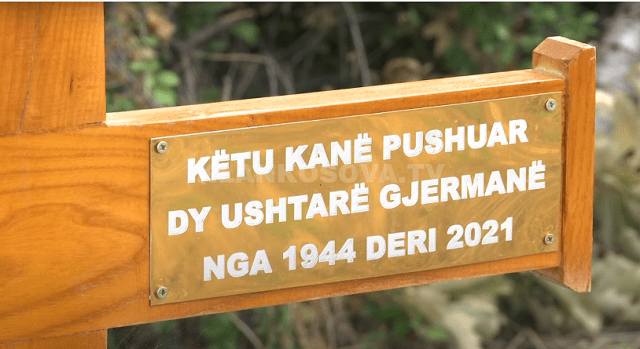
According to data extracted by German authorities from the Federal Archives in Berlin, the remains of 987 soldiers of the Wehrmacht — the armed forces of Nazi Germany during WWII — are scattered throughout the territory of Kosovo. They were killed during the summer and autumn of 1944, primarily by Yugoslav partisans on the ground and by British aerial bombardment from above. Villages in the areas of Prishtina, Podujeva, Vushtrri, Mitrovica, Gjilan and Fushë Kosova still retain several micro-toponyms, such as “the German’s grave,” “the German’s field,” and similar names that testify to the sites where German soldiers were killed or buried. Locating the graves of the 987 soldiers killed or missing in Kosovo during 1944 seems to be a nearly impossible task. Although the expeditions to locate the graves of German soldiers and collect their remains across the Kosovo Plain resemble a movie script, even these stories have not awakened any curiosity in Kosovo about WWII.
Meanwhile, last summer, while work was underway to expand the road between Prishtina and Podujeva, workers encountered several explosive devices found about a meter and a half underground. The incident occurred on June 25, 2024, in the village of Shakovica in the municipality of Podujeva. Subsequently, demining teams from the Kosovo Security Force (KSF), together with their KFOR colleagues, located three German-made shells. The explosives had remained undetected for over 80 years, dating back to WWII. These shells were removed, but beyond this information, there were no further investigations or explanations about how they ended up there, or whether similar devices might be found nearby or elsewhere in Kosovo.
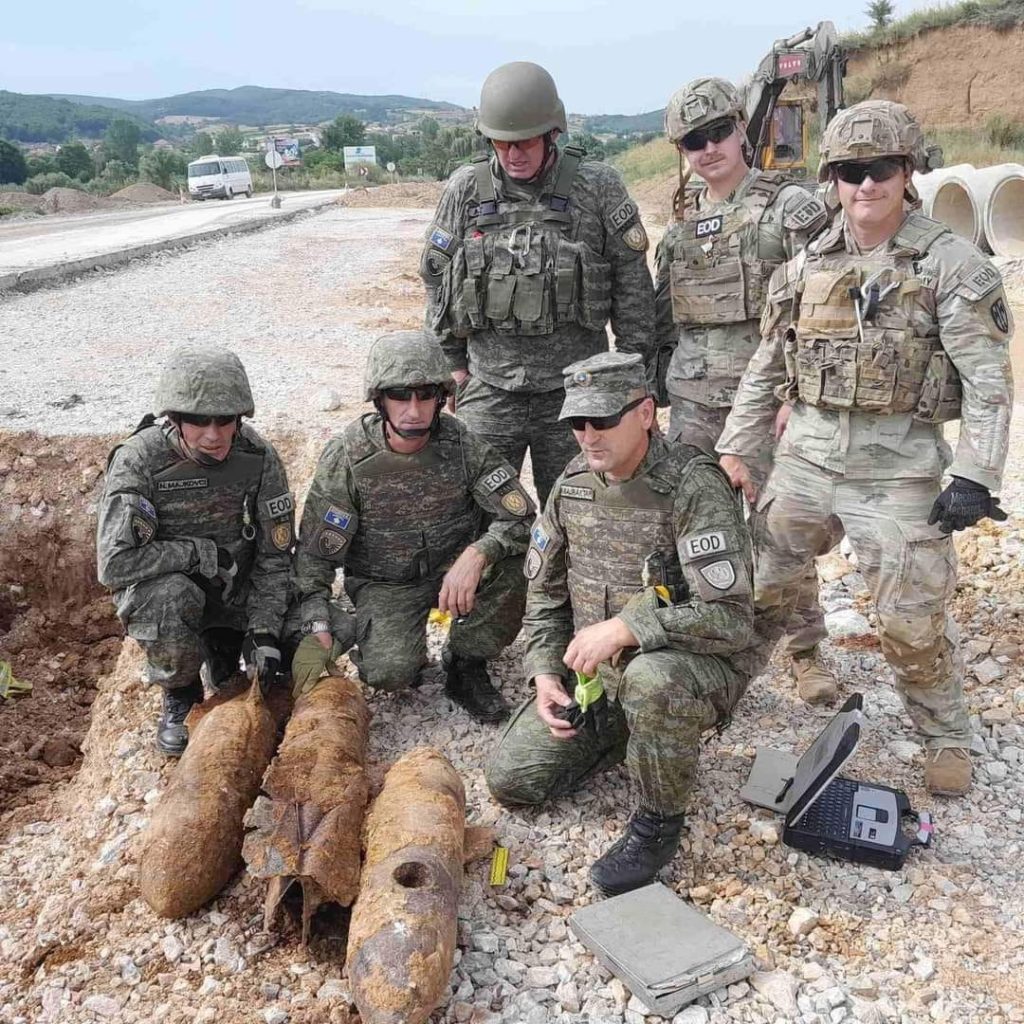
Given the historical context, these shells most likely remained underground in the village of Shakovica since the spring of 1941. At that time, from April 6-18, the German army managed to occupy the entire Kingdom of Yugoslavia, of which Kosovo was then a part of. During these 13 days, and following the strategy of “Lightning War” (in German: “Blitzkrieg”), which had previously proven successful for the Nazis, German Luftwaffe aviators targeted Yugoslav aircraft at airfields before they could even take flight. Among them, German pilots bombed a small field airport in the village of Millosheva, which had a runway measuring 1190 x 550 meters. Shakovica, the location where the unexploded shells were found, is only 10 kilometers from Millosheva. German bombers most likely dropped these shells during the air attacks of 1941, which resulted in the destruction of 49 Yugoslav aircraft — purchased only a year earlier — on the airfields.
Blitzkrieg” or “Lightning War” was a military tactic used by the German army during WWII, involving rapid strikes and surprise, concentrated attacks with tanks and motorized vehicles on the ground, and massive aerial bombardment. This combat tactic proved successful, particularly during the invasion of Poland in 1939 and in 1940.
Finding explosive devices left over from WWII has occurred in the past as well. However, as in previous instances, they were forgotten between the lines of a two- or three-paragraph news snippet, as happened on June 22, 2021, when KSF and KFOR soldiers detonated nine mines that had remained there since WWII in the village of Preoc, on the outskirts of Prishtina.
Despite these sporadic findings and the fact that Kosovo was a battle theater during WWII, no research into what is known as battlefield archaeology has developed, nor have there been proper archaeological studies of this period. To some extent, this explains the absence of a museum dedicated to the world wars in Kosovo; there once existed a limited pavilion featuring weapons from that era in the National Museum of Kosovo’s permanent exhibition.
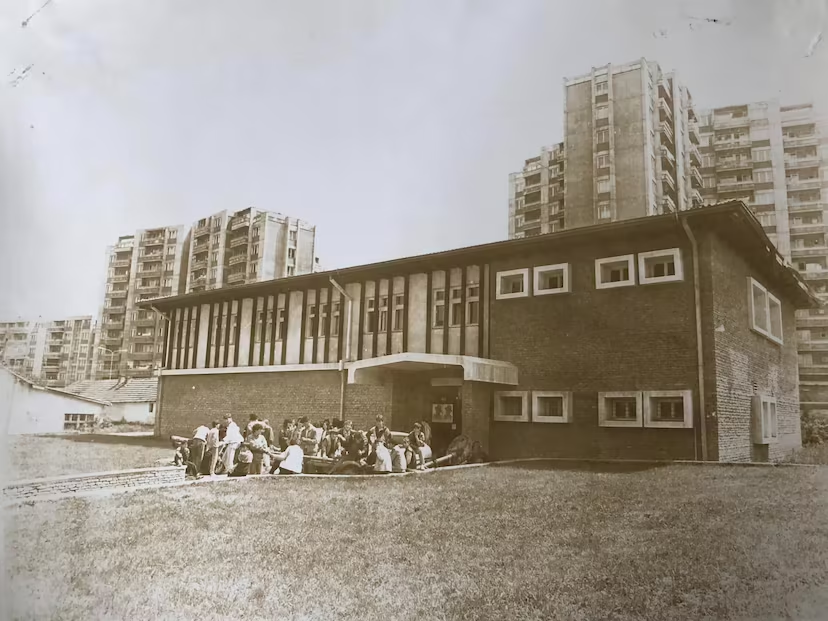
Even though there is no museum dedicated to WWII in Kosovo today, such an institution existed previously. The current location of the National Gallery of Kosovo previously housed the Museum of the Revolution of Kosovo and Metohija, established in the 1950s. This museum once safeguarded relics, notably including weapons used before and during WWII. During the 1990s wars in Yugoslavia, however, specifically in 1994, a portion of the museum’s exhibit was moved from Kosovo to Serbia, at a time when the latter appropriated much of the wealth and heritage it shared with the other republics and provinces of Yugoslavia, from museum exhibits to military infrastructure. Nevertheless, the National Museum of Kosovo still preserves a rich collection of artifacts, photographs and documents that could serve as a basis for establishing and conceptualizing a museum or museum pavilion dedicated to the history of Kosovo during the two world wars.
Memorials and memories consigned to oblivion
At the entrance to the Prishtina City Park, at roughly the average human height, stands a memorial, severely damaged by time and neglect. In front of a massive concrete wall, atop a concrete pedestal, sits the bust of a man, his face turned toward the park entrance. With no name beneath it and no informative text, this memorial has, for years, lost its original purpose and today resembles an anonymous work of art. The bust depicts Ramiz Sadiku, who was declared a hero in 1945 by both Josip Broz Tito’s Yugoslavia and Enver Hoxha’s Albania.
Sadiku was from Peja, a law student and a member of the Communist Party of Yugoslavia (CPY). As a soldier of the 42nd Infantry Regiment, he fought against the Germans in Bjelovar, Croatia, during the 1941 invasion. He was imprisoned and escaped twice: first from the German authorities who arrested him in Bjelovar, and later from the Italian police who held him in Peja and Tirana.
On April 7, 1943, Sadiku, along with the Montenegrin communist partisan Boris Vukmirović, set out from Gjakova for Prizren to meet Svetozar Vukmanović Tempo, a high-ranking Montenegrin communist leader. Italian troops captured them near the village of Landovica. On April 10, 1943, Ramiz and Boris were executed by Italian soldiers, following three days of torture that attempted to extract information from them. It is said that, just before the firing squad opened fire, Ramiz and Boris embraced each other tightly. This act became a political symbol and was used to advance Yugoslavia’s policy of “Brotherhood and Unity” among its peoples.
In 1961, this story was memorialized in Prishtina’s City Park, where the busts of Boris and Ramiz were installed. In the same spirit of commemoration, a few years later, between 1975 and 1981, the Boro and Ramizi memorial and sports complex was built in Prishtina. Following the 1999 war, it was renamed the Palace of Youth and Sports, but in everyday speech it is still primarily called “Bora-Ramizi” — often pronounced as a single word, “Boraramizi.” This name has been stripped of its original meaning, with the names of the two communist partisans essentially becoming a microtoponym associated with the building and the surrounding area.

Today, only the bust of Ramiz Sadiku remains of the park memorial; until mid-1999, the bust of Boris Vukmirović also stood to his right, but in 1999, immediately after the war, it was removed and disappeared.
The duo Boro and Ramiz were also memorialized in 1963, when a 10-meter-high obelisk, designed by Miodrag Pecić and Svetomir Basara, was erected at the site where they were killed.
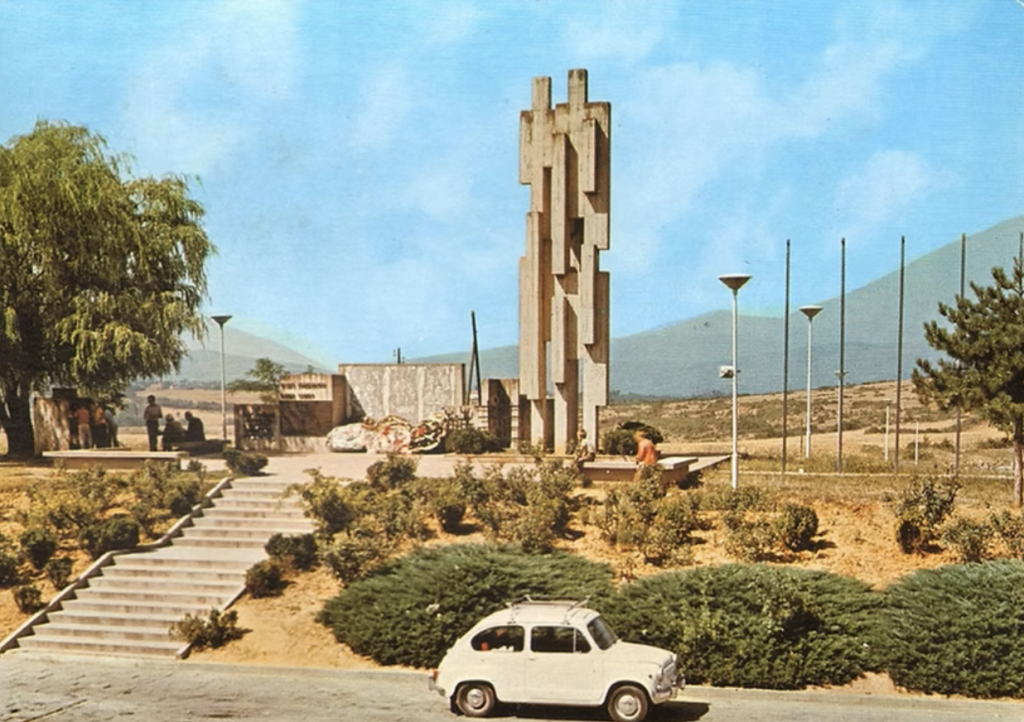
To the left of the obelisk, the artist Mirjana Barać created a 6-by-4-meter mosaic with black-and-white stones depicting several villagers and partisans, including Boro and Ramiz. In the aftermath of the 1999 war, this monument was completely demolished, and a memorial to the martyrs of the Kosovo Liberation Army (KLA) from that area was erected in its place.
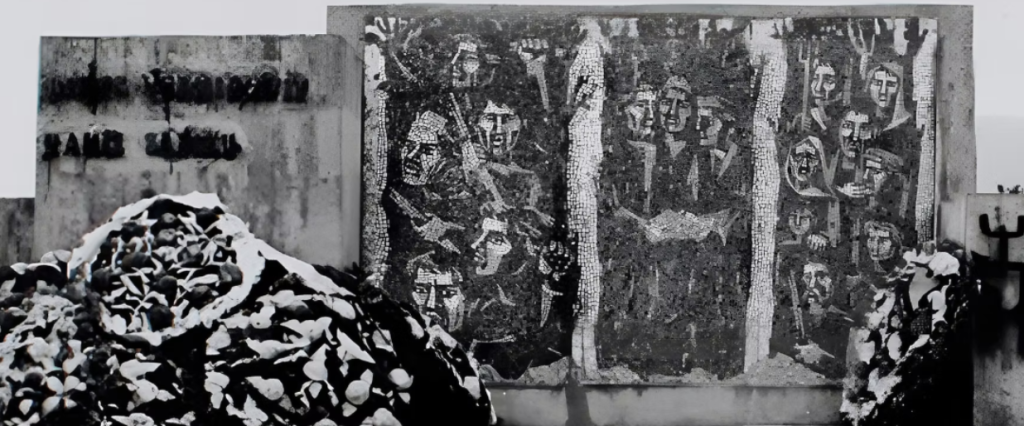
With a changing political order, the order of memory changed as well. Monuments from the Yugoslav period came to be seen as symbols of an era of occupation and oppression, and, more generally, as unwanted reminders of an epoch with which the new state felt no connection. In their place, collective memory began to focus on the most recent war; since its end in June 1999, a large number of commemorative plaques, busts, statues and memorial complexes have been erected throughout Kosovo for its victims and martyrs.
A similar process of memorial reconfiguration after 1999 can be seen at the Martyrs’ Cemetery complex in the Velania neighborhood of Prishtina. Buried there are KLA martyrs and prominent Kosovar political figures, among them President Ibrahim Rugova and the anti-Yugoslav dissident Adem Demaçi. On anniversaries, the site is filled with thousands of people who come to pay their respects, yet they often overlook the most prominent memorial at its center: The Memorial to the Victims of the National War of Liberation (1941–1945).
This memorial was built over the course of a year and inaugurated in November 1961. Designed by the prominent Serbian architect Svetislav Ličina, the memorial features curved concrete arms that form a star, a courtyard with stone slabs and a metal globe-shaped sculpture at its center. Set into the concrete arms are 220 medallions for 220 Albanian and Serbian fighters and civilians, whose remains are preserved in an urn beneath the monument.
Tucked away in a corner of the university campus in the center of Prishtina, another memorial has long been forgotten and is now severely dilapidated. As noted on its inscription:
“In this place, on October 23, 1944, German Nazis executed 104 Albanian patriots, who gave their lives for the freedom and independence of the country. The Association of Veterans of the Anti-Fascist National Liberation War of Kosovo.”
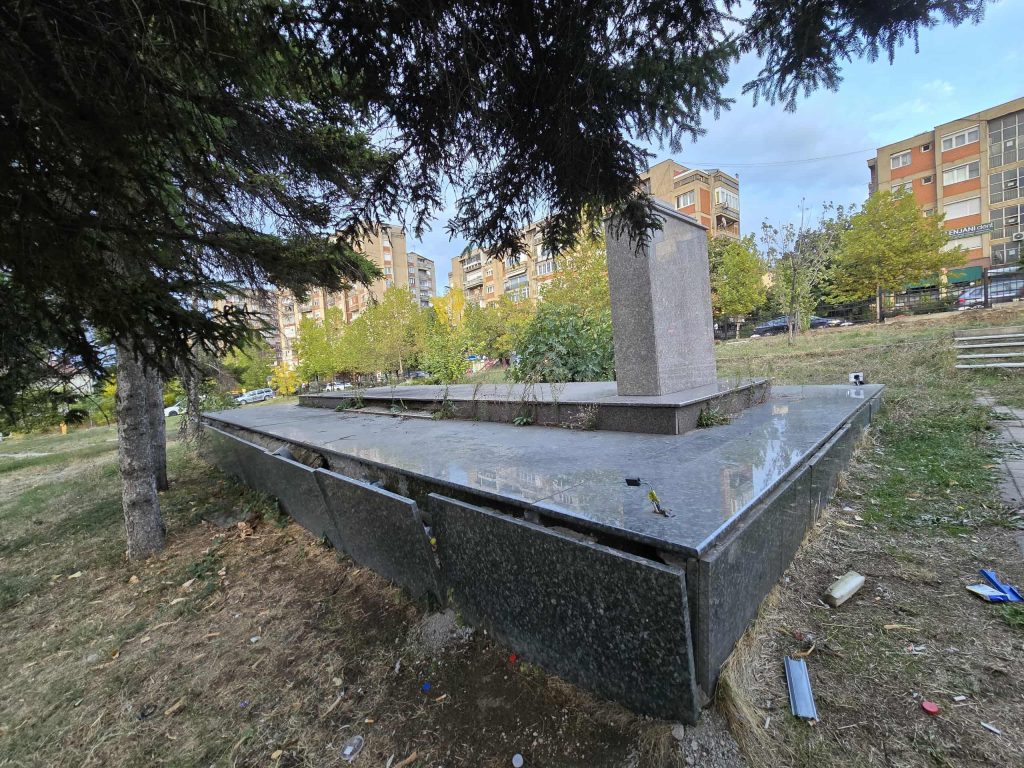
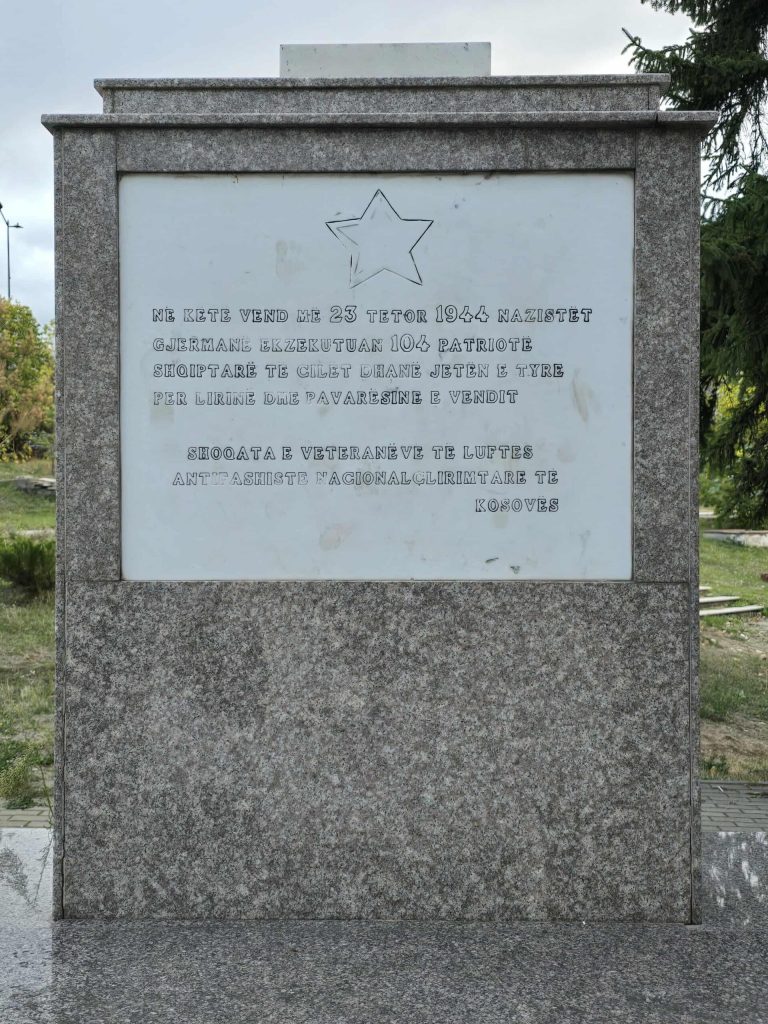
This monument commemorates the executions that took place in WWII. In an issue of the weekly newspaper, Bashkimi i Kombit (National Unity), dated October 24, 1944, it notes:
“On Dibra Street, on the night and dawn of October 21, a heinous assassination attempt was carried out against a German vehicle. The patience of the German armed forces has come to an end. Punitive measures: 1. The neighborhood surrounding the site of the incident on Dibra Street will be demolished. 2. 100 communist prisoners from Tirana, who belong to the intellectual rank and are currently being held at the Prishtina concentration camp, will be executed immediately in retaliation. 3. 80 known members of the National Liberation movement in Tirana will be held hostage, and in the event of another attack against members of the German army, they will be hanged. The Command of the German Armed Forces in Albania.”
By the time this issue of the newspaper went to press, the measures were already being carried out; at the Prishtina concentration camp on October 23, 1944, the German army executed 104 Albanians. In November 1946, a year after the war ended, their remains were exhumed from Prishtina and sent for burial in Tirana. This is evidenced by a photograph from that time, showing German soldiers — who were taken prisoner by Albanian communists — transporting the bodies to Tirana; among them was Alfred Wagner, who has detailed the contents of the photograph.
Eighty years on, the names and fates of those people are forgotten, as is the fact that a field concentration camp once stood where the University of Prishtina (UP) campus is located today.
From the Martyrs’ Cemetery in Velania and the memorial on the UP campus, the traces of WWII memories lead us back once more to the Prishtina City Park. Leaving behind the now-incomplete and forgotten memorial bust of Ramiz Sadiku at the park entrance, another WWII memorial can be found further along the park’s central walkway.
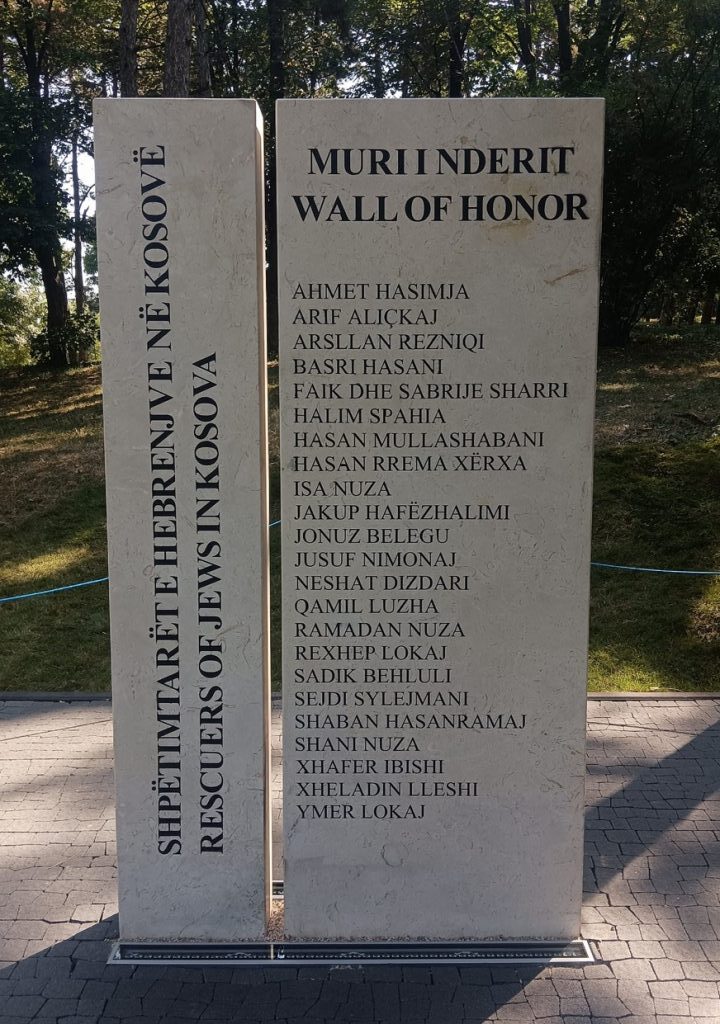
This memorial was built and inaugurated just two years ago, on August 23, 2023, through the initiative of the Kosovo–Israel Friendship Association and the Albanian-American Foundation.
Referred to by its bilingual inscription “Muri i Nderit / Wall of Honor,” this memorial consists of a plaque that is about two and a half meters high, next to which is written: “Shpëtimtarët e hebrenjve në Kosovë / Rescuers of Jews in Kosova.”
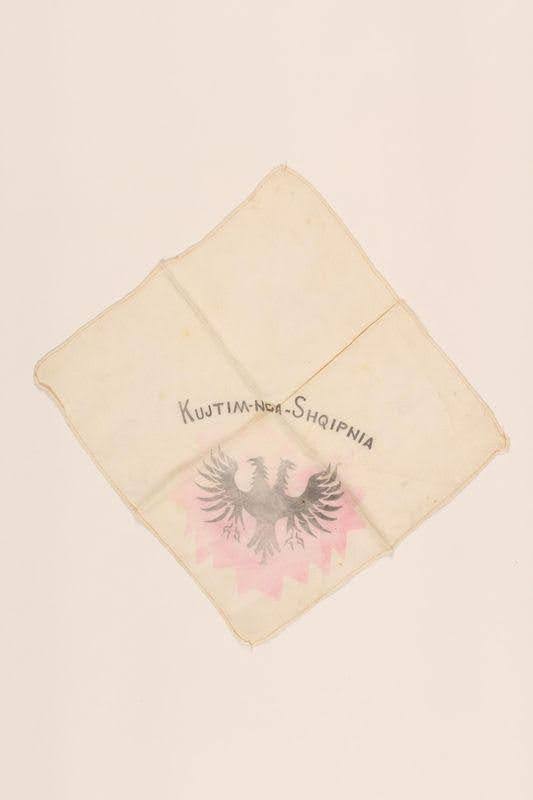
This white handkerchief, featuring the Albanian national symbol — the double-headed eagle — embroidered with the inscription “Kujtim nga Shqipnia” (A Memory from Albania), belonged to a seven-year-old Jewish boy, Jasha Altarac, who survived the Holocaust thanks to the assistance of Albanians. During the invasion of Yugoslavia by German troops in April 1941, a bomb struck a house in Sarajevo where the Altarac family — who had fled Belgrade as refugees — were taking shelter. The explosion killed Jasha’s grandmother and sister, Lea. Following their burial, Jasha’s parents, Majer and Mimi (Merjana) Altarac, returned to German-occupied Belgrade.
Before the outbreak of WWII, Majer Altarac was one of the most prominent architects in Belgrade, having discovered several sources of marble and other stones in quarries throughout Yugoslavia, which he used for his architectural projects.
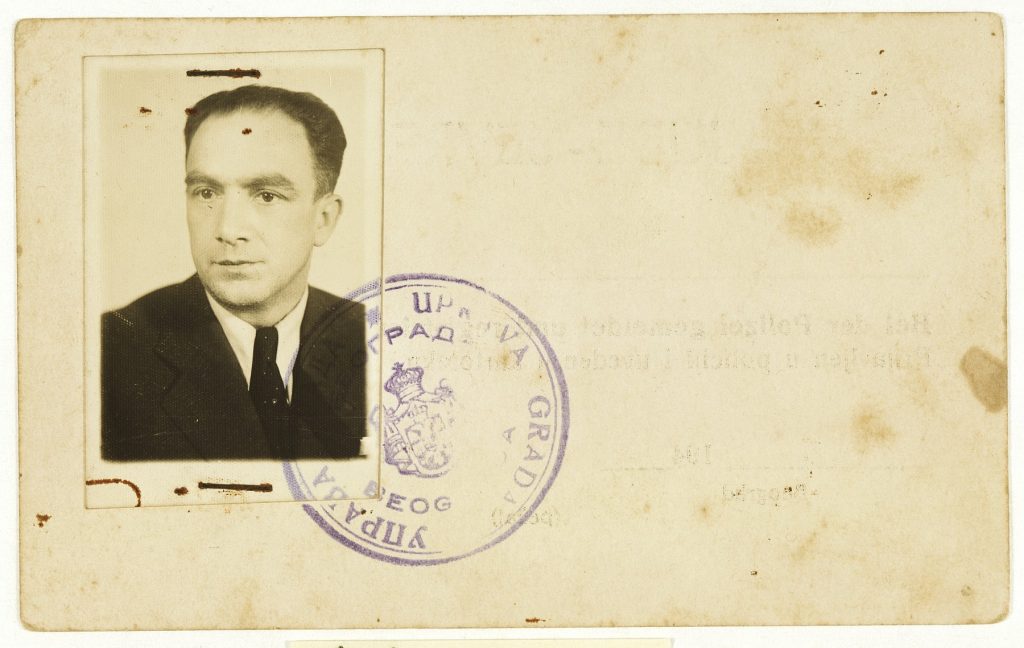
The photograph below shows the registration card of Majer Altarac, issued by the German authorities in Nazi-occupied Belgrade on July 22, 1941. In order to flee Belgrade with his family, it was necessary for his wife to be issued a similar document, which the Germans provided a month later, on August 27, 1941.
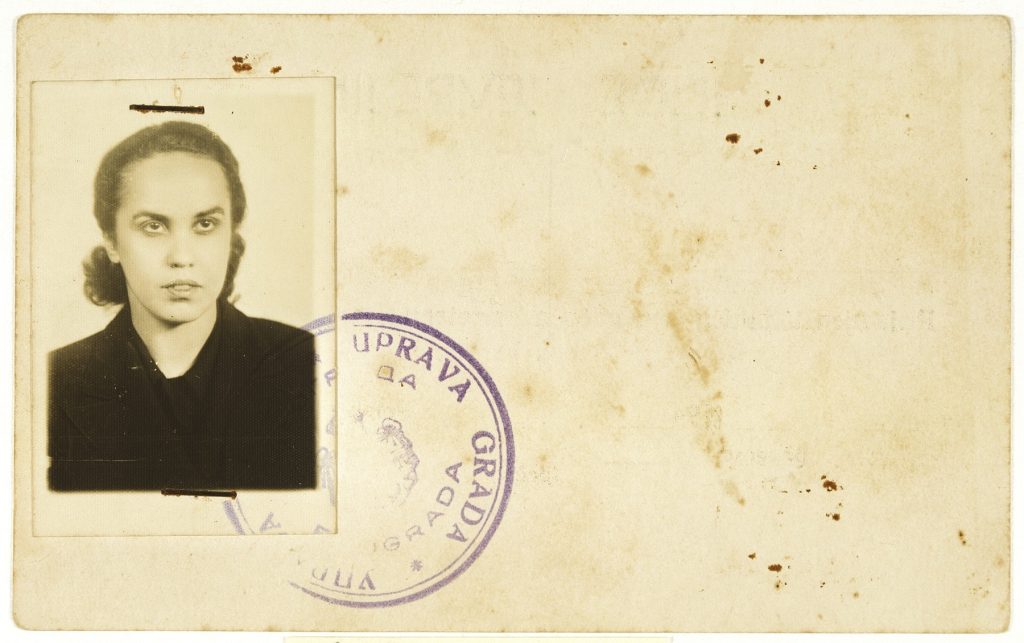
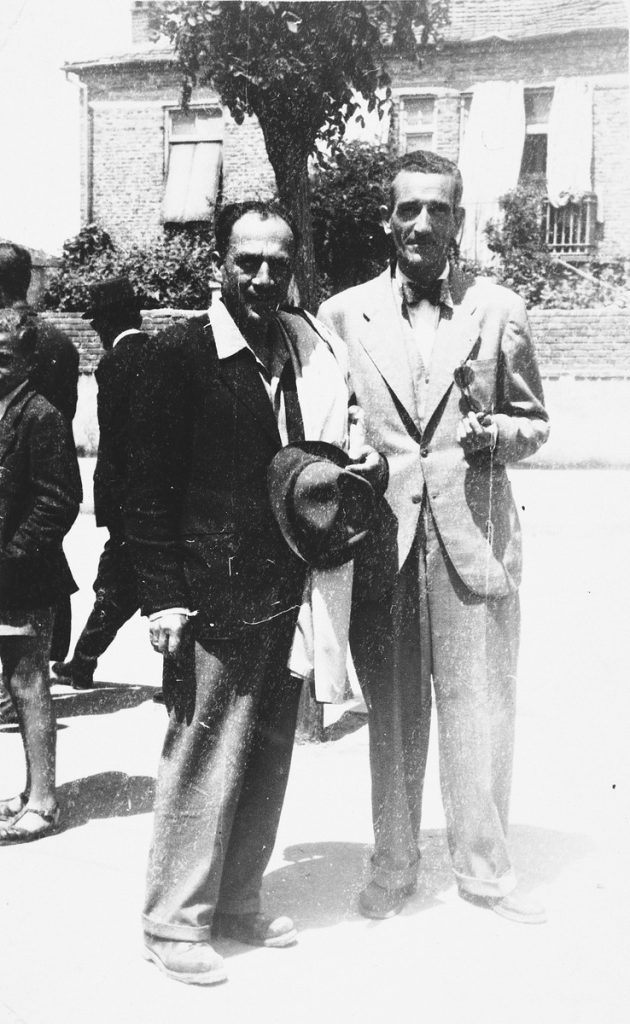
In September, they moved to Skopje, where Majer Altarac is pictured in October 1941 alongside another Jewish refugee from Belgrade, David Amarilio. A month after Skopje fell under Bulgarian control, Majer came in contact with a former Albanian acquaintance, and together with his wife and son, they moved to Prishtina. During this period, Prishtina and the majority of Kosovo were under Italian rule. Italy had annexed these “liberated” Albanian territories and incorporated them into the Kingdom of Albania.
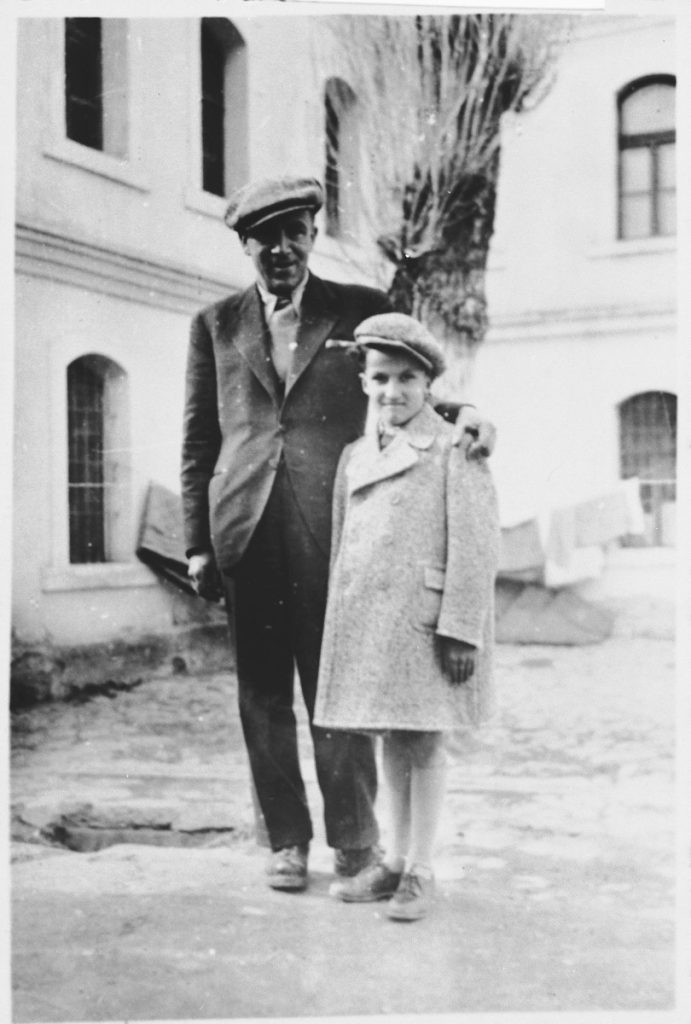
In December 1941, Jewish refugees in Prishtina were gathered by the Italian authorities into a transit prisoner camp, where the Altarac family spent the next eight months. In a photograph dated April 17, 1942, taken by Mosha Mandil — another Jew who was being held in the same camp with his family — Majer is seen with his son, Jasha, in the courtyard of the Prishtina camp.
The Altarac family was still at the Prishtina camp during the summer of 1942, as evidenced by two other photographs taken by Mosha Mandil in July. In one, only the Altarac family is pictured, while in the other, the three of them appear alongside other Jewish refugees from the Prishtina camp.
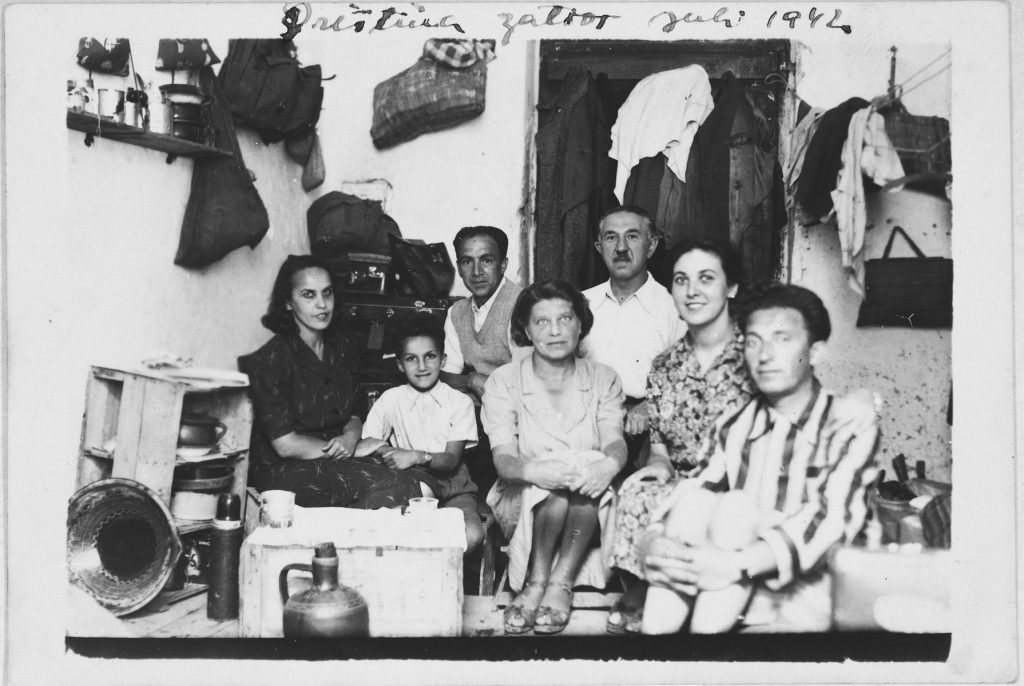
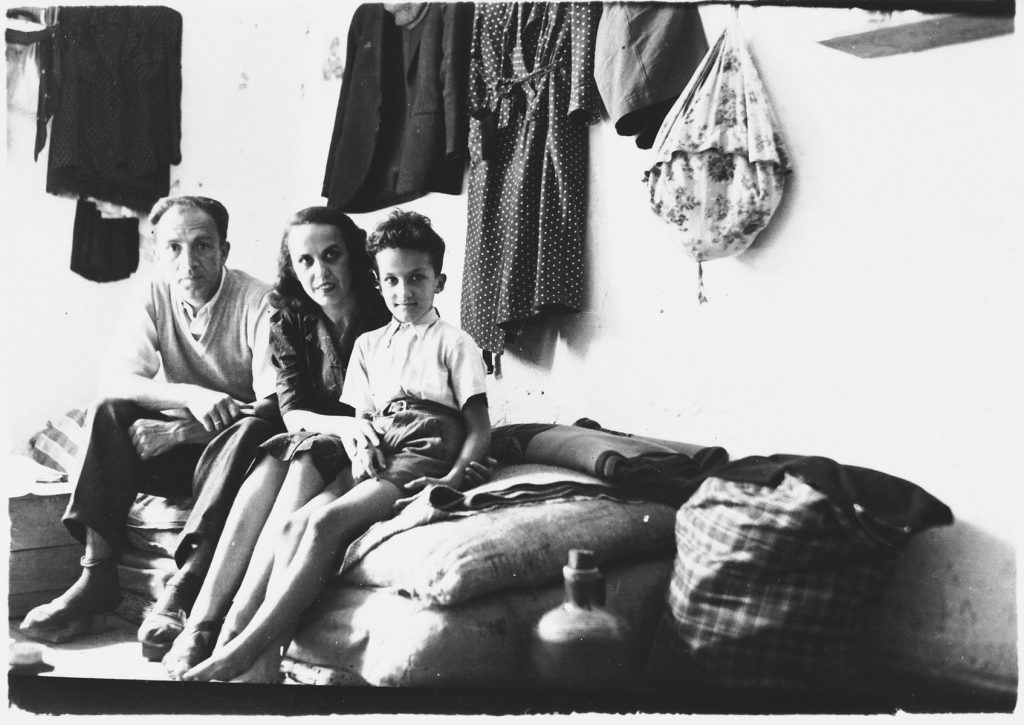
During those days of July 1942, Mandil also took a group photograph that shows over 50 Jewish refugees in the camp’s prison, including several children, as well as a Jewish man wearing a plis — the traditional white Albanian felt cap — on his head.
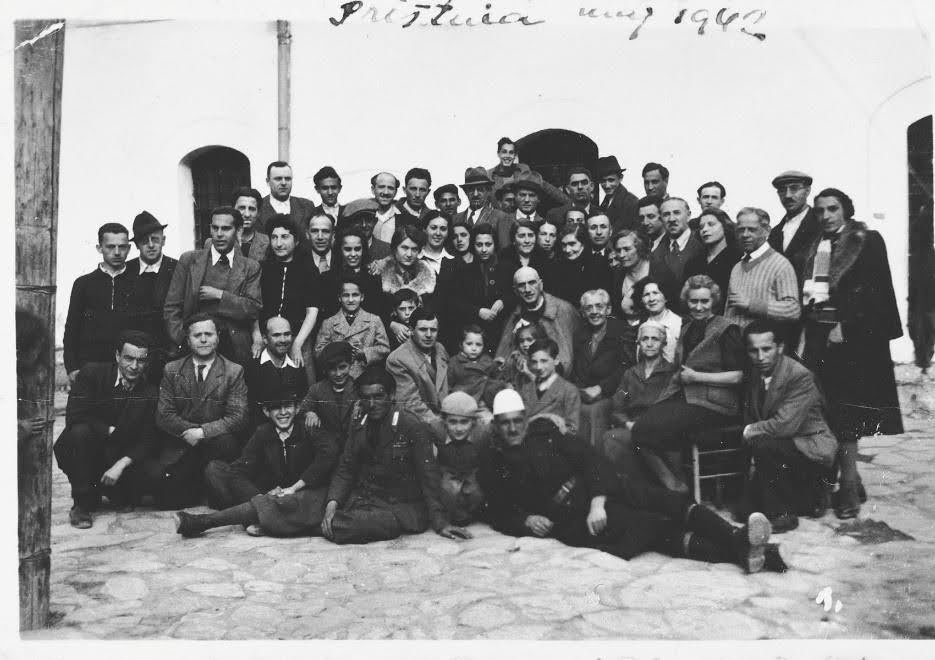
In March 1942, German authorities demanded that the Italians deport 51 Jews to the German-occupied zone. The Italians granted this request, and all those deported ended up being executed by the Germans. Among the deportees was Jasha’s aunt, Frida Barta, along with her husband and daughter — early victims of the Holocaust.
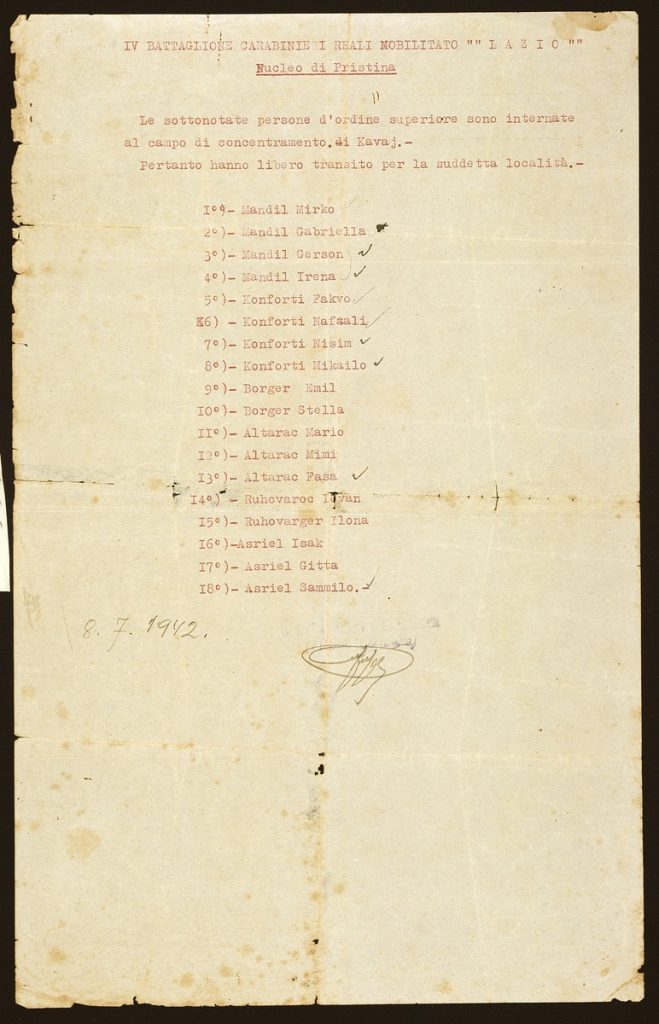
By July 8, 1942, according to a document issued by the 4th Carabinieri Battalion “Lazio” based in Prishtina, 18 Jews were deported from this camp and moved deeper into Albania. As evidenced by this document: “The aforementioned persons are to be interned at the Kavaja camp. They are to be, therefore, granted free transit to said location.”
On that list, the following names appear under numbers 11, 12, and 13: Altarac Mario, Altarac Mimi and Altarac Fasa. Two of the names are misspelled, at least orthographically: Majer’s name is written as “Mario,” while Jasha, his son’s name, is recorded as “Fasa,” instead of “Jasa.” Nevertheless, the document opened a path to salvation for the Altarac family.
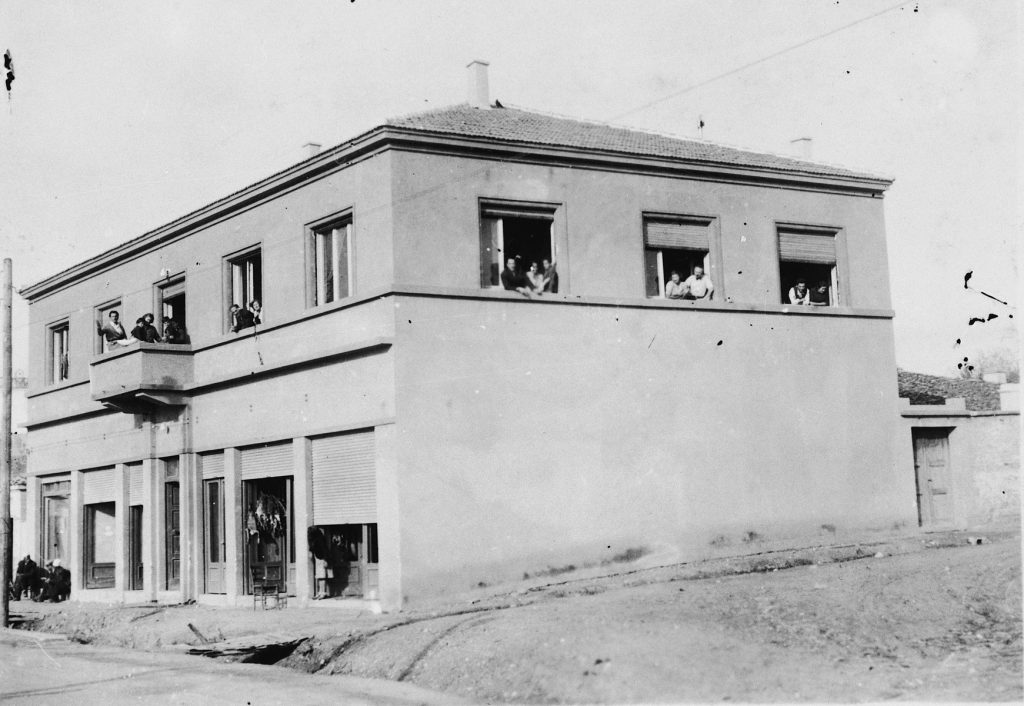
The family found themselves in the Kavaja camp along with four other Jewish families — Mandil, Azriel, Ruchvarger and Borger — as seen in another photograph taken in May 1943. The local Albanians helped them cope with daily life, Jasha recalls the words of an Albanian farmer who told him that: “Allah knows that we are hiding Jews here, and that is why we need extra food. This is the reason why we have had such a good harvest this year.”
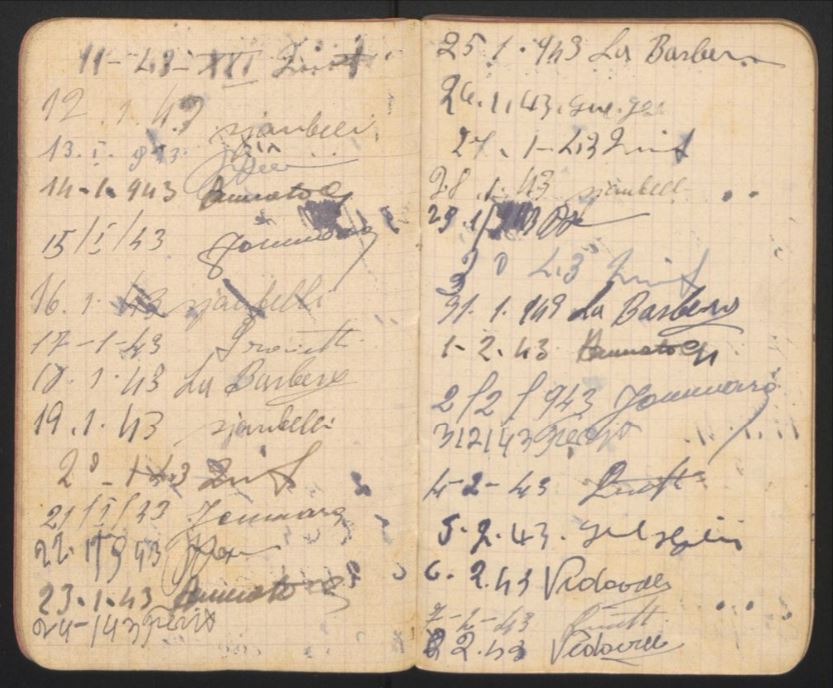
Among the items that have survived to bear witness to this history is the notebook where the Italian gendarmerie signed and recorded the Altarac family’s mandatory daily check-ins at the police station. A forged identity card has also survived, featuring Majer Altarac’s photograph and the personal details of an Albanian man named Muharrem Bajram Hasani, born on November 21, 1901, in Prishtina.
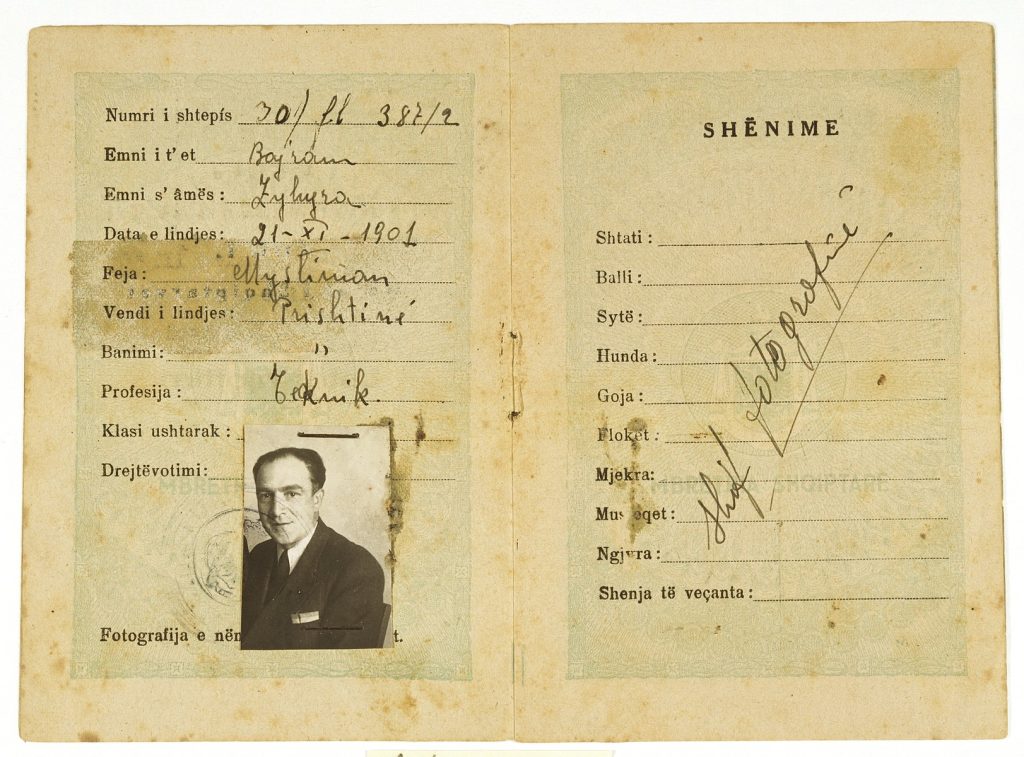
Jasha’s mother, Mimi, sold hand-knitted sweaters, and during a visit to Tirana to take measurements for an Albanian client, she realized that the seamstress and her family were Jewish as well. The client was Ganimete Toptani, who, along with her husband Aqif Toptani, reached out to the Altarac family, helping them by providing shelter, hiding them and finding them work.
After the capitulation of Fascist Italy in September 1943, Albania was occupied by Nazi Germany, which meant an increased danger for the Jews being sheltered in Albania. Ganimete and Aqif Toptani, wanting to help and save the Altarac family from the Germans, took the family to one of their properties in Kamëz. In a photograph taken in August 1944, Mimi and Majer are seen with their son Jasha in the garden of the Toptani house in Kamëz.
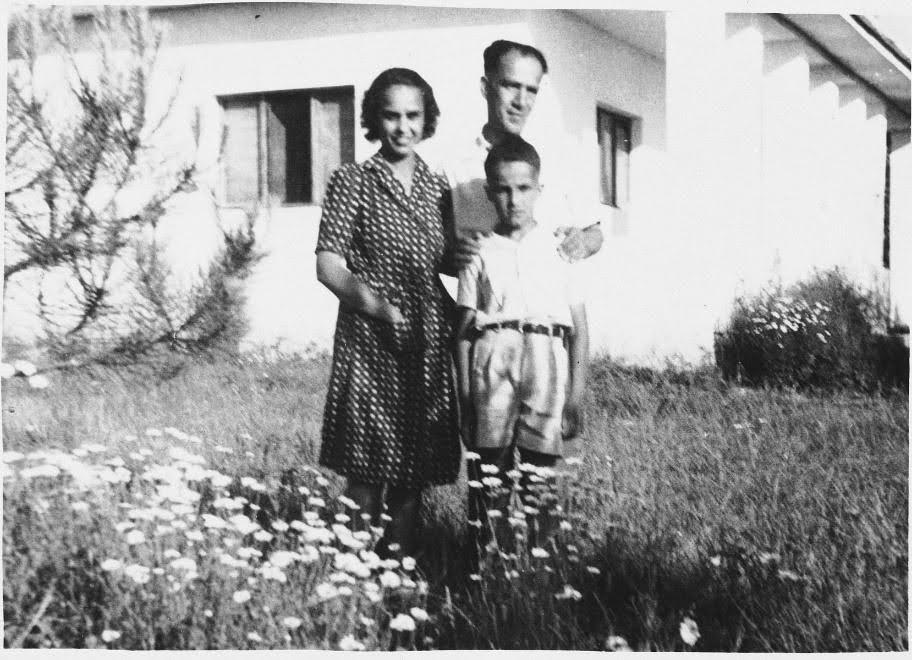
The Toptani family, who hosted the Altaracs, managed to protect their guests from at least two unexpected German raids. Due to the Altaracs’ fluent German, the Toptanis successfully passed them off as a friendly German family. In order to avoid suspicion, the Toptani family filled their house with Nazi symbols. Ganimete’s father had served as Albania’s ambassador to Vienna, and her family was well-versed in German culture, which facilitated their communication with the German authorities.
In August 1944, their house in Kamëz was raided once again after a German patrol was fired upon. While they were not arrested, the Germans ordered the Altarac family to return to Tirana. Three months later, in November 1944, the Germans withdrew, and Albania became the first country in Europe to be liberated by its own forces. Majer, Mimi and Jasha Altarac were among the Jews fortunate enough to survive the Holocaust.
Undocumented/underutilized heritage
Eighty years after the end of WWII, the traces and collective memory of the era in Kosovo remain scattered across fragmented narratives and histories, as well as through memorials of different eras. With few books, many still-untapped sources — and without proper museums or memorials — Kosovo continues to lack a historical overview of WWII and the heritage it has left behind, despite the fact that it served as a sanctuary for several hundred Jews at the height of the Holocaust.
In Prishtina’s bookstores, beyond memoirs, there is not a single biography of an Albanian political figure of WWII to be found. There are no biographies of the Prime Ministers of Albania at the time, who were appointed by the Italian and German occupying regimes — such as Mustafa Merlika, Mehdi Frashëri and Rexhep Mitrovica — nor of other figures, such as Xhafer Deva, who served as Minister of Internal Affairs; nationalist leader Shaban Polluzha; or communist leader Fadil Hoxha.
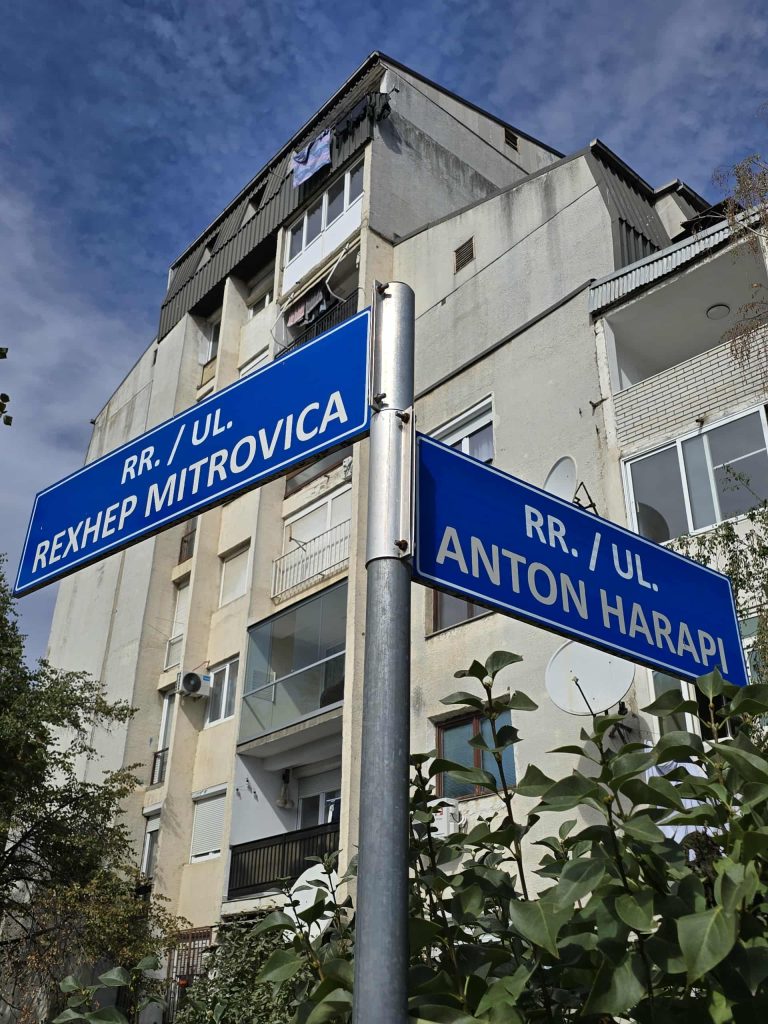
The names of some of these individuals can be found today on street signs despite the fact that their unwritten biographies provoke much public debate and despite their roles and policies as collaborators of Italian Fascists and German Nazis. In some cases, their names appear side by side, as they do in the neighborhood of Dardania in Prishtina. There, two small streets near the Dardania school honor Rexhep Mitrovica — who was the Prime Minister of Albania during the German occupation from November 4, 1943, to July 18, 1944 — and Anton Harapi, a Catholic priest who, with permission from the Holy See, served on the High Regency Council from September 13, 1943, to the end of 1944, during Nazi occupation.
In Kosovo, the history of WWII remains largely unknown, and the experience of it seems disconnected from the broader events of the war — so much so that its 80th anniversary passed by almost in silence, having been completely ignored. The memories of this period seem to have been exhausted by the more than four decades spent under the socialist regime of Yugoslavia.
Events and memories of a different war — the 1998-1999 war in Kosovo — have taken center stage in collective memory, leaving little room for WWII (1939–1945). In this context, where the memories of WWII are scattered, even an old song about the war heroine Ganimete Tërbeshi, revived by the singer Albina Kelmendi, is listened to only as light entertainment. Over the years, the story of Tërbeshi, a 17-year-old partisan killed by the Nazis in Gjakova on August 30, 1944, has largely been forgotten, like many other narratives of WWII.
The events of World War II, however, remain fundamental to the political fate of Kosovars and are essential for understanding the history and political context of Europe’s youngest state.
Italian, German, British, American, Serbian and Bulgarian archives hold voluminous documentary collections that have, until now, been only partially studied. Many human fates, military groups, political organizations and battles related to Kosovo during WWII remain undocumented, uncommemorated and unpreserved in museums.
Perhaps in two decades, when the world marks the 100th anniversary of the end of WWII, the collective memory in Kosovo will be enriched with books, documentaries and museums, shifting this heritage from the periphery of collective memory to the center of public attention.
Feature image: Ferdi Limani / K2.0
Durim Abdullahu is a historian and journalist based in Prishtina. Since 2016, he has been teaching history at the University of Prishtina.
This article was originally produced for and published by Kosovo 2.0. It has been re-published here with permission.