
I was born in December 1998, in Drenica, when the world around me was burning. My generation was born into war, greeted not by lullabies but by silence. We did not witness the fighting, yet we grew up under the weight of stories everyone carried and few dared to tell.
For a long time, I did not understand what war truly meant. It was a word that lived in the eyes of adults, in the way my mother paused when certain songs played, in how my father spoke of his best friend and how they had once been playing soccer together. But I was a child: curious, unknowing, alive. For a time.
I must have been ten years old, still in primary school. Our class had to recite poems, one after another. When the turn came for one of my classmates, he read a poem he had written about his father, who had died in the war before he could hold his son. His small voice trembled, but he did not stop. By the end, the whole classroom was crying, including our teacher.
That day, something inside me shifted. I looked around and realized how many of my classmates were orphans — nearly all of them. Some carried the names of relatives who had died, memory itself inherited through their birth certificates. In that moment, I understood: we were all children of the war, even those of us who had never seen it.
I filled the years that followed with quiet attempts to live normally, but the memories around me never left. They followed us like shadows, shaping who we were and how we saw one another. Growing up, I often wondered: how does a society learn to breathe again after so much loss and grief?
When I began studying Anthropology, I finally found a language for these questions. I learned that memory is not only what we keep in our minds; it also lives in objects, gestures, silences, stories and even names. I began to notice it in my own daily life: in photographs hanging on living‑room walls, in mothers lowering their voices, in rituals that brought villages together to commemorate a single loss. I began to see my own story as part of something larger: the story of a generation trying to understand pain it did not cause, yet still carried.
This search for understanding eventually led me somewhere I never thought I would go: Serbia. Coming from Drenica, it was not an easy decision. Many people did not understand why I would want to go there. But I felt I had to: to see for myself, to meet people beyond the inherited image of “the other.”
During an art-based project in Belgrade, I met young Serbs who had also grown up surrounded by stories of fear, loss and silence. Some were open, others defensive, but a few — rare and sincere — longed for peace just as much as I did. Some of them became my dearest friends, and I so deeply cherish the chance to have known them.
Sitting across from them, I realized that reconciliation and peace do not begin with politicians or diplomatic agreements. They begin with eye contact, with stories, with small acts of courage, and — most importantly — with listening to one another as two normal human beings.
I came back changed. I understood that peace is not forgetting; it is remembering differently. It is carrying the past not as a weapon, but as a bridge.
Remembering differently means speaking about pain without needing to assign new blame, listening to stories that challenge our own, and allowing space for empathy where resentment once lived. It means choosing conversation over silence and connection over inherited fear — like the friendships I built with people I was once taught to see only as “the other.”
Today, when I return to that memory from elementary school — a room full of children crying for parents they never met — I realize we were already building bridges. We were learning empathy before we even knew the word. And now, years later, I carry that same emotion into my work, my art, and the way I see the world: that memory is not a wall that divides us, but a bridge we must cross together.

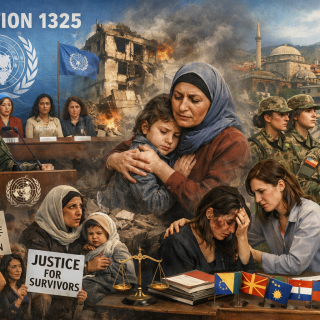
Illustration: Emilia de Haën / Pro Peace
Emnesa Rrukiqi is an artist and second-year anthropology student from Drenas. Her work bridges art and anthropology, exploring culture, identity, memory, and human experience. Influenced by observation and research, she focuses on visual storytelling to reflect emotional, social and cultural realities. Guided by deep curiosity, Emnesa sees continuous learning and becoming as central to both her creative and academic paths.
This blog is part of the Bridges of Memory series. Discover more stories here.