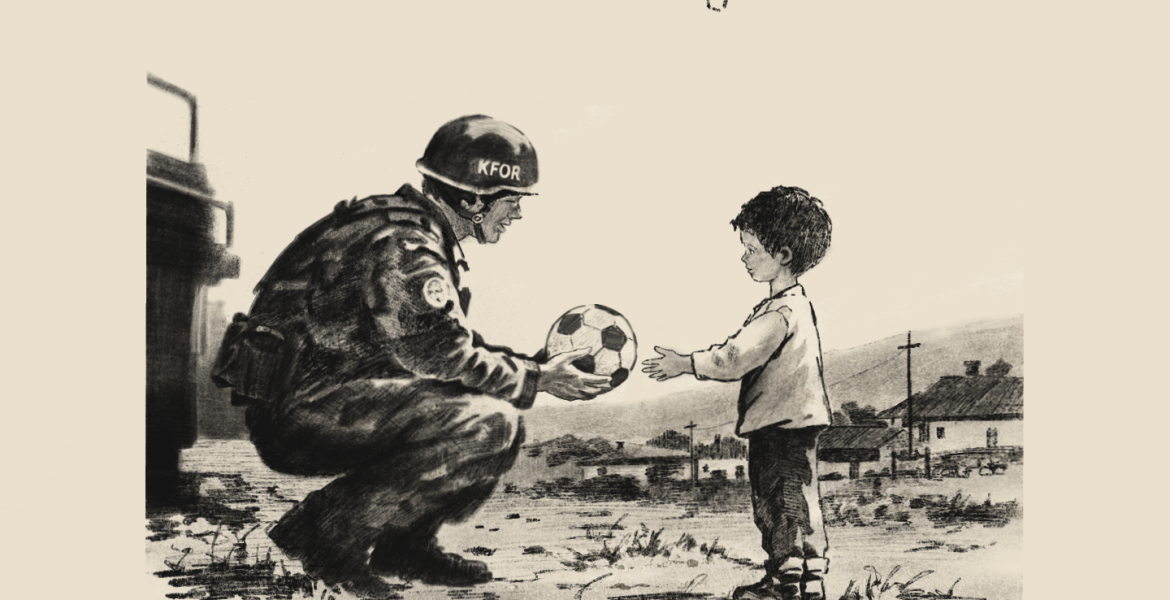
I remember a vehicle stopping near our village, a man getting out, taking a picture of me with his camera, and then giving me a ball. He was “an international,” the first one I remember. I don’t recall his name or where he came from — I was five or six years old. He had a ball, and for a child, that was enough.
After that first encounter, whenever I saw KFOR soldiers coming through the village, I would take the ball outside and play with them. I was convinced it was always the same person returning — he was wearing the same clothes.
I didn’t understand that KFOR was made up of thousands of different people from different countries. I knew nothing about international missions, peacebuilding, statebuilding or transitional justice; I had no vocabulary for any of that. I only knew that the internationals came to our village, smiled at us, sometimes spoke to us, and that one of them had given me an object of great fascination: a ball.
As I grew older, I discovered the words to describe their presence in Kosovo. I encountered them again at school, through youth programs, NGOs, conferences and exchanges. The map of my world expanded, opening up opportunities I would not otherwise have had and pushing me to question things I had taken for granted. I was introduced to people with very different experiences of Kosovo and this gave me spaces to talk about things that were sometimes difficult to discuss elsewhere: painful memories of the war, mistrust between communities, and questions that families found difficult to raise openly at home.
I visited, one after another, the many rooms in Kosovo where conversations about Kosovo take place. Some are conference rooms, others are hotel meeting rooms, and still others are the offices of international organizations. Some are filled with young activists or researchers, others with civil society representatives, but they are always filled with people who know the vocabulary: reconciliation, dialogue, transitional justice, social cohesion, conflict transformation. And then there are resilience, empowerment, inclusion, capacity-building, sustainable peace, community engagement, local ownership, knowledge-sharing, and so on.
As I moved from one room to another, I began to wonder about the people I didn’t find there. What does transitional justice mean to someone who has never attended a workshop on the subject?
On the ground, these high-sounding concepts are complicated by families remembering the war differently, neighbors continuing to distrust one another, people feeling that their losses have not been acknowledged. There, living peacefully alongside one another does not always mean that mistrust has disappeared: look closely, and the tensions beneath that coexistence surface in everyday interactions. What becomes of conversations about dialogue and reconciliation when they never leave the conference room in which they take place?
The workshop never reached my village. I don’t mean this literally: international actors have certainly reached villages across Kosovo. I remember them reaching mine when I was a child hungry for footballs. But as they travelled, the conversations rarely travelled with them.
Conversations intended for the good of everybody become circular; the people who participate in international programs quickly become familiar faces. In the rooms where these conversations happen, we start recognizing the same young activists, NGO representatives and community leaders. We learn how to describe our communities in language that makes sense to donors. We become comfortable discussing peace and reconciliation in English. We learn how to apply for projects.
There is nothing inherently wrong with this. In fact, these skills are useful and important. But I sometimes wonder whether we, internationals and local actors alike, have become very good at speaking about communities without making a sufficient effort to create opportunities for communities to speak for themselves.
This is a story about internationals, but also about us, the locals. I have attended international programs and returned home with new ideas. But how often, while drinking coffee with my neighbors in my village, did I show an interest in what these seemingly expert concepts meant to them? How often did I sit with someone who could never, or would never, apply for an international program, and listen?
Perhaps this is an uncomfortable truth about international engagement: the gap is not created only by those who organize the workshops, it is also maintained by those of us who attend them. I wonder if we have been so grateful to have made it into the room that we have forgotten those outside.
Perhaps this is where our conversation about internationals needs to become more complex. We should be able to say thank you without becoming uncritical, to point out problems without pretending that everything international has been harmful, and to recognize expertise while also asking whose knowledge is missing. Most importantly, we should ask whether the people who have spent decades discussing Kosovo’s future with us have had enough opportunities to listen to the people whose future they are discussing.
And we should ask the same question of ourselves. Internationals cannot be expected to carry every conversation into every village. They can create spaces and provide resources, but local actors have responsibilities too. Those of us who enter those spaces have a responsibility to bring something back.
After all, maybe it is not the workshop that needs to move, maybe we do. Maybe the real challenge is not to bring every villager into a conference room, but to make sure that the conference room is willing to step beyond its own walls: to listen to stories told without international terminology, without project language, and without the expectation that people must first learn how to speak in order to be heard.
Then, we could imagine reconciliation programs shaped by the concerns people actually experience, as we confront, without hypocrisy, the mistrust that persists between them. We could remain curious about issues that remain, and perhaps will remain, unresolved, and about how they continue to shape everyday life beyond the city.
As a child, I thought every KFOR member was the same person; growing up, I learned that they were not. Now I am learning that Kosovo is not one story either. There are the stories that are easier to tell in conference rooms, to write about in reports, and to discuss at workshops — and then there are the stories that remain in villages, homes, families, and memories, perhaps too uncomfortable to be told anywhere.
Maybe the task for all of us who straddle these walls is to make sure that these stories eventually meet. We could then talk about which memories are passed down around the dinner table, why mistrust persists, and what people feel remains unfinished. This would not erase disagreements or heal old wounds overnight, but it could change which problems are recognized, whose experiences inform decisions, and what we understand as meaningful reconciliation.
The most important conversation about Kosovo’s past and future may be the one that finally reaches home.
Feature image: Altin Ibrahimi / Pro Peace
Fatlum Jashari is a master’s student in Albanian language at the University of Pristina. He works as a freelance journalist and has completed numerous projects in journalism, education, and culture.