Musliu and Ypi’s memoirs disrupt hegemonic readings of the Balkans’ violent transformations across the 1990s.
History rarely arrives in childhood as an abstraction. It enters instead through silences at the dinner table while the television announces the death of the country you were born into, or through the sudden realization that the map of your homeland has shrunk to the cold black circle at the end of a Kalashnikov barrel, pointed at you because you were born into an ethnicity the regime has marked for erasure. It was through such historical ruptures that author and academic Vjosa Musliu was thrust into sudden adulthood in late-‘90s Gjilan. In Girlhood at War (2025), she revisits those years by tracing the intimate consequences of the political upheaval that engulfed Yugoslavia through the eyes of her 12-year-old self.
The book is written with piercing truth, profound empathy, and a nuanced understanding of both the realities that were shattered and those that emerged through, and in the aftermath of, political violence. Above all, it is guided by deep compassion for the lives touched by these events, refusing to reduce either Albanians or Serbs to fixed roles of victim and perpetrator, and instead inviting dialogue. It is brutally honest — at times funny, at others heartbreaking.
Most importantly, it stands as an act of resistance in a context when the past continues to be denied and politically instrumentalized; where nationalism and authoritarianism remain deeply embedded across much of Southeastern Europe’s political and social life; and where the absence of a formal apology or meaningful reparations from Serbia to Kosovo reflects an enduring refusal to acknowledge state responsibility for the violence committed, especially during the 1998-1999 war.
Despite being trained as an academic rather than a literary writer, Musliu consistently situates her own story within broader histories and shared experiences of war. She rejects the detached analytical language that often dominates academic scholarship, policy discourse, and transitional justice frameworks, where war and its aftermath are too often reduced to geopolitical events or institutional practices instead of lived human experiences.
This approach closely mirrors her academic work on statebuilding and external intervention, particularly in Europeanization and Statebuilding as Everyday Practices: Performing Europe in the Western Balkans (2021). There, she similarly challenges institutional and elite-centered accounts of political transformation by foregrounding local subjectivities as the central site through which political realities are produced and negotiated.
In line with her scholarship, Girlhood at War traces the intimate ways in which Yugoslavia’s dissolution was experienced through social fractures of everyday life, such as the militarization of daily routines, the erosion of trust among neighbors or the transformation of ordinary spaces into sites of exclusion. Rather than positioning herself as a distant observer of history, Musliu writes from within those fractures, allowing lived experience to confront the limits of academic abstraction.
In this regard, Girlhood at War can be read alongside Lea Ypi’s earlier memoir Free (2021). Both works belong to a growing body of contemporary post-socialist autobiographical literature from the Balkans, where authors trained as academics turn to childhood memory and personal narrative to reconstruct the intimate human experience of ideological and historical disintegration.
In Free, Ypi revisits her coming of age during the fall of state socialism in Albania and the emergence of a turbulent, often violent post-socialist transition, culminating in the civic unrest of 1997. She similarly employs subtle sarcasm to expose the absurdities embedded both in the socialist system she grew up in and in the neoliberal order that replaced it. The use of humor and sarcasm by both authors is deliberate: rather than moralizing or telling readers what to think, they invite them to recognize contradictions for themselves. At the same time, humor creates a measure of distance from traumatic experience, rendering it narratable without diminishing its gravity.
Being first and foremost a professor of Philosophy and Political Theory, Ypi approaches the past not merely as remembered experience, but as a philosophical problem, asking what it means to be free in the aftermath of competing ideological projects. In her book, she transforms characters into carriers of contrasting understandings of freedom, authority, morality, and historical progress, each reflecting a distinct philosophical tradition and giving human form to otherwise abstract ideological conflicts.
For example, the grandmother articulates a vision of freedom resonant with Kantian notions of autonomy and moral responsibility, insisting that genuine freedom depends on the capacity to think and act according to one’s own reason rather than external authority. The mother, by contrast, embraces the promises of market liberalism and economic opportunity that accompanied Albania’s post-socialist transition, while the father remains committed to ideals of social justice and collective welfare associated with social democracy. Rather than presenting any of these positions as unequivocally right or wrong, Ypi stages them in dialogue, revealing both their aspirations and their limitations through the story of her family.
This dialogical structure reflects Ypi’s broader philosophical project. Drawing on her engagement with both Kantian moral philosophy and Marxist critique, she examines the collapse of Albanian state socialism and the promises of liberal capitalism not through abstract theoretical argument but through the lived contradictions of everyday life. In doing so, Free operates simultaneously as autobiography and fictionalized political philosophy: childhood memory becomes the medium through which larger questions of freedom, dignity, agency, and social justice are tested against the realities of historical rupture.
Despite the different political contexts to which they address, Free and Girlhood at War can be read as parallel texts. Their affinity lies not only in the fact that both authors are scholars who turn to literature as a means of narrating history, but also in their insistence that histories of war and political transformation cannot be understood without attending to the gendered experiences of everyday life, where the personal serves as a repository of political memory. In both memoirs, girlhood emerges as a critical epistemological lens through which the violence and contradictions of post-socialist transition become more legible. The passage from childhood to adolescence becomes inseparable from transitions between political regimes, as individual formation is shaped by, and comes to reflect, moments of profound historical change. Historical rupture is thus revealed not only as an institutional or ideological process but also as an embodied one, where violence penetrates the most intimate dimensions of existence and human dignity.
Rape as a weapon of war constituted a concrete threat both during the ethnic cleansing campaigns in Kosovo and amid the armed unrest that accompanied Albania’s 1997 implosion. In Girlhood at War, Musliu — writing from the perspective of her 12-year-old self — asks: “How old do you have to be to get raped?”, as girls close to her age are violated by members of the Yugoslav-Serb army and Serbian paramilitaries. In Free, Ypi recalls her mother speaking before a French women’s rights organization whose institutional understanding of violence against women was shaped more by assumptions and the distance of Western European NGO practice than by the immediacy of cases such as Albania’s post-socialist collapse. As her mother confessed, “I always carried a knife with me,” while girls Ypi’s age were already being abducted and trafficked across the Adriatic into sexual slavery.
This gendered anxiety surrounding survival produces a distinctly feminized perspective on history in both memoirs, one that expands the notion of the battlefield to include female bodies as grounds upon which war and ideology are enacted. Yet the female figures in these narratives are not portrayed solely through vulnerability. Mothers, grandmothers, and other women emerge as crucial moral and interpretive anchors, preserving dignity and emotional coherence amid ideological collapse, economic devastation, occupation, war, displacement, and ethnic persecution. In both texts, they become the figures upon whom survival itself depends, transforming care and endurance into forms of political agency.
This feminist perspective also shapes how both authors evaluate international intervention. By privileging women’s lived experiences over geopolitical or humanitarian narratives, the memoirs reveal the limits of external interventions, whether NATO’s bombing of Yugoslavia in 1999 or the multinational ALBA mission in Albania in 1997. Rather than accepting these interventions as straightforward projects of liberation or democratization, both authors examine how they were experienced by those living through the violence. Their skepticism toward Western interventionism and its self-proclaimed mission of exporting freedom carries a distinctly decolonial dimension: by rejecting simplistic narratives of “saving” the Balkans, both works bring to the surface the experiences of those long marginalized.
International organizations in post-communist Albania, as well as NATO troops and other foreign administrators in Kosovo, are portrayed with subtle irony that serves a decolonial function, questioning the presumed authority of external actors to define and narrate local realities while privileging the perspectives of those who experienced intervention from within. Musliu and Ypi remain attentive to the ways humanitarianism, liberal interventionism, and European or American “civilizing” discourses can conceal hierarchies. Their memoirs reveal how these projects often privilege external expertise over local knowledge, reducing complex lived realities to universal narratives of democratization, peacebuilding, or women’s empowerment. In doing so, they expose forms of paternalism that frequently accompany international intervention and produce relationships fundamentally shaped by asymmetries of power and knowledge, where external actors determine how local realities are understood while often denying equal authority to the experiences of local communities.
Another convergence lies in the fact that both memoirs are written through a form of double consciousness. The narrating voice oscillates between the perceptive yet bewildered girl experiencing events in real time and the adult academic capable of historicizing them. Neither author remains confined to the perspective of childhood innocence. Instead, both retain the immediacy of that experience without relinquishing the critical perspective of adulthood. The memoir thus becomes hybrid: part testimony, part political or philosophical analysis.
Yet despite these parallels, the books diverge significantly in their orientation, as they pose fundamentally different questions and attribute distinct functions to memory, each shaped by its own historical conditions. Ypi engages conceptually with the notion of freedom and what it means under socialism versus capitalism. Musliu, by contrast, articulates freedom not primarily as an ideological question but as a material and political condition, asking whether a people can ever truly be free when their reality and statehood remain denied or only conditionally recognized. These differences emerge partly from the distinct intellectual frameworks through which the authors approach memory: Ypi blends personal recollection with philosophical reflection, whereas Musliu engages with memory through the discipline of international relations and political science.
Their tones also differ. Ypi’s narrative is more reflective and philosophically analytical, as she seeks to interrogate the ideological certainties that shaped both socialism and liberal capitalism. Musliu’s tone, on the other hand, is more overtly political and publicly engaged. She approaches writing as an act of resistance against erasure within a still-contested political landscape, seeking to confront denial and safeguard historical truth. Kosovo’s statehood remains internationally disputed to this day, including by five European Union member states that still refuse to recognize its sovereignty, while Serbia continues to engage in institutional revisionism and the denial or minimization of wartime atrocities, alongside the persistence of ethnonationalist politics in the region.
As a result, memory in Girlhood at War acquires an urgent political function: not merely to remember, but to insist upon recognition. If Ypi’s text interrogates the meaning of freedom after ideological rupture, Musliu’s insists upon the right to narrate forms of violence that parts of the international order still refuse to fully acknowledge. In doing so, the memoir challenges not only regional revisionism but also an international order that has yet to reckon fully with the political and historical consequences of the Kosovo conflict, including the contested status of Kosovo’s sovereignty, the persistence of wartime denial, and the incomplete recognition of victims’ experiences and claims for justice.
At the same time, there is an important distinction in the forms of historical violence each author confronts. In Free, violence emerges from the fragmentation of Albanian society, accompanying institutional collapse and the erosion of social bonds. It is often decentralized and perpetrated by fellow Albanians — including family members, traffickers, criminal networks, or neighbors — rather than by an external enemy. Musliu, by contrast, depicts violence as militarized, organized, and directed against an identifiable ethnic other, shaping everyday life through the constant threat of annihilation.
The distinction, therefore, is not one of degree but of historical configuration and memorialization. Both memoirs confront forms of violence that are profoundly traumatic, yet they emerge from different political contexts and have followed different trajectories of public recognition. In Kosovo, wartime atrocities, including conflict-related sexual violence, have increasingly become the subject of public recognition and struggles for justice, even as denial and revisionism persist. In Albania, by contrast, many forms of gendered violence associated with the post-socialist collapse, particularly trafficking and sexual exploitation, have remained comparatively marginalized within public memory, often silenced or treated as private rather than political experiences.
Taken together, these memoirs form a powerful feminist intellectual archive of the Balkans in the 1990s, rejecting the reductive binaries through which the region has often been understood — communism versus democracy, victim versus liberator, “backward Balkans” versus “enlightened West.” Instead, both authors show how history is lived through the intimate experiences of ordinary people, including young girls forced to confront the threat of rape before they have even learned what a menstrual cycle is, their bodies not yet fully developed. These recollections reveal that history is never experienced as an abstract sequence of political events, but as an intimate force that penetrates the family home, the female body, and the very process of growing up.
By grounding political history in intimate, embodied experience, both memoirs demonstrate that the political cannot be separated from the personal. In turn, they challenge dominant ways of narrating the Balkans by asking not only how violence is experienced, but also whose experiences are recognized as legitimate historical knowledge, who is authorized to tell these stories, and whose memories continue to be marginalized within dominant European historical narratives.
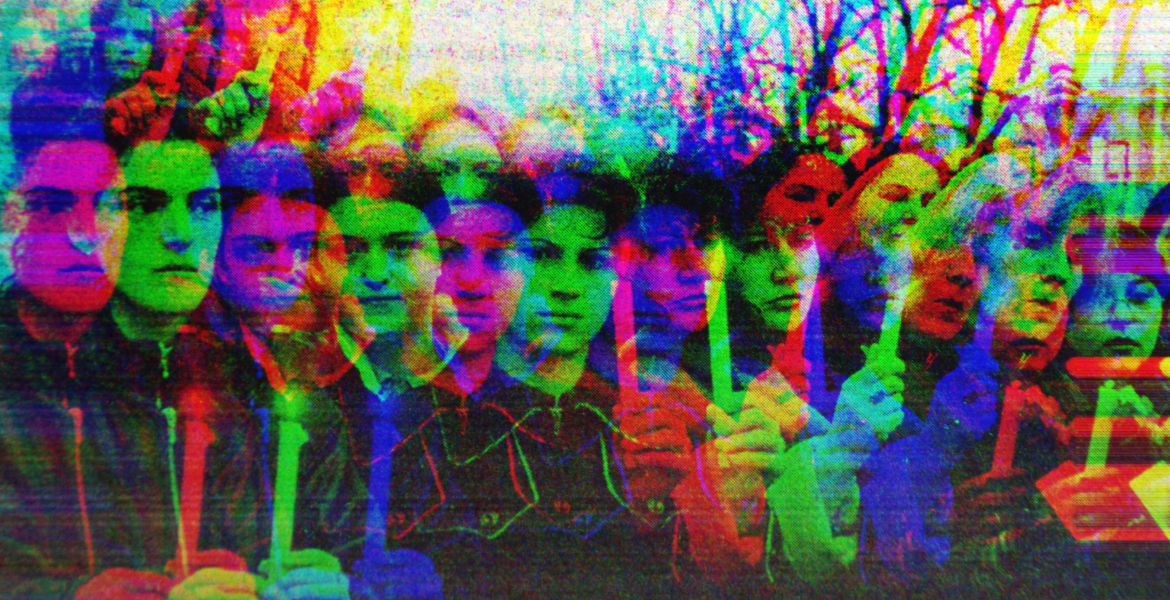
Feature image: Candlelight protest at Mother Teresa Square, Prishtina, March 10, 1998. Bujku, March 11, 1998 (via National Library of Kosovo press archives). Edited by Pro Peace.
Gresa Hasa is an expert on Albania and the Western Balkans, with a particular focus on the rule of law, state capture, democratic backsliding, and electoral politics. She is a PhD candidate at the Faculty of Law and the Center for Southeast European Studies at the University of Graz, Austria, as well as a 2026 BiEPAG Fellow.