What Kosovo’s political prisoners and bacteria can teach us about connection and resistance.
A sensation appears before it becomes a thought. Sometimes I notice sweating palms, a tightening in the stomach, a subtle shift in breathing, an inexplicable restlessness. Information shifts through the body quietly, difficult to locate yet capable of altering how one thinks or moves through the world. Only later does it coalesce into something recognizable. We often call it a gut feeling, the moment knowledge begins to surface through the body, before it can be consciously named.
A slight misalignment, a break in rhythm, a moment where something resists integration, these interruptions expose the interconnected systems moving around us and through us. Sensations become informative because they reveal where a body no longer moves in harmony with its environment. They function as early warning signals embedded in us; the body registers disturbance and begins to adjust while the mind is still searching for language.
Over time, these adjustments accumulate. What was once fleeting settles into posture, into rhythm, into habit.
In one of his poems, Walt Whitman writes: “If I worship one thing more than another it shall be the spread of my body.” What kind of body is Whitman speaking about? A body that does not end at the skin, but extends outward: porous, receptive, entangled with the world around it. If we understand our bodies as open systems, constantly exchanging signals with their surroundings, then sensation is never purely individual. Feeling becomes social, just as it becomes ecological.
In my filmmaking, I try to follow a similar idea. I treat sensation as a method of composition, constructing films through sound, rhythm, and fragmentary images that shape feeling before interpretation. This sensorial approach also guided my work with Oral History Kosovo, during a research project on Albanian former political prisoners persecuted under Yugoslav rule. The project traces lived experiences of surveillance, imprisonment, resistance, and everyday life under repression.
During interviews with former political prisoners, I became attuned to how something is being said rather than only what is being said. I noticed meanings often appeared in pauses, in the pacing of speech, in small hesitations or sudden shifts in tone. At certain moments, words would slow down, sentences break, hands fold into each other, as if the body was giving away something the voice could not fully carry. These encounters made me attentive to how oppression settles into the body over time, how it is carried through small physical traces into our expressions.
Following these traces meant returning to the environment in which they were formed, to understand them, to unearth their material impacts through imperceptible significations.
I had to follow the threads of Kosovo’s pre-war resistance movement, also known as Ilegalja, a clandestine network of Albanian activists operating under Yugoslav state surveillance and repression. The movement operated across several decades, particularly from the 1960s through the 1990s, forming a dispersed underground formation that circulated political literature, organized demonstrations, maintained communication between activists, and sustained the idea of liberation under conditions where open political expression was criminalized. I studied how this network formed, how it functioned, and how it organised itself. I met political activists and listened to their life stories.
If you were an ethnic Albanian in Yugoslavia, even a small misstep could bring surveillance: UDBA, the Yugoslav State Security Administration, was ever-present. That overwhelming awareness lodged itself into the body. It appeared in subtle calibrations: how someone sat, how loudly they laughed, how long they stayed in one place. Each action imposed adjustments. The body moved in anticipation of disturbances as they emerged.
Recalling her years of underground activity, Zyrafete Kryeziu Manaj described a world in which “there were people from UDBA all around, all around. At the bus station, at the cinema, at the theater, at the dorms, they were everywhere.” Under such conditions, vigilance became part of everyday life. “We had to be exceptionally careful, otherwise you could go to prison over the smallest thing,” she explained.
Albeit threatened, the body didn’t stop sharing or perceiving. On the contrary, just like Whitman’s body, personal experiences still spread through daily interactions.
Violence carried out by the Yugoslav state, in particular, was rarely experienced individually. Witnessing pressure often produced reactions similar to experiencing it firsthand. Bodies learned from one another. In her interview, Hava Shala, a former activist in the resistance movement, recalled one such reverberation: “I remember a time when the police got on the bus and forced the bus driver to stand up. They forced him to look at us, and then spat on his face and slapped him, trying to provoke us. They mocked him, and when they were finished, they forced him back into his seat to drive again. To be honest, I could not convince myself to stay calm or to hold still. I could not tell myself, ‘Since they didn’t touch you, it’s alright,’ and believe it. You had to be a big idiot to say that nothing happened at that time. (…) Fortunately, that was not my nature.”
Through her words, I began to understand how bodies registered and transmitted one another’s responses to acts of oppression. The violence directed at one person was felt collectively, passing through the bus in gestures, tension, silence, and reaction before it was ever spoken aloud.
What struck me in her testimony was the refusal of separation, the impossibility of treating violence as something that belongs only to the body it is directed at. I wondered if the collective behaviour that I was witnessing in people might also exist elsewhere, replicated across different scales of life. I began searching for other places where such forms of alignment appeared.
During my artist residency with Hajde! Foundation and Sekhmet Institute, this question became the seed of a video installation. I set out to explore how behavioral patterns in nature might parallel such human behaviors. This search led me inward, toward the micro-world and the systems already operating within the body, processes through which regulation, behavior, and response unfold without fully entering conscious awareness. I became interested in what we might learn from the tiniest organisms living inside us.
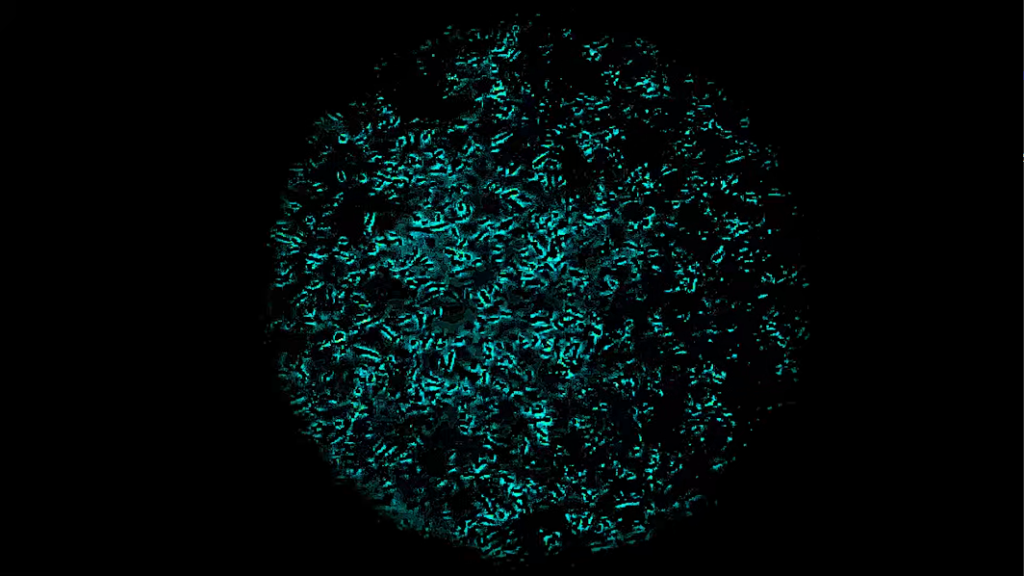
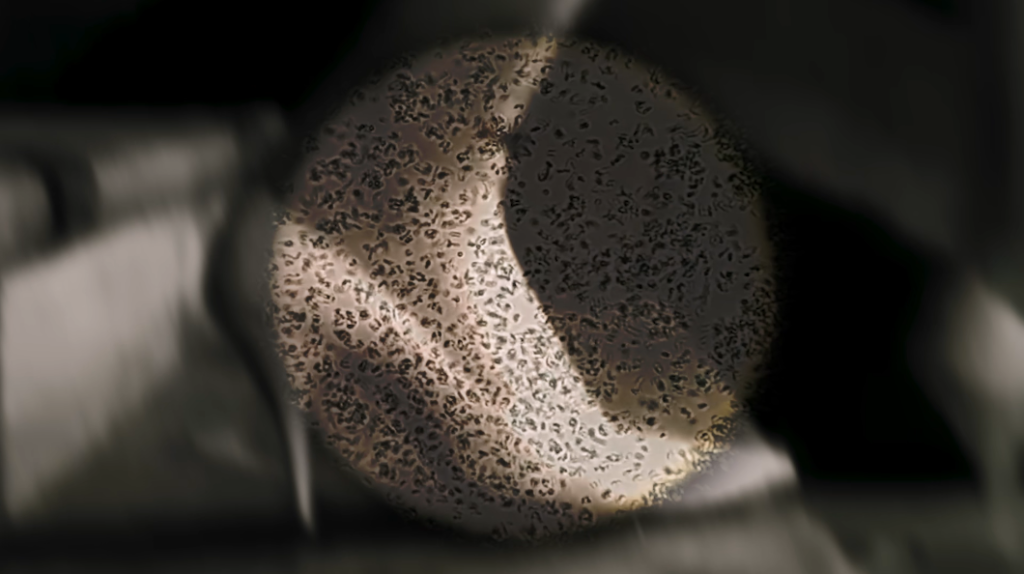
The gut, often described as our body’s second brain, is inhabited by millions of bacteria constantly interacting, responding, adjusting. I began observing bacteria under a microscope, creating environments for them, filming their movements, and waiting without knowing how they would react.
What caught my attention was a chemical process called quorum sensing, through which bacterial behavior transforms. Individual cells release small chemical signals into their environment. At low concentrations, these signals have little effect, and each bacterium acts independently. As the population grows, the concentration increases. At a certain threshold, a quorum, the behavior of the group shifts into synchronisation. Bacteria that previously acted alone begin to move together, emit light, form biofilms, or activate defence mechanisms.
No central authority directs this shift. No single bacterium decides when it should happen. Collective behavior emerges from accumulation, through the gradual stacking and sensing of chemical signals in the surrounding environment.
This logic of distributed coordination led me back to the question of the body as something porous rather than contained, a structure always in relation with what surrounds it through signal exchange. From this perspective, resistance looks like a movement through relations: gathering, dispersing, and reforming as bodies register and respond to their environment, and one another.
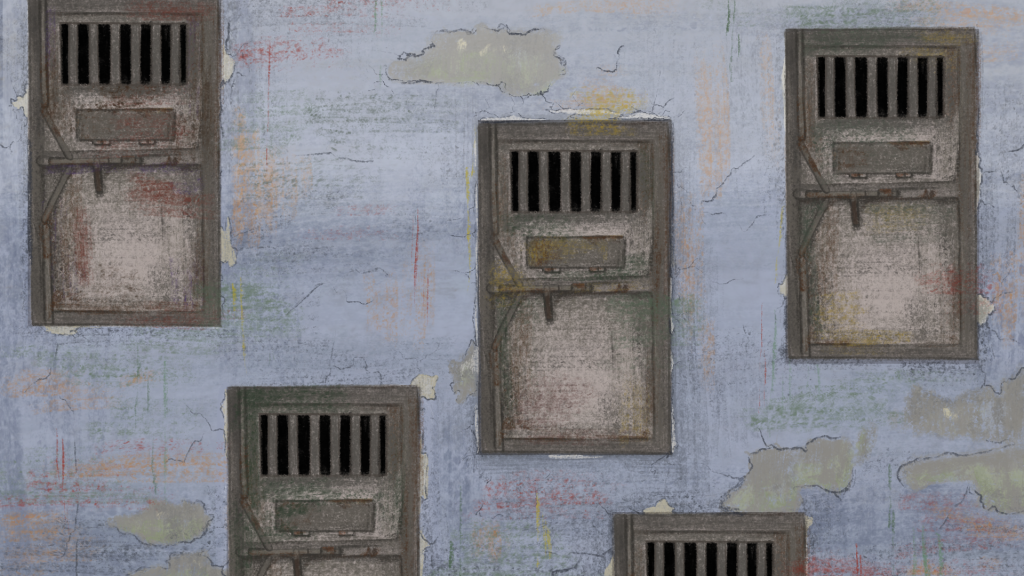
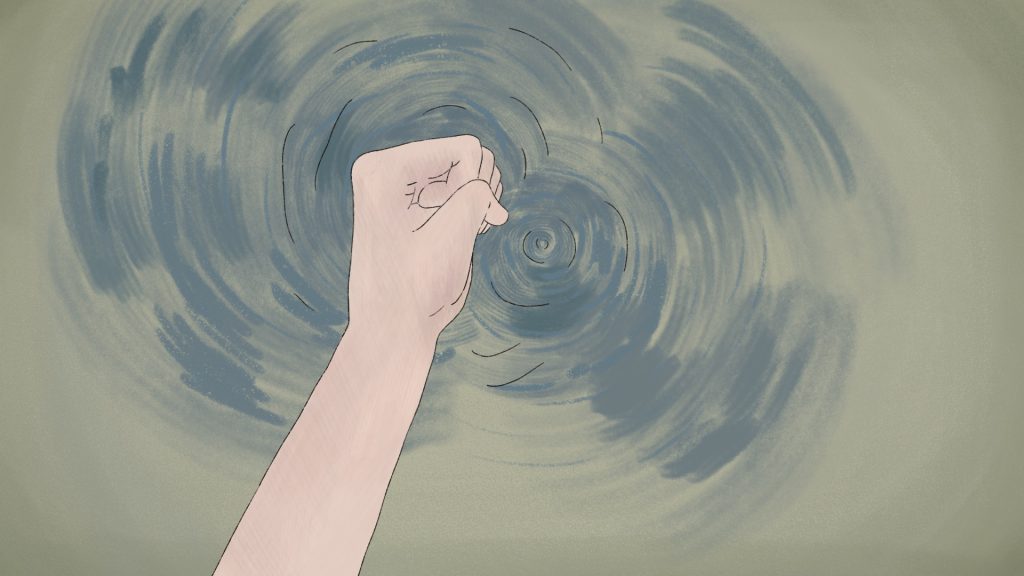
Even inside Yugoslav prisons, communication among political prisoners followed a distributed sensing logic. Information rarely arrived whole or self-contained. Through cups pressed against the walls, fragments of news traveled quietly from cell to cell. Coded phrases circulated without confirmation. Three knocks on the wall meant three people in the neighboring cell. “It is snowing” meant the revolution had begun.
No one possessed the full picture. Understanding emerged through fragments. Someone spoke when speaking was forbidden, and others followed. A refusal spread. A song began. Courage became readable in the room. Enough signals accumulated for fear to shift into movement.
During the launch of Anna Di Lellio’s book Yugoslavia Collapsed in Trepça at La Casa della Memoria in Rome, oral historian Alessandro Portelli spoke about oral history as something that always operates on two levels simultaneously: a coherent collective narrative through which events become historically understood, and beneath it, a multitude of individual stories that only become visible through what he calls the “microscope” of oral history. Recalling the 1989 miners’ strikes in Kosovo, he described how people arrived carrying whatever they could offer in support: an elderly woman brought two onions, a couple brought two gold coins, another man brought his cow. “The fall of Yugoslavia,” Portelli said, “is also the history of two onions.”
In a new film I am developing (Who Is Singing?, 2027), inspired by oral history interviews from the Oral History Kosovo archive, I return precisely to these small gestures exchanged between prisoners: acts of care, coded communication, fragments of solidarity moving quietly between bodies. I want to distance myself from the mythology of the solitary hero and instead remain close to the fragile relations that allow collective endurance to form. What interests me is resistance as accumulation, as something built slowly through repeated gestures that may appear insignificant on their own, yet together alter the conditions of survival.
In the case of Ilegalja, this formation became part of a longer trajectory of dispersed resistance that contributed to the political density from which the war of 1998-1999 and Kosovo’s eventual declaration of independence emerged. This trajectory is shaped by the interaction of multiple political, social, and cultural processes, including later armed and political formations such as the Kosovo Liberation Army, through which resistance gradually accumulated and reorganised across time.
But coherence is never guaranteed. Signals accumulate unevenly, sometimes dispersing before they take form. Signals can be misread, intercepted, or lose coherence before reaching a threshold. What gathers can also fragment, leaving only partial traces of what might have become collective.
Not only, but the state can also learn how to intervene and disrupt such processes. Just as I discovered with surprise the shifting of my bacteria, any system built through shared sensing can become legible to those who seek to control it. The Yugoslav state surely did.
During the time of Ilegalia, the state, as an apparatus of oppression, sought to introduce imbalance into the field of relation of political dissidents. It exerted pressure to engender disruption, operating both at the psychological level and through physical violence, imprisonment and torture. When a person “cracks,” signals fracture, trust weakens and the structure begins to unravel.
Afide Topalli Kuka, a former activist in the Albanian underground resistance, recalls a moment of psychological interrogation in which state security forces used both intimidation and staged scenarios to destabilize prisoners and fracture trust in sensation and information: “Besides interrogating us day and night, they darkened the room and placed me on the far side of it. For hours they left me like that. They played a song, ‘I will kill you.’ Then came the reply: ‘Kill me.’ I couldn’t tell if they were torturing someone or staging the whole thing. They saw that we didn’t break in any way and were bent on breaking us, spiritually.”
This atmosphere of uncertainty operated through the manipulation of perception itself, making it difficult to distinguish between reality and fabrication: “One of them said, ‘Naser was killed last night, we killed him. Do you want to see him?’ But I had always prepared myself for the lies of the Yugoslav State Security. ‘You didn’t tell us about your activity, we won’t even let you attend the burial.’ ”
The interrogators attempted to destabilize political agency and individuality, framing her and those around her as replaceable within a collective body. “‘Kosovo has lots of men,’ he said, trying to insult me. I stood my ground, it wasn’t true.” Confusion, repetition, staged narratives, and the erosion of trust were techniques through which identity and relations could be weakened from within.
I find that, today, similar dynamics continue to shape how collective life is formed and destabilized. Signals circulate at high speed and in overwhelming volume, making it increasingly difficult to distinguish what is collectively felt from what is amplified, manipulated, or strategically produced. Revisiting these histories allows me to reveal how such patterns persist across different contexts, while also opening possibilities for other ways of sensing, relating, and understanding collectively.
Beyond situations of organized political resistance, I have started to notice quorum sensing patterns in other forms of collective behaviour: excitement spreads through cultural trends, fear circulates through propaganda, opinions shift through repetition and proximity. Social environments accumulate signals until participation begins to feel intuitive, as if one is stepping into something already underway. Across bacteria, oral histories, prisons, and everyday life, communication unfolds as an act of sensing, where meaning appears only in fleeting alignments under shifting conditions, often when survival depends on immediate responsiveness to signals.
I find myself thinking about how we move through overlapping systems, political, social, economic, technological, and biological, each shaping how signals circulate between us, what becomes amplified, and what disappears into noise. If oppression works by fragmenting relations and isolating bodies from one another, then resistance may begin in preserving forms of relational awareness: the capacity to remain affected by one another despite the pressures that push toward numbness, distraction, fear, or separation.
I see resistance today in attention itself: in how we remain with the environments we move through, in the signals exchanged between people close to us, in the kinds of stories and news that circulate and the interests they serve. It appears in noticing how collective moods are produced, redirected, or intensified, but also in recognizing quieter gestures that sustain social life from within. Not all forms of resistance appear at the scale of spectacle or historical rupture. Sometimes they persist through small acts of care, attentiveness, solidarity, and the decision to remain perceptive to one another within systems that continuously pressure us toward disconnection.
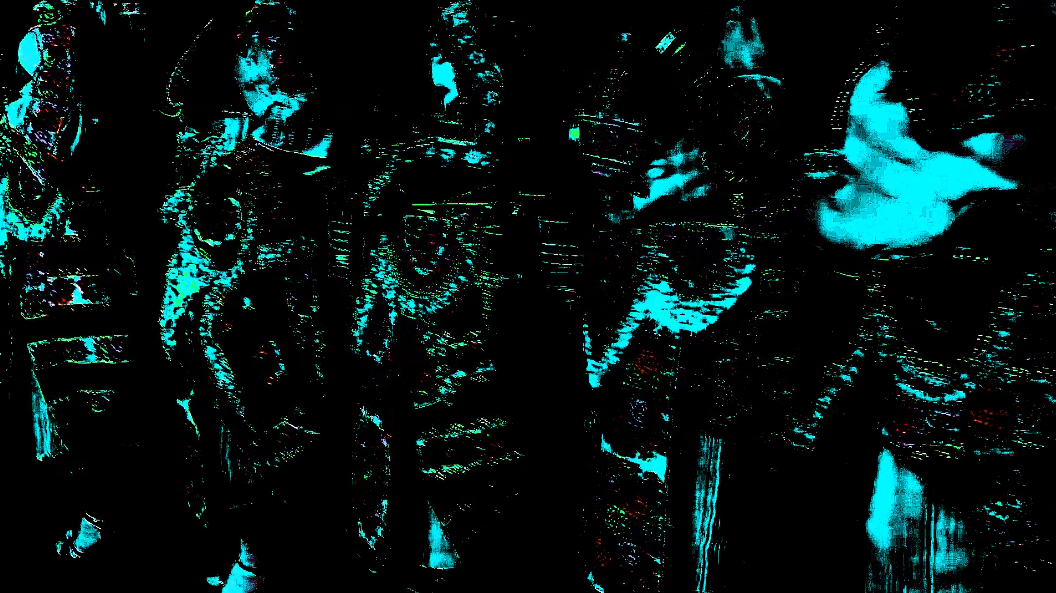
Feature image: Still from did you get the chemical signal i sent you? (2026), a video installation by Ana Morina. Photo: Ana Morina
Ana Morina is a filmmaker and researcher from Kosovo. Working across film, animation, oral history, and artistic research, she explores collective memory, mythology, and the ways stories are shared, transmitted and preserved. Her practice centers on communication, collaboration, and collective experience across communities and species. Through her work with Oral History Kosovo, she engages with questions of memory, ethics, and narration, while supporting young people in developing their own storytelling approaches.