Roma talent must enter society to change it.
Today, the world is changing rapidly. We speak more and more about human rights, equality, and democracy, but when we look at reality, many communities still remain on the margins of society. Among them are Roma people, who continue to face discrimination, stereotypes, poverty, and the feeling of not being fully accepted.
While documented cases provide ample evidence of ongoing discrimination, they likely represent only a fraction of the actual incidents experienced by Roma communities. Many cases remain unreported due to fear of stigmatization, limited trust in institutions, lack of awareness of available complaint mechanisms, or the perception that reporting will not lead to meaningful change. Not only, discrimination is often indirect and embedded in everyday social practices, making it difficult to identify, prove and officially register.
Discrimination against Roma does not always come in obvious forms; people do not always realize they are practicing it. It can be found in the surprise on someone’s face when they learn that you have a university degree, speak several languages, or hold a respected profession. It is in the lowered expectations that many people have of Roma from the moment they meet us.
Some stereotypes are so common that they start to feel like facts. As a result, Roma encounter barriers in employment, education and access to services that are not always easy to recognize as discrimination, despite having a significant impact on their opportunities and quality of life. Too many still think of us only as street musicians, people who do not want to work, people who refuse to change, or people who live — and like to live — in poor and dirty settlements. These stereotypes have followed Roma communities for centuries, becoming so deeply rooted that many people accept them without ever questioning their origin.
Few people stop to ask how generations of discrimination have shaped our reality. For centuries, Roma have been pushed to the margins of society, denied equal opportunities, and expected to overcome barriers that others never had to face, or were given the means to overcome. The consequences of that history are still visible today.
To the surprise of some, several young Roma graduate with ambitions and a desire to contribute to society as teachers, lawyers, economists, engineers, and other professionals. From conversations I have had with Roma community members, I know that around one hundred young Kosovo Roma complete university studies every year, yet many of them struggle to find opportunities that match their education and skills. Too often, their choices are limited to low-paid work abroad, such as construction jobs in Germany, or employment within the few civil society organizations working on Roma issues. Stereotypes about us seem to overshadow our real stories and limit the possibilities of what those stories could become.
The question we should ask is why so many talented and educated Roma continue to face barriers even after doing everything society asks of them. Sometimes it feels as if we have to work twice as hard just to prove that we belong.
Obviously, the issue is not that Roma organizations or minority political parties employ Roma professionals; the issue is that many qualified Roma professionals feel they have few other alternatives. In a similar way that the violence Roma experienced during and after the Kosovo War has been pushed to the margins of collective memory, our achievements in the present also struggle to find space for expression in broader public life. Even when we are recognized as capable of succeeding, there remains an implicit expectation that we can or should do so only for and with Roma.
This creates a paradox: what about a Roma doctor, nurse, lawyer, engineer, or economist? Should they be expected to serve only members of their own community, or should they have the same opportunity as anyone else to contribute to society as a whole? A doctor does not choose patients based on ethnicity. A teacher does not educate only children from their own community. Professional qualifications are meant to serve society, not a single ethnic group.
In practice, however, many educated Roma find themselves confined to roles connected to Roma issues and Roma organizations. While this work is important and valuable, it should be a choice, not an expectation. The goal of education should not be to create professionals who are limited by their identity, but professionals whose identity is no longer a barrier to their opportunities. From this viewpoint, the issue extends beyond employment or educational attainment; it concerns whether Roma are genuinely recognized as professionals — or, one might add, as individuals — beyond their ethnic identity. This raises a broader question about the meaning of inclusion and the policy approaches commonly promoted to achieve it. When identical qualifications do not lead to equal opportunities, education alone cannot dismantle the barriers that persist.
Indeed, I often feel that society is more comfortable accepting Roma as beneficiaries of support programs than as decision-makers, professionals, managers, public servants, academics, or leaders within our institutions. We rarely see Roma in positions where important decisions are made — both for their own community and for society as a whole. This is a fundamental betrayal of Kosovo’s project as a multiethnic state. A multiethnic democracy means not only that no one’s ethnicity should be a barrier to the full enjoyment of citizenship, but also that it should not define the boundaries of a person’s contribution to society. Visibility, influence, and leadership should not be mediated exclusively through ethnic identity. The Roma, however, continue to be afforded few opportunities to become part of Kosovo’s social and institutional mainstream.
At the same time, I believe it is important to be honest with ourselves as well. In recent years, we can also notice a certain passivity within parts of the Roma movement. We participate in conferences, workshops, and discussions, but very rarely do we come forward with our own concrete solutions. Too often, we remain only participants in processes led by others, rather than becoming those who initiate change ourselves. While discrimination, exclusion, and inequality remain significant challenges, I also believe that the Roma movement and Roma leaders must also engage in deeper reflection on our own role and responsibility in shaping the future of our communities.
The question is not only what governments, institutions, or international organizations can do for Roma communities. The question is also what kind of vision Roma leaders are offering to their own people. Are we preparing young Roma to become professionals, entrepreneurs, academics, and decision-makers? Are we creating pathways that allow them to succeed beyond the Roma sector? Are we building institutions that will serve future generations? If we want real change, Roma leadership must go beyond advocacy alone. Our communities need leaders who not only speak out and rally support, but who are also prepared to make change happen.
That requires a different approach to Roma activism. The future of our communities cannot depend solely on outside support, nor is mere inclusion in processes enough. This does not mean rejecting cooperation with institutions or international organizations, quite the opposite. It means Roma people must move from a passive role into that of equal partners, actively shaping policies and decisions. We cannot expect partners to recognize us as equals if we are not ready to act as such ourselves.
There are moments when identifying problems and waiting for institutions to respond is not enough. We must be prepared to take responsibility and demonstrate leadership. We cannot expect others to build our future; we must take a more active and confident role in shaping society, including by being the ones who bring about solutions.
If the whole world is changing, then perhaps it is time for Roma communities — especially in how we approach the change we wish to see — to change as well.
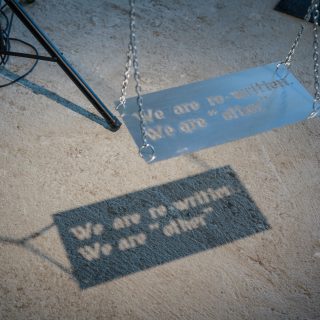
Feature image: Robert Gabris, ERROR – ROMA CORPOREALITY AND THEIR NON-BINARY SPACES (excerpt), photo prints and text on fabric, 2021/2024. A photo-manifesto exhibited in Prishtina in August–September 2024 as part of “Wrapped in the Shadow of Freedom.” Photo by Zana Begolli, courtesy of Sekhmet Institute.
Gazmen Salijević is a Roma human rights activist with over 20 years of experience in civil society and international organizations. He has worked on minority rights, reconciliation, youth support, humanitarian aid, and community integration. He served as Deputy Minister for Communities and Return and became the first Roma chair of Kosovo’s Advisory Council for Communities. He currently advises the President of Graçanica Municipality on economic development and community integration.