Post-Migration and the Transnational Agency of the Balkan diaspora
For years now, the Balkan diaspora has been hotly debated through the prism of belonging that idealises unbroken attachment to the former home and fantasies of return. Rigid economic frameworks have instead scrutinised the spillover effects of remittances and foreign investments on those grappling with a fragile welfare state. Either way, the political history of guest workers, former war refugees, and post-migration generations has been barely addressed, lest they openly contest the broken promises of integration or reveal any transnational postulate of “wokenism”.
In Northwest Europe, “Yugo restaurants” and Balkan-owned local businesses remind passers-by of a history of a country untouched by genocidal wars and epistemic violence that tore Yugoslavia apart and engulfed democratisation in the region. This banal image barely resonates within “other diasporas”. Most Albanians, Roma, and Bosniaks – all distinct groups but at times bound together by religious identity and former citizenship – share a much darker history of political subordination and economic inequality that caused migration and negatively influenced ensuing experiences of integration elsewhere.
Research on belonging may thus carry the risk of pre-empting this history from its political implications, eventually whitewashing or knowingly bypassing the troubling continuum along which migration and dislocation have been shaped.
A New Awakening?
The echoes of war from Ukraine to the Middle East, and Gaza in particular, resonate deeply across the Balkan diaspora. The reverberations of war have become the entry point for exploring the constructive and pragmatic responses of post-migration generations vis-à-vis anti-migration policies and “remigration” discourse. Images of dislocation and violence going viral on social media quickly reactivate existential fears and reopen unhealed wounds, especially among those who have inherited similar stories of migration and conflicts. If former guest workersand war refugees remain rather passive yet emotionally exposed to the current turmoil, post-migration generations no longer bear witness.
Their “Balkan history” politicises them. Their feeling of in-between-ness fades away soon after they realize that their marginal voices echo more powerfully beyond the Balkan echo chamber. Yet active participation in a cascade of diverse solidarity campaigns, ceasefire rallies, and social media initiatives adds a burden to their transnational identity. The heterogeneous, at times contradictory, and ephemeral nature of grassroots networks supporting “Ukraine”, “Gazans” and other intersectional forms of solidarity, allows them to realise that the countries which welcomed their grand/parents—where they themselves were born and raised—have not learned much from the history of violence and destruction. All these mobilisations are not simply an emotive issue nor a matter of political participation alone. Rather, they all constitute a microcosm through which post-migrant generations perceive and interpret injustice.
Moreover, as they recollect the past, their heritage ceases to be politically neutral. Some lump family (hi)stories of migration and violence together with those of other same-age peers from the Middle East, Asia, and Africa. Others fully rely on their post-memories, to use Marianne Hirsch’s paradigm[i], to double down on Europe’s (racial) biases toward Balkan communities – the “wretched of Europe”. They liken the West’s hesitancy to rescue Bosniaks in Bosnia and Albanians in Kosovo in the 1990s to the West’s moral bankruptcy over the current geopolitical turmoil. The contrast between the West’s welcome policy for Ukraine’s war refugees and the earlier scepticism toward refugees arriving from the post-2015 Balkan route, as well as between the support for Ukrainian resistance and its laisser-faire approach to Israel’s actions in Gaza, lends support for the idea of Western double standards.
Although such mnemonic recollections often contradict history, this new web of post-memories reveals the too-often untapped transnational role of Balkan diaspora as composed of new agents of contestation against democratic backsliding and transnational injustice.
Кичево’s or Kërçovë’s “Generation After”?
A transnational and genealogical reading of the history of Yugoslav migration to Northwest Europe better illuminates the socio-economic and political causes that largely conditioned labour migration before the violent eruption of interethnic wars in the 1990s and early 2000s. This historical lens reveals broader patterns of minoritization and marginalisation that similarly exploit and depoliticise the Balkan diaspora along the Northwest-Southeast European axis[ii].
Germany began to welcome Yugoslav workers in the mid-1950s – a process that continued until the “Anwerbestopp”of 1973. Another wave of Yugoslav labour migrants occurred during the 1970s and 1980s, when many Albanians sought better social and financial conditions in Germany as inequalities and divisions deepened along socio-economic and national lines. Just as stratification in Yugoslavia limited access to state employment and social benefits[iii], the very acceptance of gastarbeiter as new city dwellers in Germany was soon challenged by nesting forms of racism that had persisted after the Second World War. Following 1989, the violent period of the Baseballschlägerjahre – namely, “the baseball bat years” – particularly affected the Balkan diaspora, among others. The racist and far-right attack in Hanau on February 19, 2020, which took the lives of nine young people with Balkan migration backgrounds, is a reminder of a long-lasting phenomenon whose roots trace to the broader history of European racism.
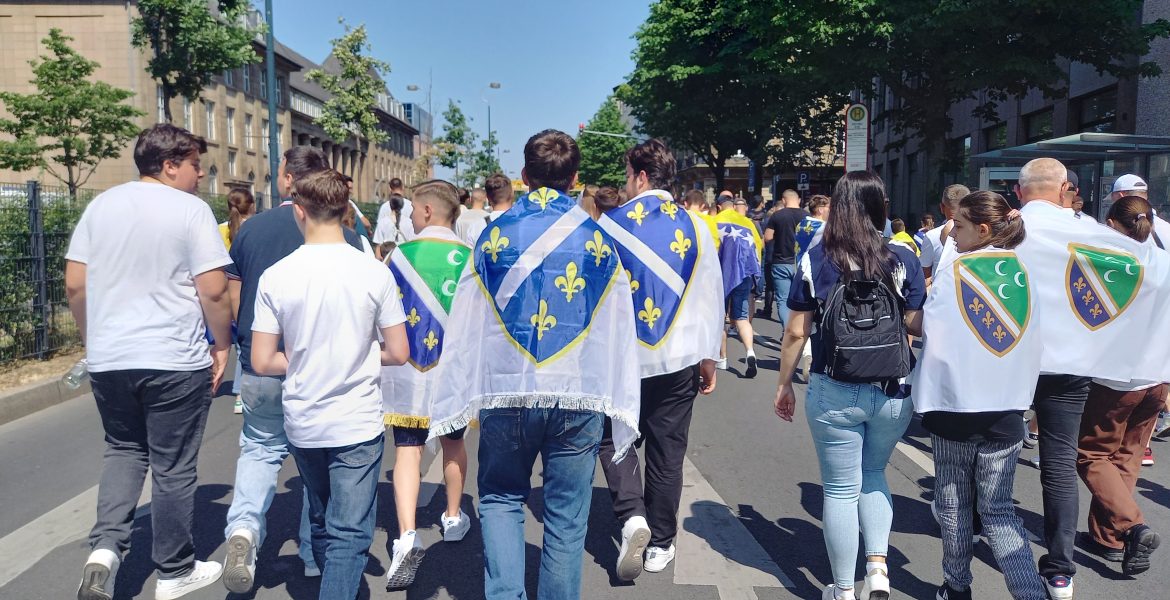
Conversations with young Muslims residing in Dortmund and born to former Albanian gastarbeiter families from Kičevo, North Macedonia, reveal the different modes of former Yugoslav diasporas to counter anti-migration discourse and everyday racism. Post-migration generations pragmatically nurture their identities by often renegotiating their belonging across both private and public sites. Parallels are made between the socio-economic discrimination experienced by Albanians in Yugoslavia and the external ascriptions of petty criminals and migrants to post-migration Albanians born and raised in Germany.
Nonetheless, the Albanian language and family traditions are nurtured in different geographies and political contexts, yet almost jealously preserved. At times, they become a vehicle for processing traumas of migration and coming to terms with the fatigue of integration. Former Albanian gastarbeiter remain anchored in the memories of Yugoslavia and Kičevo, while those born and raised in Dortmund show neither attachment to Yugoslavia nor to North Macedonia. Perhaps Kičevo – or better say, Kërçovë – still occupies an important symbolic place in their lives despite the multicultural history of the city carries poignant reminders of uprootedness. Occasional visits to Kërçovë reactivate a sense of belonging deeply rooted in a history of socio-economic inequalities lasting across borders and time.
Moreover, criticism toward Germany’s societal model of fairness and prosperity goes hand in hand with self-criticism toward Albanian national culture in and beyond North Macedonia. Looking at these two countries relationally, another series of parallels was spontaneously made between the boundaries that keep Albanians and Macedonians distant from one another, and those that likewise shape societal divisions in Dortmund – one of the most segregated urban spaces in Germany[iv]. Albanian-ness goes likewise through critical scrutiny. Among others, gendered dynamics are particularly contested in an attempt to reject (the stereotype of) the Albanian man’s world – one which is a matter only of fathers and sons – and compare the latter with similar exclusionary attitudes of the German (Christian) society. Outside this Albanian (diaspora) man’s world, female interlocutors were more likely keen on interacting with people sharing similar experiences of (post-)migration, thereby renegotiating their belonging in a transnational community where women’s issues and political claims transcend borders and patriarchal dynamics[v].
The “Good diaspora”
There is little doubt that Balkan diaspora often self-reiterates the downward spirals of alienation and dominant hierarchies that they themselves have suffered from. In Dortmund, some proudly recalled the history and culture of Albanians, silently yearning themselves with the values of liberal democracy and therefore “culturally superior” to other diasporic communities in Europe.
This reckoning entails yet another too-often silenced political issue: the discourse of German (Western) political elites mulling unfairly over European debates of security and migration has been largely internalised not only by Albanian elites in North Macedonia, Kosovo and Albania proper, but also by young Albanians. Their (double) citizenship appears to be contingent on silencing one’s own history and “other people’s” history of migration and epistemic violence. The popularisation of the “historical friendship” between Albanians and Italians, as well as Italy and Albania, is instructive.
Although Italy was not been a typical country of migration for former Yugoslavian citizens, the wars of the 1990s and the collapse of communist regime in Albania changed that trend rapidly. The history of the “hunting campaigns” (in Italian, caccia all’albanese) against those Albanian refugees who attempted to flee the welcome centers has been recently consigned to the oblivion. The 2023 Italy-Albanian migration deal and its much-debated externalisation model of asylum procedures not only reproduces EUrope’s racialised power imbalances forged in the colonial ways of seeing and engaging with non-EU countries such as Albania, but it also leaves unaddressed, and almost uncontested, the complex political and colonial relations of Italy with Albania in the Adriatic Sea and the Mediterranean region in general.
While Albania’s EU accession seems largely conditioned by Italy and Euro-Atlantic power dynamics[vi], the same thorny question of EU integration (including North Macedonia, by extension) has been marginally contested by the young segments of the Albanian diaspora in Italy. For instance, Zanë Kolektiv was born as a self-organised and independent group of young Albanian activists in Padova, northern Italy, whose transnational stances and critical voices have reached the Italian debate and Albania proper. Their anti-racist, and anti-fascist identity recuperates their lived experiences of post-migration generation engaging critically with the legacies of colonial relationships between Albania and Italy.
Shifting the Paradigm?
Viewed from multi-sited perspectives, a much longer history of migration also reveals a broader geography of inequality along South-eastern and North-western Europe. Yet again, this transnational perspective recuperates the historical experiences of displacement, discrimination, and integration that are embedded in national peculiarities, context-specific interactions and shifting meaning of racialisation. Taken together, they all constitute the epistemic viewpoint for re-understanding “Europeanness” and Europeanisation more critically.
The sense of belonging of the post-migration Balkan communities seems no longer a project in the making but rather being activated and transformed by new postulates of solidarity and grassroots activism. What political agency may these post-migration generations ultimately produce remains an open question. Without a doubt, however, these same post-migration generations will contribute to the future of Europe and the Balkans by challenging the mutual image of both regions being passively exposed to external instabilities.
Francesco Trupia, PhD
Adjunct at Nicolaus Copernicus University in Toruń, Poland
Postdoc at CEU Democracy Institute in Budapest, Hungary
[i] See more: Hirsch, M. (2012) The Generation of Postmemory. Writing and Visual Culture after the
Holocaust. New York: Columbia University Press.
[ii] See also: Trupia, F. (2025) “Here, There, Nowhere: Urban Eviction as State Erasure of Roma Rights and Heritage between Bulgaria and Germany” Comparative Southeast European Studies, 73(3), 416-429. https://doi.org/10.1515/soeu-2025-0055.
[iii] See more: Archer, R., Duda, I., and Stubbs, P. (2016) Social Inequalities and Discontent in Yugoslav Socialism. London: Routledge; also, Trajanovski, N. (2022) Remembering the 2001 Armed Conflict in Macedonia: Modes of Commemoration and Memorialization. Belgrade: Humanitarian Law Center.
[iv] See more, Sürig, I. and Wilmes, M. (2015) The Integration of the Second Generation in Germany Results of the TIES Survey on the Descendants of Turkish and Yugoslavian Immigrants. Amsterdam: Amsterdam University Press.
[v] See more, Trupia, F. (2025). On Being Young, Muslim, and from the Balkans: Perspectives of Belonging in Belgium and Germany. Journal of Intercultural Studies, 46(4), 613–628. https://doi.org/10.1080/07256868.2025.2531768
[vi] See more: Coloniality by proxy: Albania’s road to Brussels runs through Tel Aviv. UntoldMag. Available here.