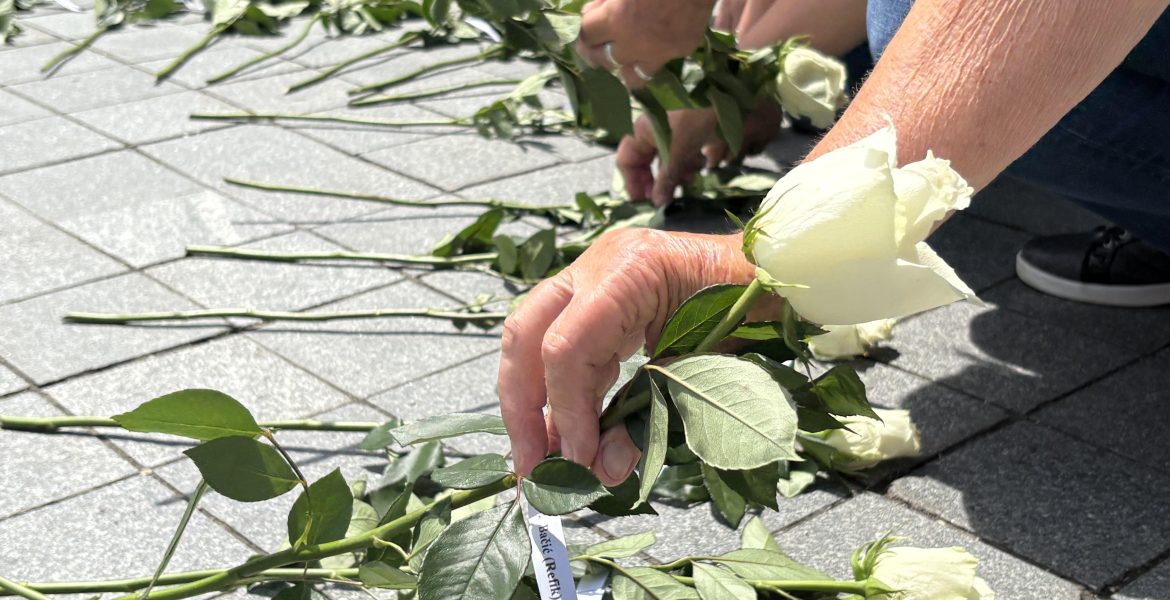
It is a sunny May morning in Prijedor. The summer heat could already be felt from the early hours of the day. We entered the premises of the KVART Youth Center. The hallway was crowded, there was a sense of urgency in the air, everyone had their own tasks and moved from room to room. We passed through the first door on the left and saw a large table covered with white roses. Some might find it unusual to see so many of them in one place. But today is White Armband Day. Each of those roses represents a murdered child from Prijedor. There were 102 of them on the table. That is how many children were killed in Prijedor during 1992 and 1993.
Activists from the “Because It Concerns Me” Initiative carefully removed the thorns from the roses. Others used staplers to attach slips of paper bearing the names of the murdered children. Parents of the murdered children were also present in the room. Their presence reminds us why all of this is being done and why the struggle for remembrance matters. Although more than three decades have passed since the crimes were committed, the City of Prijedor has, for thirteen years now, refused to allow the construction of a memorial for the 102 murdered childre.
After half an hour, it was time to head toward the Old Town, where the central gathering was taking place. Before leaving, we lowered a large white sheet from the window of the KVART Youth Center. The KVART premises are located on the city’s main pedestrian promenade, and the sheet is visible to everyone passing.
By the time we arrived in the Old Town, the area was already filled with people. Activists from the “Because It Concerns Me” Initiative, together with representatives of the Initiative of Parents of Murdered Children of Prijedor, were distributing white armbands. People tied them around their arms in silence and with respect. White ribbons bearing the names of the murdered children were tied to the bridge, leaving a visible mark of remembrance in a city that, even after all these years, has still not erected a memorial to the murdered children. All 102 white roses had already been distributed.
Kolona se lagano postavljala i isticali su se transparenti „DAN BIJELIH TRAKA BUDIMO LJUDI“, „ZAHTJEVAMO SPOMENIK ZA UBIJENU DJECU PRIJEDORA“, „JER ME SE TIČE“.
Hundreds of people lined up and the march set off toward Prijedor’s main square, where the central commemoration of White Armband Day and the laying of 102 roses bearing the names of the murdered children were to take place.
The procession gradually took shape. At its front were banners carrying the messages: “White Armband Day – Let Us Be Human,” “We Demand a Memorial for the Murdered Children of Prijedor,” and “Because It Concerns Me.” Hundreds of people took their places in the march and then proceeded in silence toward Prijedor’s main square, where the central program marking White Armband Day was held. In the square, 102 white roses bearing the names of the murdered children were laid as a reminder of 102 childhoods cut short and as a continuing demand that Prijedor finally erect a memorial dedicated to the youngest victims of the war.
Fikret Bačić, a representative of the Parents of Murdered Children of Prijedor, opened the ceremony with a speech: “I stand here with you every year, wearing a white armband, and I continue to repeat the justified demand of us surviving parents that a memorial be built in Prijedor for the murdered children of this city. We have stopped believing that any domestic official will stand up for us. Those who are paid to protect human rights laugh in our faces from the comfort of their offices. Attempts by certain ambassadors and other international officials to support us have produced no results. In our case, it has become clear that the international community, despite all the instruments at its disposal, is powerless even to arrange an ordinary meeting with the mayor,” Bačić stated. “However, we have you on our side—you who come here every year on this day. You are our strength. And not only you, but also all the well-intentioned people around the world who today mark White Armband Day and remember the 102 murdered children of Prijedor. Yet your support has so far not been enough for the local authorities to issue a permit for the construction of a memorial. That is why we continue to place our hopes in something that has the greatest power to change people and influence their decisions. Despite the fact that war criminals killed the most precious thing we had, we have not stopped believing in humanity,” Bačić emphasized
In his address, he stated that the time had come for Mayor Slobodan Javor and the city authorities to demonstrate humanity and responsibility toward the city and its citizens. He emphasized that the demand for a memorial to the murdered children is not a plea, but a just and reasonable proposal that should be in the interest of the entire community. “By refusing to continue a dialogue with us and by failing to approve the construction of a memorial to the murdered children, you have turned this issue into the greatest stain on this city since the war. The injustice you are inflicting on us, the parents of the murdered children, has become known in almost every corner of the world,” Bačić said.
The KVART Youth Center launched a public competition aimed at memorializing the children killed in Prijedor during 1992 and 1993. The competition was initiated as an expression of support for the Initiative of Parents of Murdered Children, which has advocated for the construction of a memorial since 2013, and as a step toward gathering the necessary documentation and obtaining the required permits for the construction of a memorial dedicated to the youngest victims of the war.
“A competition has been announced for the conceptual design of the future memorial to the murdered children. If you know any artists, designers, or architects, encourage them to participate and submit their proposals. That memorial will reflect their humanity and will mean that this city has finally become a city for all the people of Prijedor, both those who are alive and those who never had the chance to be. The memorial will not bring our children back, but it will give us, their parents, the feeling that this city mourns all murdered children together with us, regardless of their names or the families they came from. We want this memorial to serve as a warning that war must never happen again and that no one should ever kill anyone’s children in our Prijedor again,” Bačić said.
On behalf of the “Because It Concerns Me” Initiative, the organizer of the White Armband Day commemoration in Prijedor, Nemanja Tubonjić from Banja Luka addressed those gathered. In his speech, he emphasized that White Armband Day is an act of protest, but that this protest is not directed solely at the fact that the authorities in Prijedor have still not approved the construction of a memorial to the murdered children, an issue previously addressed by Fikret Bačić. He stressed that it is also a protest against the denial of crimes, against injustice, and against the decades-long absence of a responsible attitude toward victims and their families.
“Today, we are protesting here because, in this city, only events related to the military and the police are officially commemorated. Monuments are erected to those who died with weapons in their hands, wreaths are laid, speeches are delivered, while civilian victims of war are not mentioned at all. In Prijedor, both in the most recent war and in the Second World War, far more civilians than soldiers lost their lives, yet to this day they have not received even the smallest memorial in the city,” Tubonjić emphasized.
In his address, he stated that remembrance of the victims can be cultivated with dignity and without political speeches, national symbols, religious insignia, or party messages. He pointed out that the names of the murdered children were written on the white ribbons attached to the bridge from which this year’s procession began, emphasizing that the bridge symbolically connects the Prijedor of the past—marked by war, suffering, and destruction—with the city as it exists today.
“We carried the children’s names on white ribbons and on white roses arranged in a symbolic circle in this square. That circle represents a memorial in the making. Through the loudspeakers, we hear the names of the murdered children, restoring to them, if only for a moment, their identity and presence in their own city. From the very beginning, we have stood alongside the initiative of the parents of the murdered children, and we have made the construction of a memorial our primary goal until it becomes a reality. We will not grow weary in our struggle and in our justified demand that the murdered children receive a permanent memorial in their own city,” he explained.
At the end of his speech, he stated that a clear message is being sent from this place against the killing of children, regardless of where such crimes occur. He stressed opposition to all wars and armed conflicts, emphasizing that it is long past time to stop viewing war as an acceptable means of resolving disputes. He also underlined that responsibility for starting wars must not be forgotten and that those who initiate them should be remembered for the consequences they leave behind.
Melani Isović, a journalist and activist from Banja Luka, was born on July 15, 1992. She is employed at the KVART Youth Center. Through her work, she has consistently focused on issues of human rights, gender equality, and the position of marginalized groups. A particular focus of her engagement has been the fight against discrimination, the advocacy of equality, and the creation of space for the voices of those who are often excluded from society as well as from decision-making processes.
Translated by Bogdan Petrović