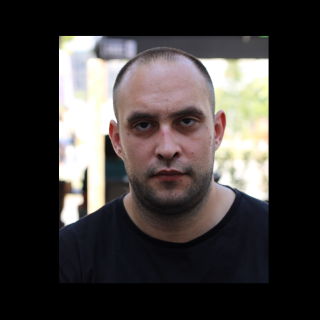
Zgjim Zyba’s exhibition touches on the concepts of memory and manhood in war.
On the sixth floor of the Grand Hotel in Prishtina, the sound of leaves and water dominates, as if flowing from mountain springs. Four rooms house parts of the exhibition “There is a Dream I Have in Which I Love the World” by the contemporary artist Zgjim Zyba.
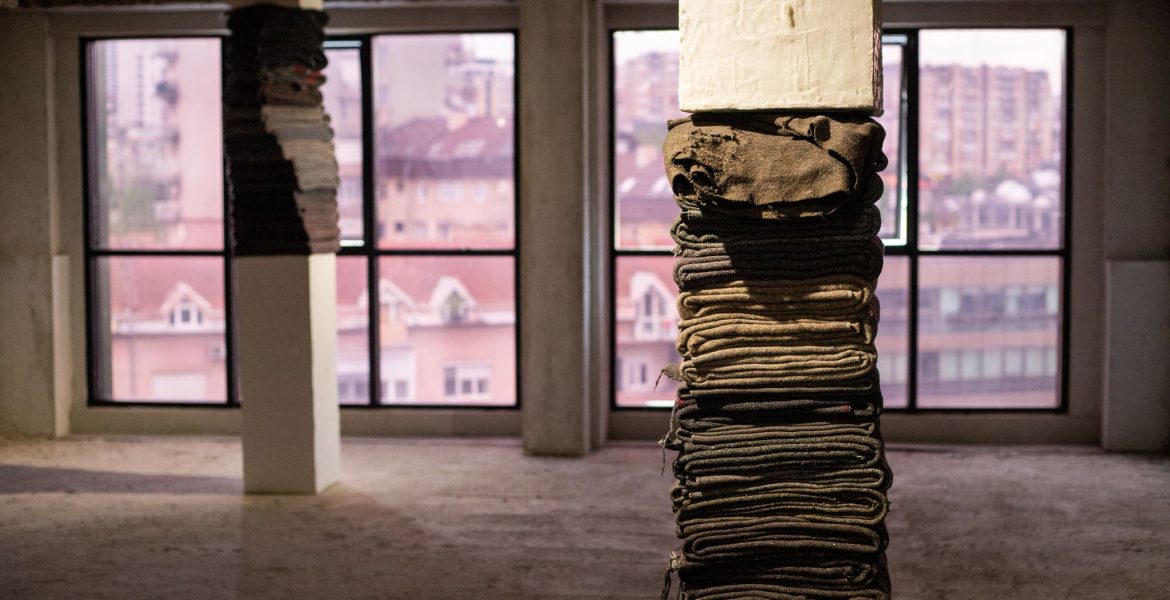
The most identifiable objects of this exhibition are the blankets, or as they are called in the memory of many, the aid blankets, around 130 of them, which Zyba has collected across various places in Kosovo this year. These blankets were donated to Kosovars by international organizations during the 1998–1999 war in Kosovo.
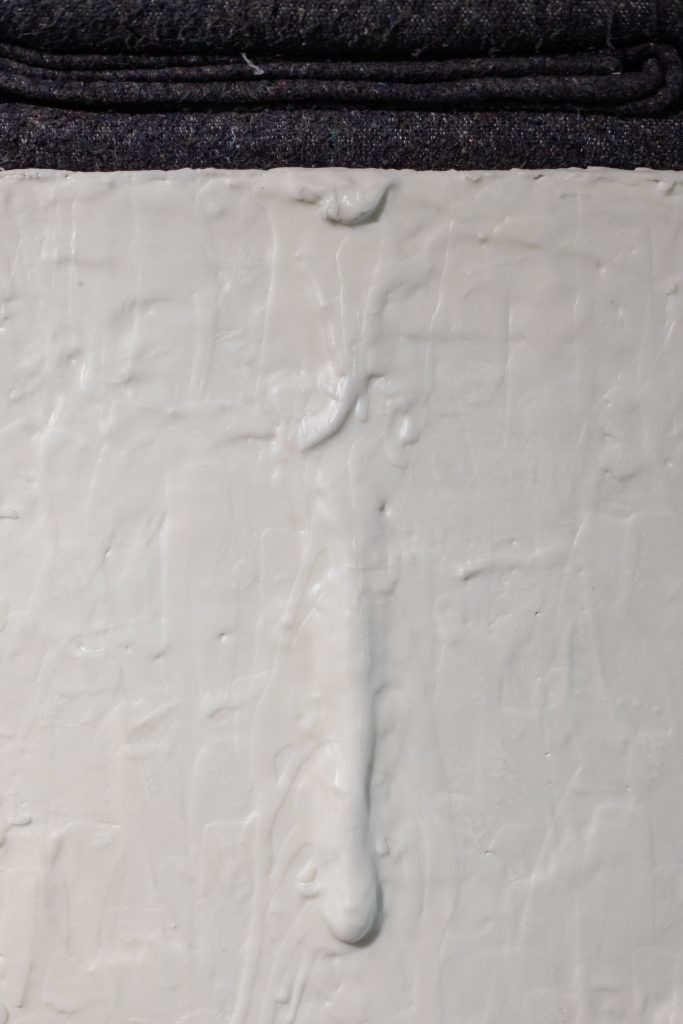
For Zyba, 32, these blankets, all of them gray, that “irritate the body” because of their rough material, embody the heavy burden of Kosovars’ traumatic wartime history. Visitors to the exhibition will see them piled and pressed between pillars made of candle wax that traverse a kind of geography of war trauma in Kosovo.
“I’ve used the blankets as a bridge between what happened here and what we are as a society,” Zyba said. “It connects me to how I see the collective, the way I see my personal and collective traumas, and how I perceive who causes wars and who narrativizes it.”
His awareness of Kosovo’s socio-political reality has been shaped by a system of self-protection that Zyba has had to build for himself since childhood.
“When a person is five years old, they usually know how to speak, they know the language, they know who the family members are, they know their own home, who they belong to,” he said, “and you have some kind of awareness, you know what protection is and what danger is.”
Instead of his childhood being built on freedom and curiosity about the world, it was shaped by a system of occupation and the fear of death. “Instead of being curious about life, you’re curious about protecting life, because the war, the enemy is on your mind.”
This violent disruption of his childhood has become a primary catalyst for his creative artistic endeavors. Today, Zyba creates unconventional artworks through which he attempts to intertwine individual and collective memories of war trauma, while highlighting the experiences of women and queer people during war.
Through the use of blankets, lullabies and knitting needles, Zyba touches on and visibly confronts concepts of manhood and heroism forged in relation to the Kosovo war — those which heritage and museum studies scholar Laurajane Smith calls “Great Men narratives” or “Great Hero narratives” in her book Uses of Heritage, According to Smith, official history is filled with such accounts that leave no room for the visibility of ordinary people’s stories about the dark heritage of war.
His exhibition, supported by the Ministry of Culture, Youth and Sports (MCYS) and the Hajde Foundation, a non-profit cultural organization that supports Kosovo’s art scene, remains open to the public from April 23 to July 22, 2026. This exhibition, curated by the renowned Turkish curator Övül Ö. Durmuşoğlu was realized in close collaboration with co-producers Dardan Hoti and Lendita Idrizi from the Hajde Foundation, and is the result of four years of research by Zyba.
But the roots of this exhibition stretch back even earlier, to his childhood in Bukosh, Suhareka, and to how memories of war shaped his worldview and his ideas about the body, identity and trauma.
The blankets as carriers of trauma, in time and space
In the first room of the exhibition, visitors encounter a brightly lit space where the first pillar, wrapped in blankets, stands. For Zyba, this space functions as the emotional and conceptual starting point of the entire exhibition, because here the blankets of his own family are gathered, which were first exhibited in 2022, in Venice, as part of a residency he won from the municipality of Venice and the Bevilacqua La Masa Foundation in Italy.
He considers that exhibition, based on the memories of his grandmother and his family, to be the inspiration for his exhibition “There is a Dream I Have in Which I Love the World.”
His current show is filled with bare construction pillars and structures, the use of which, Zyba says, was inspired by the views from the sixth floor of the Grand Hotel. From this level, the city’s collective environment, according to him, resembles the processes of reconstruction and reorganization of life in post-war Kosovo.
Zyba has covered the pillars with wax, linking them to the way Albanian families used candles during the war to make light, while covering windows with blankets so as not to be detected by the Serbian army at night.
“The candles and the blankets reflect the trauma we still need to reflect on and process, collectively, as well as the resilience to face it,” Zyba said.
From the first room, which Zyba sees as a reflection of his individual memory, the exhibition leads us into a larger space that he calls a representation of collective memory. Here, as a result of his research, he has multiplied the number of blankets collected, transforming the space into a collective archive of war, organized by regions and into the itineraries of displaced Albanians who were sheltered in villages during the Kosovo War.
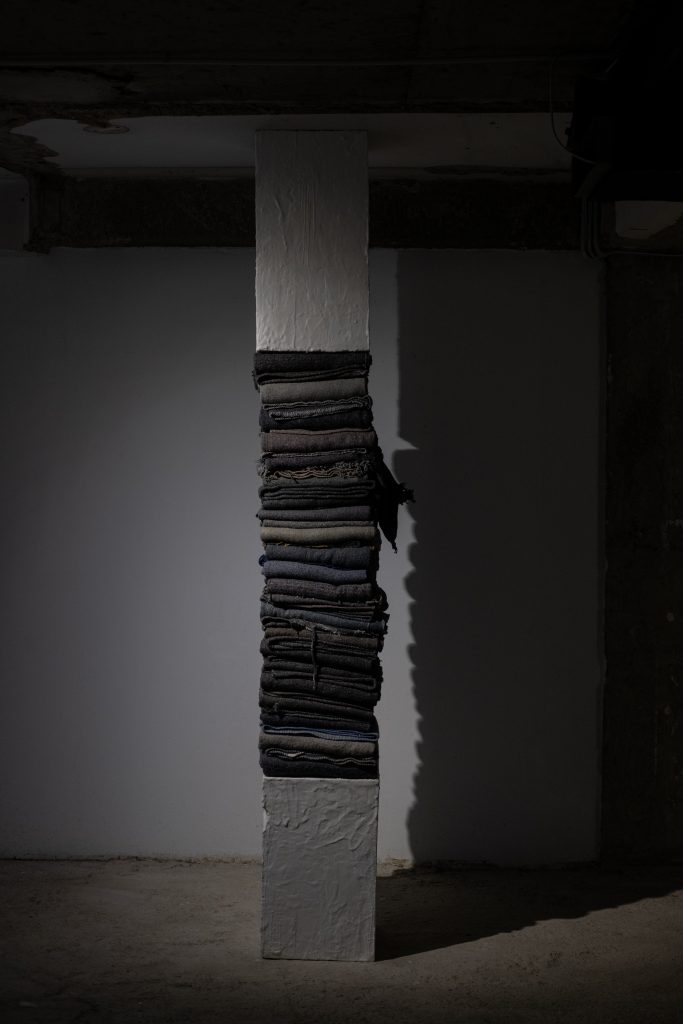
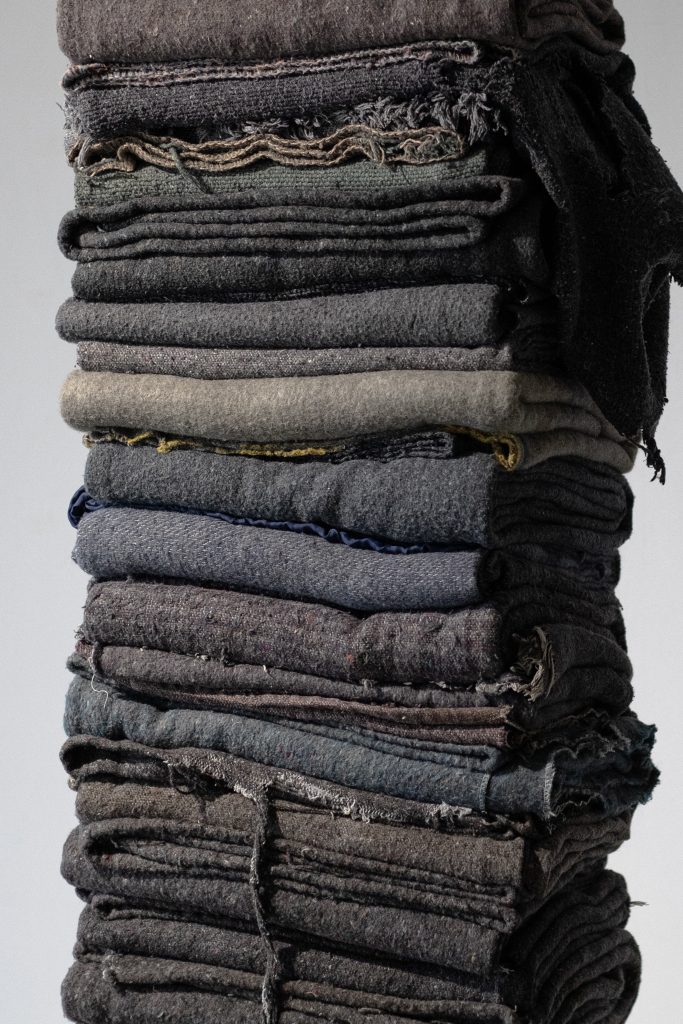
Photos: Hajde Foundation
Throughout the exhibition, the placement of the blankets emphasizes and recalls precisely these displacements and flights, while sound functions as another layer of memory. In collaboration with composer and sound designer Dren Suldashi, Zyba constructs a soundscape based on natural sounds: breathing, leaves, walking and creaking.
“The return of Albanians to Kosovo, the way they crossed from mountain to mountain… the wind, walking on leaves, the creaking. All of these served as guideposts for people at war, in the mountains,” he said.
Before the exhibition, in early 2026, Zyba had circulated a public call on his social media, through friends and through the Hajde Foundation as well, inviting people to share with him the blankets that they had held on to from the war.
During the first months of this year, Zyba had also met with history professors and students and visited primary schools, where he spread the word that he was looking to collect blankets from the time. He encountered unprecedented enthusiasm from people eager to collaborate with him, providing blankets from all corners of Kosovo.
In this way, in addition to securing the blankets for his exhibition, he had managed to initiate numerous discussions about their meaning in the schools and cities where he had conducted his research, about the ways war is spoken about and remembered.
“The blankets multiply as a mode of expression,” he said, “taking into account the places in Kosovo in which they were stored, as stations in the geographical sense.”
The blankets, individually, carry different sub-stories. Two large pillars connect with one another vertically, holding between them three blankets donated by a woman from Krusha e Madhe, whose husband, brother-in-law and father-in-law were killed during the war.
Zyba decided that her three blankets should stand on a single pillar, as a separated emotional unit within the exhibition. “I had an extremely strong emotional connection with this woman,” he said. “I didn’t want to provoke her traumas, so our relationship has been based on sincere and safe conversations, through which I have respected her memory.”
In a corner of this space, another blanket stands completely alone, stretched out and abandoned in the space. For Zyba, that blanket represents the way many objects were found when people returned after the war: thrown across yards, covered in oil or gasoline, repurposed for entirely different functions, completely detached from the painful past.
Navigating through the exhibition’s spaces, Zyba also reflects on the lack of institutional infrastructure for treating trauma in post-war Kosovo. According to him, post-war aid has focused mainly on physical reconstruction: “There has been aid only for constructional aspects, material architectural aspects,” he said, “and never any help that deals with our minds and bodies.”
To the question of why many families have held onto the blankets for more than two decades, he answers by speaking of a state of fear that continues even after the war.
“Maybe it can happen again,” he recalled the words of one family that had donated 11 blankets, almost unused since the war. “They used to say: ‘You never know.’”
Knitting as resistance
From the collective, Zyba’s exhibition takes us into a third room, which presents one of the most personal spaces in the show, based on his intimate memory and serving as the connecting point between his identity as a queer man and the prevailing narratives about the war.
With knitting needles, Zyba starts to interweave his gender identity with the narratives about the war. As a child, he recalls having an aesthetic curiosity about how the women in his family, specifically his great-grandmother, worked with knitting needles. However, when he had shown interest in learning to work with them, he recalls that his great-grandmother told him, “If you learn to knit, your rifle won’t shoot at war.”
In retrospect, Zyba sees in this sentence the entire architecture of patriarchy in post-war Kosovo, the gendered division of labor, the glorification of male fighters, and the attempt to discipline any behavior considered a deviation from the norm and masculinity, including knitting.
“I didn’t know at first why I wasn’t allowed to knit,” Zyba said. Later, however, he begins to understand this sentence. “I understand the phrase as triangular, questioning art, manhood and war,” indicating how this kind of phrase, perpetuated through cultural and gender lenses, carries enough significance to affect three distinct areas: an individual’s artistic style, the way one remembers and what it means to identify as male within a patriarchal society.
As a symbol of this memory, Zyba has placed two completely opposite objects in front of each other: an AK-47 rifle wrapped in a blanket worked with knitting needles, facing a handmade blanket with motifs of his baby footprints.
This part of the exhibition reflects on the way gender roles and the concept of manhood have been constructed in post-war Kosovo. “As a male, you know from birth how to protect yourself,” he said. “Protection comes from the rifle.”
He doesn’t stop there; he reflects on the masculine worldview of this weapon by transforming it and clothing it with material knitted by seamstresses from the women’s association Fortis in Kosovo, with whom Zyba has collaborated, describing this co-creation as an extremely fulfilling part of the exhibition.
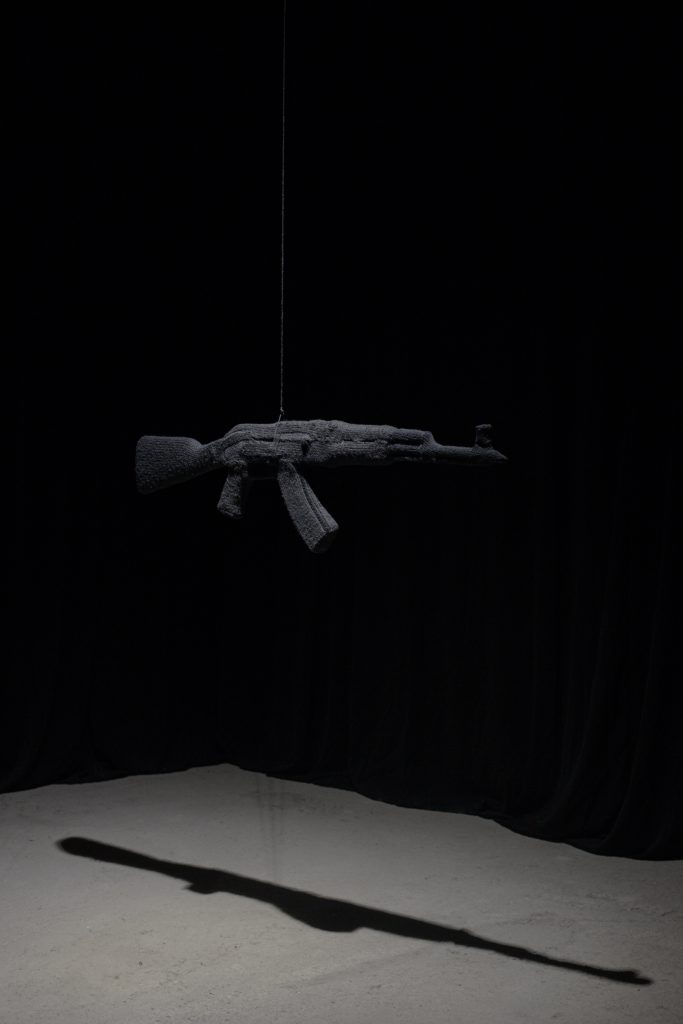
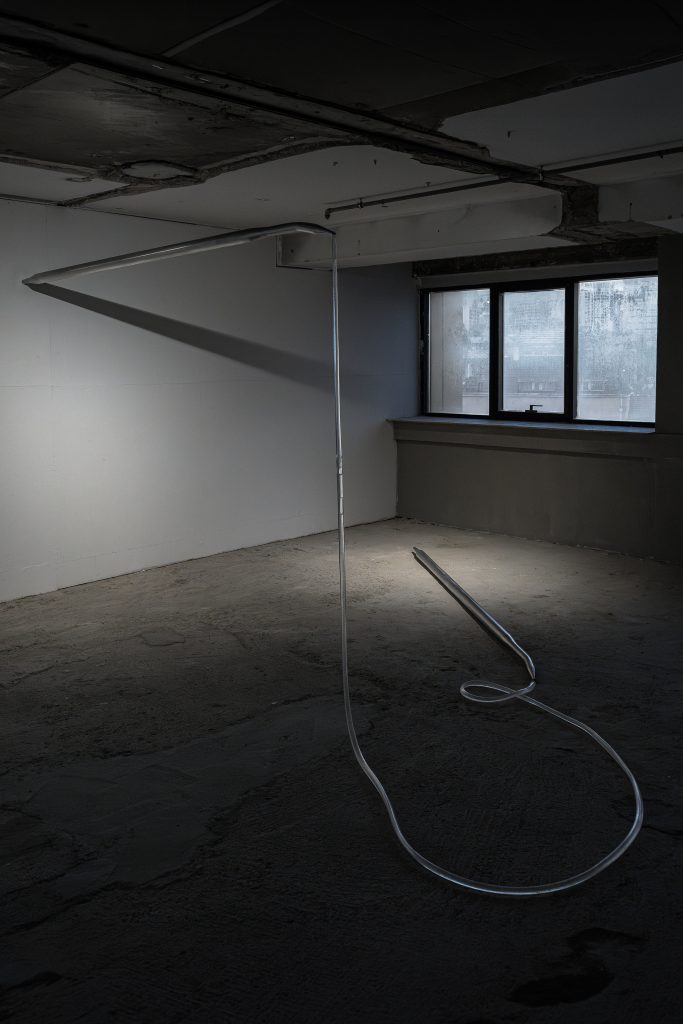
Photos: Hajde Foundation (left), Esko Duraki (right)
By enveloping a weapon, a symbol rooted in force and aggression, in the traditionally feminine craft of knitting, Zyba intentionally provokes conventional portrayals of Kosovar masculinity.
Through this interweaving of symbols, Zyba challenges the prevailing theory that protection and resistance in wartime only exist if they are manifested through weapons or militaristic masculinity. He attempts to make room for the narratives and experiences of war, from men who do not identify with this type of masculinity, or, in fact, with any typical type of it.
“I try to give these narratives another turn,” Zyba said. The symbolic transformation of these representative elements of heroism and manhood becomes a pretext for raising discussion about the experiences of war and post-war, of men and women, queer people, who have not felt that they belong within the frameworks of gender and sexual binarism in Kosovo.
Facing the weapon stand, the blankets bear motifs of infant footprints, resembling those his great-grandmother made when he was born. “I decided to create the same spiritual warmth that she gave me at that time. My grandmother made the same footprints for my sister as well, who was born during the war period,” he said.
He notices that one of the footprints he has drawn on the blankets is missing its lace. “My mother told me that the absence of the lace always reminds her how, during the war, some managed to return home, while others never did.”
In the final room of the exhibition, Zyba presents two large aluminum knitting needles, which he describes as the exaggerated dimensions of traditional knitting needles. He sees them as another form of weapon, not for war, but for protection and reconstruction.
“A new weapon of protection,” he said, “in honor of the women, who had the patience and who were the main facilitators enabling the reorganization of the community after the war in Kosovo.”
Through them, he attempts to shift attention from heroic narratives of war toward the invisible emotional and physical work of women in the post-war period.
“So many women still suffer in their emotional expression,” he said.
For him, both embroidery and knitting are not only aesthetic practices or traditional crafts, but stories of gendered labor and patriarchal division of roles.
This reconceptualization of knitting needles and handwork as tools of resistance finds a powerful resonance in the book by scholar Joseph McBrinn, “Queering the Subversive Stitch: Men and the Culture of Needlework,” to which Zyba refers several times theoretically. In this book, McBrinn documents how textiles and sewing have historically been used as subversive practices to challenge strict gender norms and to heal collective traumas in moments of crisis and war.
By shifting attention from the grand narratives of hyper-masculinity during conflicts, just as Zyba does in his exhibition, the book argues that work with yarn and knitting needles has often served as an alternative terrain of political expression for historically marginalized subjects, including queer people and women. McBrinn emphasizes that across many political contexts, this craft has served to confront emotional silence and document traumatic experiences that official historiography tends to erase.
Photos: Hajde Foundation
In the context of collective memory in Kosovo, the appropriation of these traditionally gendered practices takes on a double liberating dimension. On the one hand, as McBrinn notes, craftwork is portrayed as an instrument of patriarchal division of gender roles, where women were tasked with contributing to the “intimate” or invisible spheres of the home. On the other hand, when a queer artist enlarges knitting needles to the size of weapons and calls them “weapons of protection,” knitting is stripped of its passive role and transformed into a political act of women’s strength. In this way, Zyba tells us that knitting is not simply an aesthetic practice but also serves as material testimony to spiritual and social reorganization.
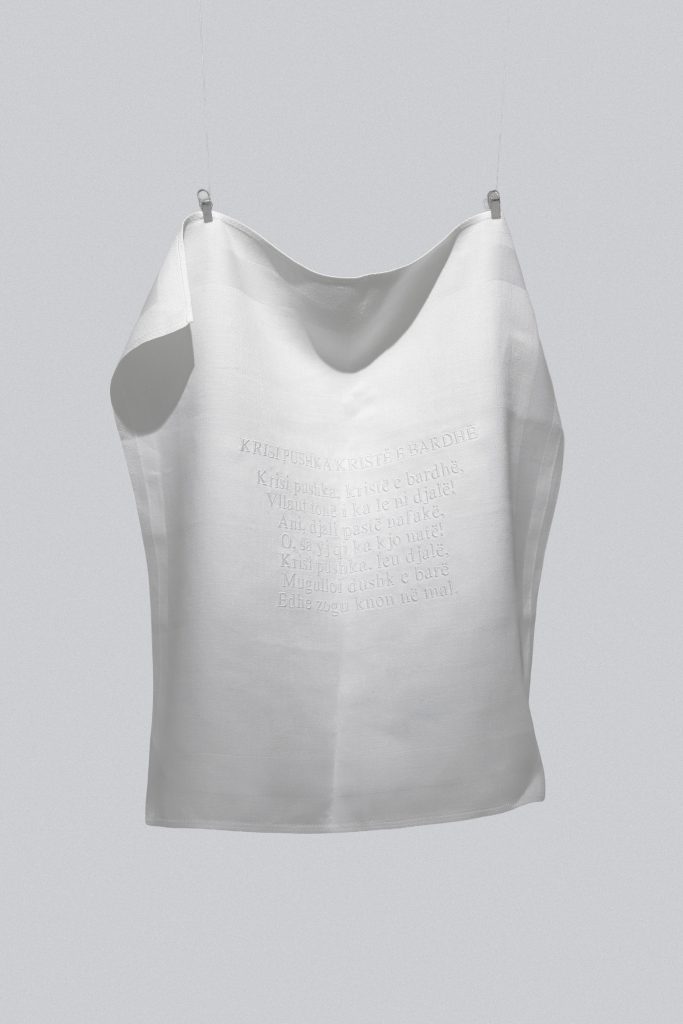
At the end of Zyba’s exhibition, visitors are left feeling strange, having passed through a memory that is as individual as it is collective, belonging not only to someone but to everyone. A hanging towel, embroidered with a lullaby published by the Albanological Institute of Prishtina in 1982, marks the end of the exhibition.
The lullaby “Krisi pushka kristë e bardhë” (The rifle blasts, blasting white), celebrates the birth of a boy, and encapsulates the weight of Albanian masculinity that is attributed to men from the moment they are born. At the same time, the towel, as Zyba says, is also a symbol of his research process in real time, since the lullaby and the towel are details he has attached to the exhibition as it was coming to a close.
Among the hanging blankets, the pillars with overflowing wax, the sounds of leaves and the rifle knitted with knitting needles, the war no longer appears as a monumental tale of heroism, but as an experience of the body and the mind.
“There is a Dream I Have in Which I Love the World” is an attempt to tell the war differently, from those bodies that usually remain outside the heroic narrative: women, children, queer people, emotional memory and the invisible work of survival.
Perhaps that is why his exhibition does not leave you with a sense of closure. On the contrary, it leaves you with the impression that trauma never fully ends, but can be transformed through memory, art and collective retelling. In the spaces of the Grand Hotel, among the pillars wrapped in blankets, Zyba seems to be searching precisely for this: not to erase the pain, but to make it bearable when it is remembered together, seen, shared, and finally, perhaps, understood.
Feature image: Hajde Foundation
Valmira Rashiti has a bachelor’s degree in Law and Cultural Anthropology from the University of Prishtina.
This article was originally written in Albanian, and is also published also by Kosovo 2.0.