The first country my father was supposed to emigrate to was Germany. A cousin of his had promised to help him find work and get the necessary papers. Everything was set. A few days later, though, someone in his cousin’s family died; he went back to live in Kosovo, and the whole plan fell through.
A few months later, my father decided to emigrate to Italy instead, where — in the early 1990s — obtaining a residence permit was far easier than in Germany. His plan was the same as any emigrant’s: find a job, earn money, stay long enough to save as much as possible, then return home. No one leaves their homeland intending never to return. Everyone dreams of going back one day. Very few ever manage to do so.
My father’s reasons for emigrating were financial. There was less and less work in Kosovo. In what was about to cease being Yugoslavia, in addition to the economy, the political situation was also falling apart. War had already broken out in Slovenia and Croatia. And so my father emigrated when I was not yet a year old.
To his great surprise, when he returned a year later to visit us, I did not recognize him. Although my mother had made sure to show me his photograph every night before putting me to bed, in his absence I had started to think of my uncle as my father. In my child’s mind, my father and his brother had exchanged places. I had no idea who this man was who had suddenly appeared in our home out of nowhere. The one I didn’t want to be held by. He could not be my father — only a stranger.
It was my reaction that convinced him to bring my mother and me to Italy as well. He wanted to give me a better future, not deprive me of a father. And so my mother and I followed him.
The war spread, first to Bosnia-Herzegovina, then to our own Kosovo. My brother was born in Italy, and our family began a new life, a life like the one of so many other immigrant families.
I spent twenty years of my life in Italy. Throughout all that time, one constant that always followed me was a phrase my parents repeated like clockwork: “When things get better, we’ll go back to Kosovo.”
I spent every summer in Kosovo until I turned eighteen. I loved going back, and cried far too many tears each time we had to return to Italy. I, too, dreamed of going back to live in the land where I was born. I was convinced that I would as soon as I came of age.
Then one day, we left Italy for real. We didn’t return to Kosovo, though; we emigrated again. Once more. We headed for Germany, where my father was supposed to have gone in the first place. Because going back to Kosovo made no sense. For all the progress that has been made, Kosovo remains, unfortunately, a country people still leave. Few of us return to rebuild a life there.
It has been ten years since we came to Germany, but only recently have I started to think seriously about what “home” means to me. Growing up, my idea of home wasn’t tied to any specific place: home could be anywhere in the world, as long as my brother, my parents and I were there.
Until one day, my therapist pointed out that we all have a place that smells like home. She asked me if there was a place I never wanted to leave, a place I never wanted to run away from. And there, to my own surprise, in the blink of an eye I answered: “Milan.” Even though I grew up in a small town and only really experienced the city during my last years in Italy — when I commuted there every day to study at the university — in that instant I realized that Milan was the place where I would gladly spend the rest of my life.
What had driven such a swift and confident answer? What effect did it have on me to grow up with two parents who had done nothing but long for and wait for the day they would return to their homeland? Did we truly live those twenty years in Italy, or was it simply an interlude — a long wait for that fateful day? Where did we live those years, really? Now that I have freed myself from all the ties and obligations that kept me bound to Germany, I find myself asking these questions. Now that I could, if I wanted to, return to Italy.
Perhaps that hasty answer was nothing more than nostalgia talking. Perhaps I am simply not capable of claiming a place as my home. Growing up between two cultures and two worlds, people often told me how lucky I was, what personal richness I had at my disposal. Being able to speak two languages, embody two cultures, see the world with two hearts, four eyes.
And it is true, but only in part. Because we, the children of the diaspora, are all caught in the same bind: that cursed feeling that clings to you and makes you believe that you do not belong — to any place, to any story — not fully, not naturally. Cesare Pavese wrote: “You need a village, if only for the pleasure of leaving it. Your own village means that you are not alone, that you know there’s something of you in the people and the plants and the soil, that even when you are not there it waits to welcome you.” But what happens to those who have two villages? To those whose lives have always been cut in half.
Gëzim at home, Jimmy outside. Albanian at home, Italian outside.
Being a child of the diaspora comes with a long list of advantages, especially compared to the children of those in Kosovo who decided to stay, or had no way out. It means growing up in a wealthier country, having more opportunities for education and work. In short, being the child of immigrants means being privileged. That is who I am. And I did nothing to deserve it; it just happened to me.
At the same time, though, it also means growing up with unhappy parents. It means seeing them content for only one month a year, when you go back to Kosovo for the holidays. It means watching them shoulder the humblest jobs just to give you a better future. It means watching them slowly fade, as they forget their dreams. It means taking on the debt of repaying their sacrifices — even though they never once asked you to. You know it is your duty. The least you can do.
And there will always be a higher milestone to reach, an achievement, a victory that will truly — I am sure! — make them happy, at last. So that they can say their son has become someone, in the country where they have become no one.
But even when we give in and manage to accumulate possessions and titles for which — perhaps — it will have been worth it, the question remains: who is the someone we will have become? Being a child of the diaspora means living in a permanent fog of identity, consumed by the exhausting daily work of trying to keep alive both the worlds you inhabit, that inhabit you. Caught in the constant quest to make them fit together, we become translators, peacemakers, bridges.
Being a child of the diaspora means becoming many things at once, all of them packed into a single body — how can we possibly fit them all in? It means stopping every now and then and realizing that you are not quite sure who you truly are, wondering who looks at you and sees something, someone that makes sense. I envy the many around me who seem visible, who can narrate themselves as understandable, detailed, belonging. Me — all scribbles and scattered dots — I want to ask them: is your home where you drew your first breath, or where you have breathed the most?
Every time an Italian finds out about my background, the reaction is always the same: “so you’re Italian!” And without fail, I feel a sting, because that sentence amounts to a forced erasure of my Albanian side. I snap back: “I’m also Italian.”
I grieve over this narrow idea of belonging — one that pulls people like me inside while shutting out so many young women and men with stories nearly identical to mine, but without skin as white as mine. I grieve for them, because maybe they feel more Italian than I could ever manage to, and it reminds me just how many phrases that pass as harmless carry racism within them, the construction and exclusion of the other.
Above all, it reminds me how difficult and complex it is to explain identity: something that puzzles even us, who live its contradictions on our own skin. Many on the outside think they can sum up our existence in a short sentence, a handful of words. Not ours… and perhaps not even their own.
A few years ago, that cousin called my father. They hadn’t spoken in a long time. He asked what my brother and I were up to. Dad told him I had moved to start a master’s degree in a German city called Trier. The cousin’s eyes went wide, disbelieving. Then he smiled and told him that he had lived in Trier. That Trier was precisely where my father was supposed to have joined him.
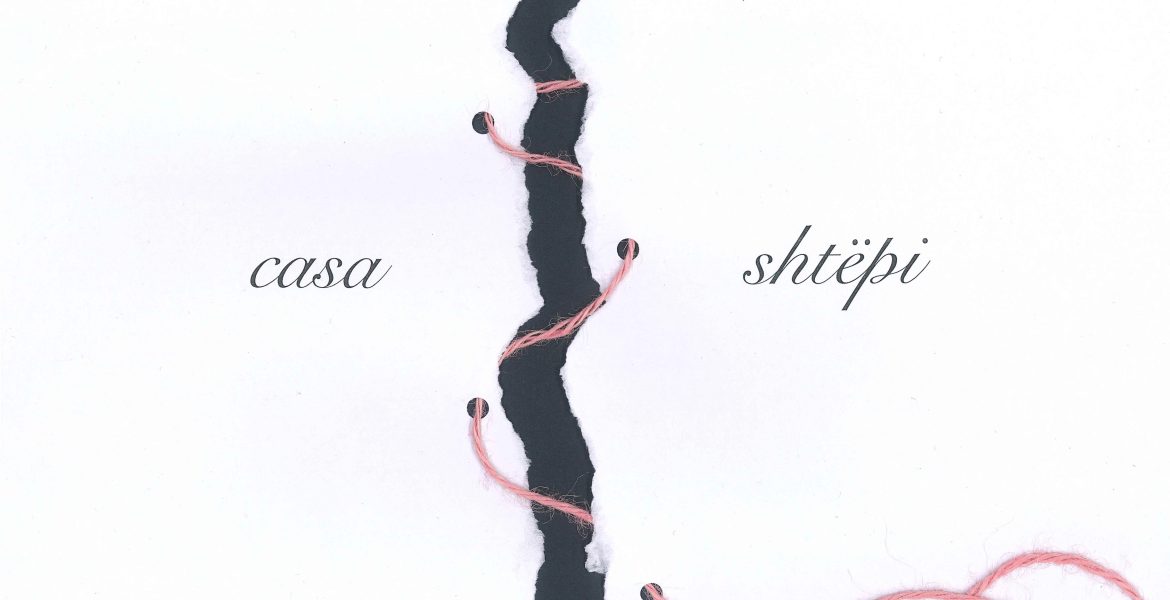
Feature image: Luca Tesei Li Bassi / Pro Peace
Gëzim Qadraku was born in Prishtina, spent twenty years in Italy, and has lived in Germany for the past ten. He is co-founder of La mia vita in valigia (“My life in a suitcase”), a platform for Italians living in Germany, and author of the newsletter Sport e geopolitica (“Sport and geopolitics”).
This article was originally written in Italian and is also published on Meridiano 13.