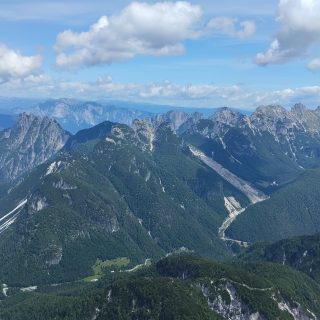

It’s summertime. A time when everyone, no matter where we are from, gathers here in Prespa, where our families originate from. It is a time to see each other, to celebrate the holidays, but also to talk about “our affairs” in the villages. Like every summer in the past decade, I am here in the village of Brajchino, the southernmost point of Macedonia on the slopes of Pelister and close to the shores of Lake Prespa. A region where a handful of villages eke out an existence, inhabited by a few dozen mostly older folks who never made it out—or for their own reasons, stayed behind instead of leaving home in search of a better life. They manage as best they can, without any support from state institutions and some help from their relatives, friends and former villagers who are today scattered around the world in the so-called diaspora, representing almost the only source of financial resources for repairing the old infrastructure in the villages today.
The last thing that is remembered as a state intervention in this region is the asphalting of the roads to the villages sometime in the late seventies of the last century. Since then, state institutions have been visible here when it comes to the exploitation of the forests of Baba Planina and that is about all. More serious investments in the last decade were only those of private individuals who installed two hydropower plants on the Brajchinska River, which greatly endangered the exceptionally rich diversity. The profit goes who knows where without leaving a trace in the region from which it originates.
“To be fair, they did repave the asphalt to our village, but they cut the road width from five meters to three… they made us a bike path,” states a resident of Nakolec village ironically. He further explained that this was part of an agreement with a specific political party that demanded their votes in exchange for the road. “And look at that, they built it… we went from a road to a bike path,” says my interlocutor from the village, laughing.
The only projects currently being implemented that are expected to have an impact on the development of rural tourism are those funded by the EU. With support from the EU Prespa Fund, sewage systems and water treatment plants are being built in several villages, the area’s rich cultural and historical heritage is being restored, the border crossing is being updated, and other smaller projects are underway. These initiatives are meant to bring back hope for Prespa’s future and perhaps keep hold of the few young people who still call this place home.
Meanwhile, the old infrastructure projects from the seventies are aging and collapsing. The water pipes from that time are deteriorating, the village buildings, former village cooperatives and homes, are becoming piles of stones from which they were once built. If any of it is renovated, it is usually a joint initiative of the local population and the diaspora, which in the name of love for the places of their origin, provides the funding so as to do as much as can possibly be done.
“Here in Nakolec, the water pipes rusted, the water became toxic, the springs decreased, so I decided to personally invest to fix things,” says ………. “If we from the diaspora don’t raise money, everything will remain like as it is and eventually it will completely crumble. Last year, it was good, we raised $100,000 to restore the village hall and build a playground so that young people have a place to gather,” says…..
Diaspora funding in Nakolec paid to replace the water supply cistern, gravel the roads, and install a solar system for the water pump to eliminate electricity bills. It also funded the restoration of churches and mosques, cemetery fences, and countless other small repairs vital to keeping the basic functions of the village community alive. Remarkably, when it comes to Nakolec—a village where Macedonians and Albanians have lived side by side for centuries—the diaspora always unites for fundraising drives, completely looking past ethnic origins. “Whether it is for a church or a mosque, Macedonians and Albanians in the diaspora always contribute whatever they can to help rescue our cultural heritage. It belongs to all of us equally, no matter our faith,” says my source, now a retiree in Sweden who spends every summer in the house he left decades ago. Faro wishes they could fix many other things the village lacks, but notes that they have hit their limit. Going through the conversation, he lists every single project realized in the village, adding them up to a far-from-modest sum of half a million euros poured in by the diaspora just to keep the village alive.
During our conversation with Faredin, we also came to the topic of the diaspora’s opportunities to invest in their home country, which could significantly help the country’s economic development. “It’s a long and difficult story,” Fare tells me, recalling the experience of his daughter-in-law Melahate Isai, a successful businesswoman in Sweden. Melahate was born in Macedonia. She was educated there, but has now lived with her husband and children in Sweden for 19 years. She and her husband have their own company that deals mainly with investments. On one occasion, the Swedish ambassador to Macedonia encouraged her to invest in Macedonia.
“North Macedonia still has a special place in my heart and I visit it often. It allows me to closely follow the social, political and economic conditions in the country. Considering that migration is one of the significant factors in the country, I felt that there was a great need for support and care for the elderly. An additional motive was the possibility of opening new jobs, which would provide young people with the option of working full or part-time. I especially wanted to create opportunities for women who may not have a formal profession, who are housewives or already work, but have the need and desire for additional income and additional engagement. That is why we founded the company “DORI CARE”, which offers services for the care and nursing of the elderly, with assistance in their homes.”
Melahate’s investment is worth 200,000 euros and the newly established company is located in Gostivar, which is also Melahate’s hometown.
“We currently have about 12 employees and are experiencing continuous growth. Our expectation is that in the near future we will expand from a local level to a national level and help all mothers and fathers who need care and support,” she said during our conversation.
Melahate believes that North Macedonia has great potential and capacity to attract investors from the diaspora and abroad, but notes that further improvement of the efficiency of public administration is needed.
“Moreover, the state needs to develop a separate and long-term strategy for attracting and supporting investments from the diaspora. Investors need clear procedures, timely information and institutional support from the very beginning of the investment process,” says Melahate.
She believes that in addition to investments that will bring forth development and new jobs, the diaspora could significantly help with the experience and expertise in various fields that they have gained in the countries where they now live.
“Therefore, the state needs to establish a clear plan on how it will welcome the diaspora, how it will facilitate investment conditions, and how it will provide appropriate guidance and support throughout the entire process. The potential exists, but it is necessary to improve cooperation between institutions and investors from the diaspora,” says my interlocutor.
Then we came to the painful part of this topic – the challenges faced by an investor coming from somewhere in Macedonia.
“Unfortunately, I personally faced numerous challenges when establishing and starting the company. The problems started from the very first step – from the company registration and licensing process, to opening a bank account and providing internet services. I did not receive clear and timely guidance on how to proceed. Despite the fact that I studied the legal opportunities and procedures in detail, in certain situations the institutions made it impossible for me to go ahead with carrying out the activities. Although I had a strong bank guarantee, it did not help me conclude agreements with the relevant institutions. The most common answer I received was: ‘The company is new and that is not possible.’ It was truly absurd and discouraging. However, my desire to realize this idea was great and I did not give up. I was determined to succeed!” emphasizes Melahate, making it known that the institutional insufficiency and the mentality of the bureaucracy would not deter her from her intentions.
The Diaspora as a Channel for Importing Civilizational Values
Several years ago, in the Prespa region, I filmed my documentary film “The Prespa Code” dedicated to the tradition of interethnic relations in that region, where, like rarely anywhere else in the Balkans, there is coexistence between the different ethnic communities that have lived in Prespa for centuries. Without going into details, one of the aspects I paid attention to in the work on this film was the genesis of the quality of coexistence of differences that failed to threaten any of the crises in the Balkans. I received an identical answer from several of my interlocutors. They told me that their grandfathers who went to work in America at the beginning of the last century were faced with cultural differences there and created that culture of tolerance towards others, which they then brought back home to their native land. The same thing is happening today, but some things do not take root so easily.
A large part of today’s Prespa diaspora lives and works in Scandinavian countries, Australia, Canada or the USA, countries with a long democratic tradition or societies in which the transparency of the use of public finances has regular accountability to all who participate in creating the budget.
“Every time we are asked for money from the village to do something, we immediately organize and send to help, but then whenever we ask for an account of where, for what and how much money was spent, we have a hard time getting an answer. That is something that is unthinkable in the countries we live in, but that is how things are and it is difficult to convince the people here that these principles of transparency should be respected,” says one of my interlocutors, who asked me not to publish his name so that the locals wouldn’t hold it against him.
Similar examples exist in areas such as environmental protection. Throwing garbage anywhere in the countries where the diaspora is located is legally punishable and culturally unacceptable. My dear acquaintance, and in this case anonymous interlocutor, gave me more examples. Unfortunately, it is not difficult to come across one of the many illegal landfills in Prespa. “We are trying to convince the locals that it is a shame to throw garbage like that and that the greatest damage from such (lack of) culture is to the local community. I tried to give a personal example. I cleaned up one dump but they started throwing a little further and now a new one has been created. You will find plastic bottles everywhere. The institutions that tolerate this are largely to blame here, but the people who live here cannot be amnestied from the blame,” says one of my interlocutors, leaving me with a dose of hope with his comment that younger people are finally starting to understand that whatever lies outside their gates is not beyond the scope of their responsibility.
Finally, let me return to the title of this text with very specific data.
According to official data from the National Bank of North Macedonia: In 2025, personal transfers amounted to around 423 million euros through formal channels (banks and licensed payment systems). The World Bank, which uses a balance of payments-based methodology, registered around 458 million US dollars (around 420–430 million euros, depending on the exchange rate) for 2024.
But this is not the whole story. Almost all economists who deal with Macedonia believe that official statistics significantly underestimate the true remittances, because much of the money arrives: in cash, when emigrants return home; through relatives and friends; and through informal channels.
Therefore, the National Bank also uses estimates of total personal transfers in its methodological explanations, and academic literature often states that the real inflow related to the diaspora is between 1.5 and 2.5 billion euros per year, or about 10–15% of GDP, when informal flows and other private transfers are included.
All examples and statistical data point to the extremely important role that the diaspora has in the socio-economic and even cultural development of society, but no one recognizes that potential and, even less, valorises it in the way that the diaspora deserves.
Borjan Jovanovski, Journalist