For the past three decades, foreigners working in embassies, international civilian and military missions, and NGOs — known in Kosovo simply as “the internationals” — have had a significant impact on Kosovo’s statebuilding, economy, and, perhaps most importantly, some of the most sensitive questions of transitional justice. While they have been praised for bringing international expertise and resources across a range of fields, internationals have also been criticized for using their privileged position in ways that have sidelined local knowledge and weakened local agency and autonomy.
As an international NGO ourselves, we are interested in critically exploring the impact, actions and inactions, as well as the intended and unintended consequences of international actors in Kosovo. We are particularly interested in perspectives that explore both the role of international actors and the role of local actors in relation to, in response to, or in opposition to international actors.
We welcome contributions on themes including dealing with the past, memory, research on the war, advocacy for survivors and victims, Kosovo’s statebuilding as a sovereign and multiethnic democracy, support for inclusive and conflict-sensitive civil society, and any other topics related to transitional justice and conflict transformation.
We are not looking for academic texts. Instead, we encourage blog posts that focus on a single, specific element of this broader discussion and explore it clearly and thoughtfully. We strongly encourage authors to draw from their own lived experiences, connecting wider themes to everyday realities. In the blogs we publish, we value curiosity, honesty, and nuance. Submissions should be between 1,000 and 1,500 words and written in English.
As inspiration for your blog, you may wish to consider one or more of the following guiding questions:
- When did the internationals enter your life? What is your first or strongest memory of them? What impact did their presence have on your life and your surroundings?
- In what ways do you think internationals have influenced how memory work and transitional justice are approached in Kosovo? Can you think of specific, lived examples?
- What is something you think internationals brought with them that you are grateful for?
- Is there something you wish internationals had not influenced or changed, particularly in the ways Kosovo and its people understand their history, identity, or ideas of what is best or just for society?
- How has your personal relationship with internationals shaped your understanding of the war, its causes, and its consequences?
- How do you think internationals have interacted with the divisions in Kosovo that were caused or deepened by the war, whether ethnic or otherwise?
- Are there aspects of your own experiences that you feel internationals have struggled to understand? Why, and with what consequences?
- How have the privileged positions of internationals in setting priorities and approaches related to memory, dealing with the past, and transitional justice manifested in everyday life? What specific examples can you share? In what ways have local actors, including yourself or people around you, resisted, adapted to, or contributed to these dynamics?
- What do you think Kosovo would look like without internationals? How might your own or your country’s ways of remembering and dealing with the past have been different?
Authors whose stories are selected for publication will receive compensation and editorial support to help prepare their submission for publication on our Dealing with the Past platform, a space dedicated to memory work in Kosovo and beyond. We strongly encourage contributors not to rely systematically on AI tools to edit their text or proofread their English. Based on our experience, doing so can negatively affect the quality and clarity of a submission. English proficiency will not be a factor in the selection process, and we regularly select submissions that contain a few English mistakes.
Send us your blog by email to luca.teseilibassi@propeace.de by September 13, 2026, with the email subject line: “Blog submission”.
If you have any questions or need clarification, feel free to reach out to us at the same email address. All those who submit a piece will be notified about the status of their submission in due course.
For further inspiration, you can explore blogs published under our previous series, “Bridges of Memory” and “Stories of Unfinishedness.”
About Pro Peace
Pro Peace was founded in 1996 by German peace and human rights groups responding to the Balkan Wars, originally under the name Forum Civil Peace Service (forumZFD). Today, we work in 13 countries across Europe, the Middle East and Southeast Asia. Our mission is to strengthen civil society actors committed to peace and non-violence in the midst of conflicts. We advise, support and collaborate with local initiatives, and advocate for sustainable peace policies at the international level.
Kosovo Program
In Kosovo, Pro Peace focuses on fostering dialogue, dealing with the past and building non-violent approaches to conflict transformation. Through platforms such as the Dealing with the Past initiative, we amplify voices and stories that might otherwise remain unheard. By doing so, we help connect generations and communities, and create spaces for reflection, healing and common ground.
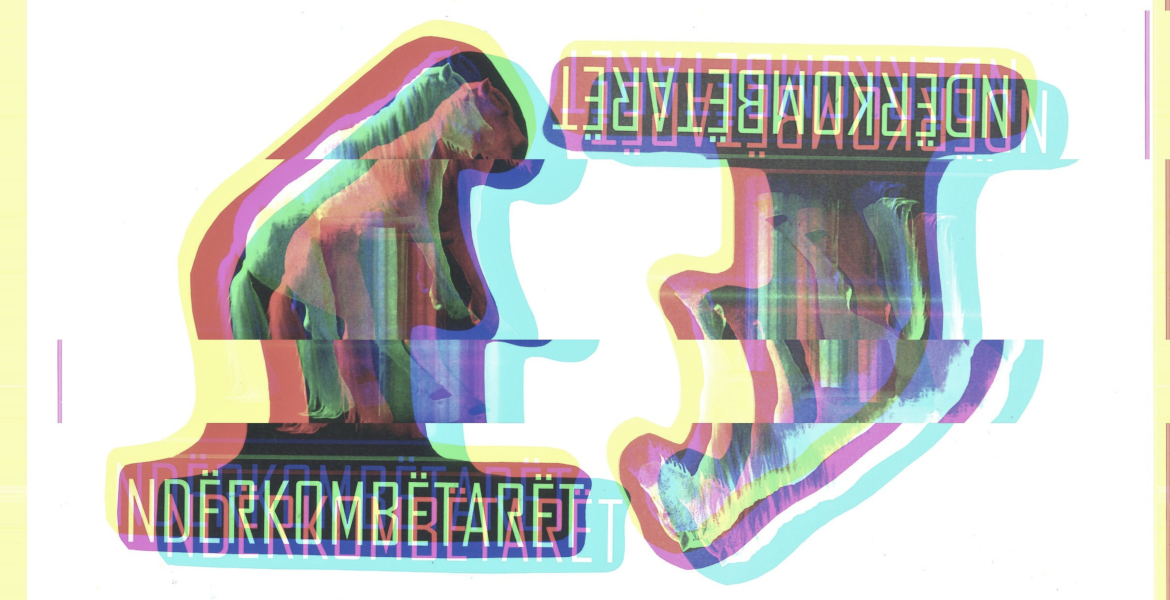
Feature image: Detail from the cover of Ndërkombëtarët by Ylljet Aliçka, designed by Daniel Prifti using artwork by Anri Sala (R&Z Tirana Times, 2016). Edited by Pro Peace.