
The Serbian public is often confronted with the question of what the most expensive Serbian word is. Yet every year, as July approaches, it becomes clear which three words are truly forbidden.
They are the name of a town (Srebrenica), a date (July 11), and a number (8,372). This ban has never been formally proclaimed in any legally binding document, yet it has become socially accepted, because outside the circles of nongovernmental organizations, there is virtually no broader public remembrance of the July 11 commemoration. Public debate does exist about the denial of the crime and of genocide, but this analysis focuses on what lies at the root of the problem: silence through neglect.
How did ignoring become desirable? After decades of crisis, and through the suppression of the trauma of the 1990s, society in the Republic of Serbia—whose attitudes are reflected, like a mirror image, in the circumstances of the Bosnia and Herzegovina entity of Republika Srpska—gradually stopped paying attention, particularly after 2008, to what had been established and documented by the International Criminal Tribunal for the former Yugoslavia (ICTY). This opened the door to a phase of triumphalism that, in plain view of society, culminated in the Novi Sad tragedy of November 1, 2024. Violence, in effect, regained its momentum. At the surface level, this can be attributed to at least two overlapping causes: first, the narrative of corruption-driven construction “progress,” and second, a somewhat older factor—the prolonged confrontation with death brought about by the COVID-19 pandemic—which returned like a boomerang to the unresolved legacy of the 1990s, the decade of war. The mass killings at the Vladislav Ribnikar Elementary School in Belgrade and in the village of Dubona in May 2023 created space for a broader social awakening, expressed through attempts at collective catharsis, opposition to lithium mining, and ultimately the peak of social tensions embodied in the student movement. Yet violence has not subsided, as the most recent incident in Tivat in May 2026 demonstrates. In Republika Srpska, public resistance to violence was evident in 2017 through the Justice for David movement, itself part of the broader wave of empathy that began with Justice for Dženan. But that momentum eventually stalled and gradually disappeared. Since then, the public in Republika Srpska has largely avoided looking itself in the mirror. One factor contributing to—though never justifying—the neglect of violence is the struggle for personal survival. This is a consequence of the authorities’ neglect of the economy, as bureaucracy has taken precedence, helping to preserve a frozen social order while also concealing violence and sidelining the crimes of the past in an effort to evade responsibility. Responsibility has thus become the most controversial word of all. After many years, it was brought back to the forefront of public debate by the student protests, yet the prevailing pattern of disregard persists, often slipping into outright denial of the events that took place in Srebrenica and Potočari on July 11, 1995. By bypassing this fundamental social problem, the cycle repeats itself over and over again. In recent years, this has reached the point where the country’s highest-ranking officials have denied the use of a long-range acoustic device during the mass protest in Belgrade on March 15, 2025, despite the presence of thousands of witnesses and extensive video footage. Everything can be justified—even dismissed as part of some conspiracy. At this point, it is worth recalling the discourse built around the method of denial through disregard: the claim that what happened in Srebrenica on July 11, 1995, was merely a conspiracy, a fabrication, or a hoax, rather than an act of institutionally organized violence that has been established in court as genocide.
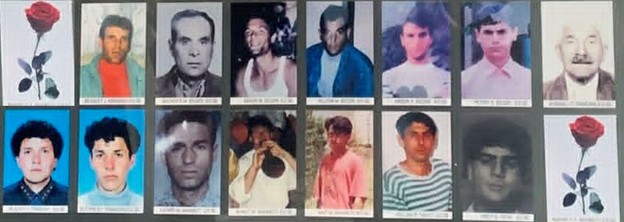
What is being ignored? Despite the extensive body of documents and testimony presented before the International Criminal Tribunal for the former Yugoslavia (ICTY), on the basis of which its judgments were rendered, in what has become the most thoroughly documented armed conflict in human history; despite the exhumation of victims’ remains from mass graves and their burial at the Potočari Memorial Cemetery; despite the production of documentary films openly presenting the trauma of genocide survivors; despite the feature film Quo Vadis, Aida?, intended for the broadest possible audience as an educational and poetic interpretation of an ancient tragedy; despite the United Nations General Assembly Resolution of May 23, 2024; and despite the Srebrenica Flower memorial in the park outside the United Nations Headquarters in New York, bearing the inscription 8,372—the Serbian public remains silent. Apart from the occasional overnight appearance of a mural depicting Ratko Mladić, society as a whole continues to ignore these realities, without recognizing their causal connection to contemporary violence. It is precisely this persistent disregard that has prompted this article, in which we will attempt to shed light on its underlying causes.
Burdened by this painful legacy of the recent past, the strained relationship between Bosniaks and Serbs remains one of the many potential flashpoints for ethnic conflict in the Western Balkans. The second objective of this analysis is to bring the historical roots of this legacy closer to the Millennial and Generation Z generations, who, in less than a decade, will bear full responsibility for a society shaped by a culture of silence amid the interplay of ideology and violence—a society confronted with rumours and a superficial understanding of history. For if catharsis never occurs, one fundamental question remains: what kind of people will we become? That is my personal question to the readers of this article, because I myself belong to the transition between these two generations. What kind of people will we become if we continue down the path of disregard?
Source Analysis: The primary source is a video subtitled in English, titled in Cyrillic General Ratko Mladić – Srpska Srebrenica, July 11, 1995, and published by the group Verni otadžbini (“Faithful to the Homeland”). This is emphasized for a straightforward reason: one of the disguises—or methods—of disregard is a form of pessimism presented as objectivity. By identifying the source in this way, we seek to pre-empt reflexive dismissals such as, “This is Bosniak propaganda,” “a mujahideen conspiracy,” “a Satanist fabrication,” or the many similar clichés that are often invoked. In addition to Ratko Mladić, the footage also shows General Radoslav Krstić, who was likewise convicted of genocide. Throughout the video, it is evident on several occasions that Mladić himself directs the cameraman to accompany and film him, a fact corroborated by his own explicit remarks—for example, at timestamp 4:20.
Before turning to the analysis itself, it is worth briefly considering Mladić’s understanding of his own ideas and his interpretation of history. Using the method of presentism—through which history is interpreted in light of contemporary values, moral standards, and political perspectives—we can observe that Serbian nationalism lost the contest with progressive ideas after 1945. Through a new system of education, it was supplanted by socialist ideology, which itself, by 1989, on the eve of Yugoslavia’s disintegration, had lost its own progressive appeal in competition with the “West” and liberal democracy. During the war in Bosnia from 1992 to 1995, these ideological concepts also came into conflict. To be precise, they existed not merely on party platforms or in the endless disputes of parliamentary politics; they were struggles taking place within individuals themselves. Mladić stands at the center of this convergence of tensions. His statements, including those made in the present video, reveal a divided identity shaped by his social position and by two ideologies that had once been opposed but, during the 1990s, merged into ethnonationalism. Defeated by the forces of historical progress, these two ideological traditions found common ground among conservative groups prepared for war, united by their shared reliance on autocracy as the essential link in a broader rural resistance to the freedoms associated with the achievements of liberal democratic governance. This aspect of the problem remains particularly important today because it is directly connected to contemporary destructive political narratives that serve as a cover for disregarding the events of Srebrenica in 1995, while simultaneously reviving the rhetoric of martial heroism and sovereigntist autocratic politics.
My interest in the politics of memory led me to seek out precisely this type of source, given that this article focuses on the events that took place in Srebrenica on July 11, 1995. In preparing this analysis, I was interested in Ratko Mladić’s conduct on that day—not only as the principal perpetrator of those events, but also as a figure who has since become an icon of denial intertwined with disregard. I deliberately chose a video recording as the primary source because it is readily accessible to all readers and can serve as a tool for encouraging critical thinking, which constitutes the third methodological objective of this article.
We will focus on four of Mladić’s remarks as he entered Srebrenica on July 11, 1995—his personal confrontation with the symbolism of the “Other,” made several hours before his arrival in Potočari. The footage begins with Mladić reacting to a UN vehicle stranded in a roadside ditch in the forest: “Film this now, show how we’re rescuing UNPROFOR,” he says, pointing to the vehicle marked “UN.” This illustrates precisely what was noted in the previous paragraph: a divided mindset, a parallel ideological conflict fought through symbols, resembling a rural tug-of-war staged to obscure the true purpose of the UN vehicle, which represented a peacekeeping mission. A second example of his confrontation with the symbols of the Other occurs upon entering Srebrenica, when he asks about the construction of a mosque and, a few minutes later, about the removal of a green flag. The third example, which has been discussed elsewhere as well, is his removal of the street sign bearing the name Reuf Selmanagić “Crni,” which Mladić declares he wants to take with him as a war trophy. It is here that the conservative foundations shared by the two ideological traditions embodied by Mladić become especially evident. Everything he had achieved before 1992, as an active officer, had been within the Yugoslav People’s Army (JNA)—the very army that emerged from the Partisan movement, of which Reuf Selmanagić Crni had also been a member. The clash of symbols unfolds alongside a forceful ideological performance staged before his own soldiers in an abandoned town. Finally, at approximately the twelve-minute mark, Mladić addresses the cameraman directly for about twenty seconds, stating that, “on the eve of the holiday, Srebrenica is being presented as a gift to the Serbian people,” before adding that “the time has come to take revenge on the Turks in this area, after the uprising against the Dahijas.” The events of 1804 and the reference to the Dahijas are invoked only superficially, in the service of a single, dangerous word: revenge. Throughout the recording, Mladić repeatedly frames the conflict as a struggle against “the Turks,” rather than against Bosniaks as one of the constituent peoples of Bosnia and Herzegovina. The pattern of disregard that, in this analysis, culminates in denial ultimately leads us back to the concealment of an intention rooted in revenge—an intention that has continued to resist acknowledgment throughout the decades, from 1995 to the present day.
It is because of this analysis of the footage that the article bears the title *The Road to Potočari*, taken from one of Mladić’s repeated commands, heard throughout the recording: “Head toward Potočari.” That road has remained, for the Millennial and Generation Z generations, a crossroads: one path leads to disregard that ends in the denial of genocide; the other, to cathartic reconciliation. Without a mature awareness—both societal and personal—of the events that took place in Srebrenica on July 11 and of the deaths of the 8,372 innocent victims, there can be no moral or value-based progress. Without such progress, we remain lost in the forest of disregard, from which there is no escape except through the perpetuation of violence. The answer to a single question has the potential to transform both the prevailing paradigm of life and the everyday reality of society in the Republic of Serbia and in Republika Srpska, the Bosnia and Herzegovina entity: the day when people approach Bosniaks with respect and compassion, acknowledge the loss of human lives, and accept responsibility by symbolically burying the hatchet at the memorial cemetery where the victims of the genocide are buried.
Dušan Kravljača was born in Belgrade in 1994. He lost both of his parents as a teenager. During his high school years, he attended history seminars at the Petnica Science Center. He studied History at the Faculty of Philosophy, University of Belgrade, where his undergraduate thesis examined the concept of sin in medieval writings on Kosovo. After taking a break from his studies, he plans to enroll this year in a master’s program at the same faculty, where he will research the politics of memory. He currently lives in East Sarajevo.