by Fisnik Minci
In the center of Suharekë, amid the ordinary bustle of a day in May, there is a place marked by a profound and sorrowful silence. For visitors, it creates the impression that time stopped forever in the spring of 1999.
The old aluminum doors, forced open and punctured by bullets, remain in their original condition. Faded bloodstains still mark the walls—dimmed by time, but not by memory. Bullet casings remain scattered across the floor, exactly where they fell on March 26, 1999, when Serbian forces carried out one of the most brutal massacres against Albanian civilians during the Kosovo war, killing 49 members of the Berisha family. Three others survived by sheer chance and lived to tell the world about the war crimes committed that day.
This site, located in the Shopping Center of Suharekë and formerly known as the “Kalabria” Pizzeria, was transformed five years ago into the Berisha Family Martyrs Museum. Today, it stands as a testament to collective memory, unhealed grief, and the determination to prevent oblivion from taking hold.
Baby Bottles, School Notebooks, and Bullet Casings
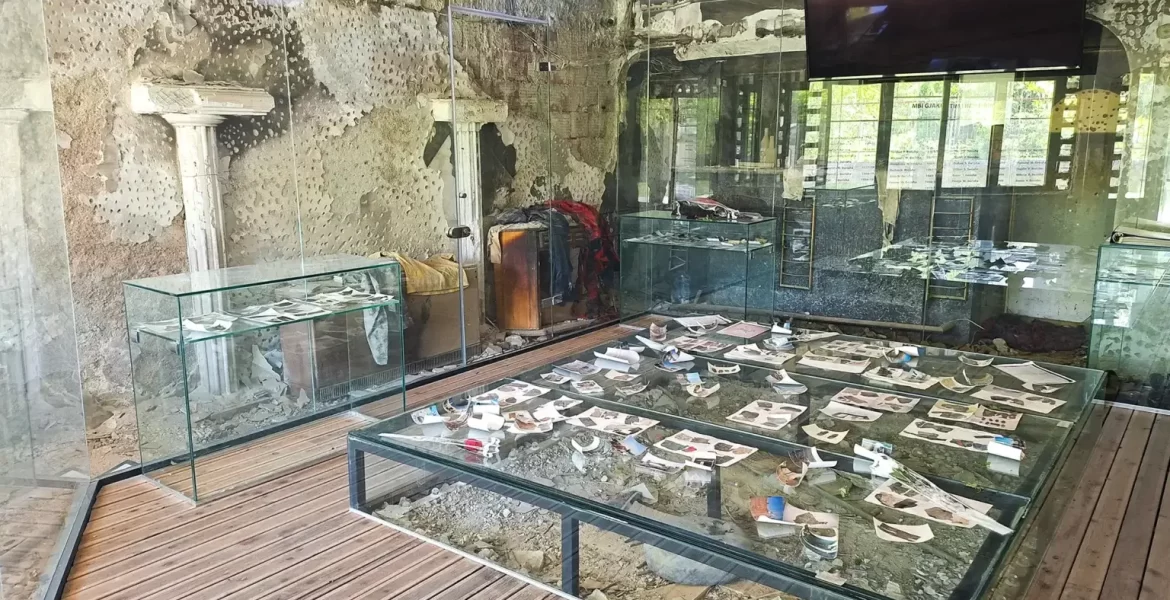
The original color of the walls remains untouched, blending with the silence that dominates the interior. Every photograph, every object, and every preserved trace carries its own story. Thanks to a donation from the Golden Eagle Foundation, the exhibits are protected behind glass, including the central floor display, which resembles a vertical showcase.
The objects visible beneath the glass is a baby bottle. Silent and ordinary in appearance, yet heavy with the weight of history. It serves as a painful reminder that even children were not spared in the massacre.
Further along, copies of school notebooks, drawings, and creative works made by Berisha family children are displayed. There are pages filled with innocent handwriting and school assignments marked with excellent grades. Nearby are photographs of clothing belonging to the victims, recovered following exhumations from mass graves in Kosovo and Serbia. These items stand as evidence of dreams cut short and of systematic efforts to conceal the crime.
On the left side of the entrance are the names of those who were killed. On the right are the names of the three survivors: Shyhrete Berisha, Vjollca Berisha, and Gramoz Berisha. Beneath them is an inscription: “Angels who returned from death to tell the story of sorrow.”
“The Crime Against Them Was Fivefold” The museum is cared for daily by 72-year-old Hysni Berisha. He welcomes visitors with kindness and a calm demeanor that conceals years of exhaustion and the burden of memory. He walks slowly through the space, pausing beside photographs, occasionally touching an object before beginning his account—not only of what happened to the Berisha family, but also of the long struggle to locate the missing and preserve the truth.
“All the crimes committed in Kosovo during 1998–1999 were grave, crimes that wiped out entire families. What happened to the Berisha family was not merely a crime—it was genocide. According to international conventions, genocide is a crime committed against an ethnic group. I call it a multiple crime because they were executed in this building, loaded onto trucks, buried at the Yugoslav Army shooting range in Lubizhdë, dug up again with excavators, their bodies damaged, loaded into refrigerated trucks, taken to the Danube, and then transferred from there to Batajnica. In other words, the crime against those bodies was committed five times over. That is why I call it genocide,” Berisha says.
Within that small space, his testimony does not feel like a distant historical account. The traces remain—clothes, blankets, and personal belongings that seem to bear silent witness.
The museum itself was not created by chance.
Family members decided that the site of the massacre should not be rebuilt and forgotten but preserved as evidence for future generations.
“We wanted to show the crimes committed against our family, the pain we experienced, and to leave a legacy for the generations to come. We decided to create a museum precisely in the building where the massacre of the Berisha family took place, in what was once the Kalabria pizzeria. With the understanding and support of the owner, he offered us the premises so that we could transform them into a museum,” Hysni Berisha explains.
He rarely speaks about the challenges involved, preferring instead to focus on the achievement of preserving the site. “For me, it was a great success that we managed to convince the owner to leave the building as a museum, so that future generations could see the crimes of war.
Today, I am proud of this work and of the fact that we have preserved this place as a museum.”
“There Is No Dignity Without a Grave”
Yet pride does not diminish the pain. More than two decades later, the Berisha family continues to live with the absence of over twenty missing relatives.
“Even today, 24 members of the Berisha family remain missing. A family cannot have dignity until it has at least a bone, until it knows where to place a flower, where the grave is. We have prepared the gravesites and everything else, but 24 bodies are still missing,” he says.
Even so, hope remains part of daily life.
That Still Speaks at the Berisha Family Museum “Hope never dies. When I founded the Association for the Investigation of War Crimes, I named it ‘Shpresimi’ (Hope), because we have always believed that we would reach the truth. We still hope. We wait for the day when all those who were killed will at least have dignity—a grave, a place where a flower can be laid, a place where families can come and remember them.”
Visitors who enter the museum often leave deeply moved. This is reflected in the museum’s guestbook, signed by numerous international and local personalities.
According to Berisha, most visitors cannot hold back their tears.
“The museum has a multidimensional character. Most visitors come from abroad—members of various missions in Kosovo, our diaspora, and guests who visit during anniversaries. Whenever people come and share our pain, even for five minutes, we feel some emotional relief. We feel calmer and freer because someone is listening to us,” he says.
Museums as Evidence Against Denial
For experts in transitional justice, places such as this play a vital role in preserving collective memory and confronting the past.
Bekim Blakaj of the Humanitarian Law Center in Kosovo says that memory museums play an important role in transitional justice because they serve as spaces where the experiences of victims and the consequences of violence are documented, preserved, and communicated.
“Transitional justice is not only about court proceedings. It is also about the right to truth, memory, and public recognition of suffering. In this sense, memory museums help society confront the past, challenge the denial of crimes, and foster a culture of respect for human rights. They also serve as educational tools for younger generations so that the crimes of the past are neither forgotten nor repeated. At the same time, memorialization creates spaces for discussion and reflection, which in the long term can contribute to sustainable peace and reconciliation.”
According to Blakaj, documenting and publicly presenting war crimes is essential for post-conflict societies.
“Without credible documentation and public acknowledgment of the past, there is always a risk of relativizing or denying crimes. Documents, photographs, testimonies, and artifacts preserved in museums and memorials create a collective archive of memory that gives voice to victims and contributes to establishing historical truth. Public exhibitions of these crimes also raise awareness and foster empathy toward victims.”
Spaces such as the Berisha Family Martyrs Museum contribute directly to preserving collective memory.
“Very few crime scenes have been preserved in their original condition. One of them is the former Kalabria restaurant-pizzeria, where members of the Berisha family were executed. Because the site remains authentic, the museum makes memory more tangible and personal. It serves both as a place of reflection and respect for the victims and as a form of resistance against forgetting.”
Blakaj emphasizes that the testimonies of victims and their families must be treated with sensitivity, dignity, and responsibility within memorialization processes. Victims and survivors should not be regarded merely as sources of information but as active participants in shaping public memory.
“It is essential that their stories are presented authentically and without political instrumentalization. In the case of the Berisha family and many other cases where people remain missing, memorialization remains incomplete. The lack of information about the fate of the missing keeps families’ wounds open and turns memory into not only an act of remembrance but also an ongoing demand for truth and justice.”
Transitional Justice Between Documents and Reality
Kosovo’s Transitional Justice Strategy 2024–2034, drawing on data from the Humanitarian Law Center, states that approximately 13,000 people were killed during the war in Kosovo, while 1,597 people remain forcibly disappeared, including 109 children.
The document references massacres, forced expulsions, torture, and the systematic destruction of civilian life during the war, as well as domestic and international efforts to address the past through transitional justice.
“Previous truth-seeking initiatives failed to fulfill their mandates,” the strategy notes, adding that “societal transformation from a context of systematic violence into peaceful coexistence is difficult to achieve when victims lack adequate care and when the principles of transitional justice are not implemented.” It further states: “
In Kosovo, various initiatives have been undertaken by local, regional, and international civil society organizations to address the past. Despite their importance, these initiatives cannot replace the need for Kosovo’s public institutions to address and promote transitional justice.”
According to Blakaj, Kosovo has made progress in transitional justice, but the process remains fragmented and incomplete. Important steps have included documenting war crimes, establishing the Institute for Crimes Committed During the War, drafting the National Strategy for Transitional Justice, and other initiatives.
“Nevertheless, we have not yet seen any serious institutional initiative aimed at strengthening memorialization and preserving collective memory. Above all, victims have never been placed at the center of transitional justice processes. As a result, many victims and their families continue to feel excluded, particularly because of the lack of full justice and the unresolved fate of the missing. For the past 27 years, the burden of preserving memory and advancing transitional justice has largely been carried by victims’ associations, family members, and civil society organizations.”
Without Justice, There Can Be No Sustainable Peace
Blakaj argues that strengthening Kosovo’s culture of remembrance requires greater institutional commitment, support for museums and memorials, integration of education about the past into school curricula, and support for professional documentation and archival preservation. “It is also important to create spaces for dialogue between communities and to involve young people more actively in discussions about the past. A culture of remembrance should be seen not only as a way of honouring victims but also as an investment in peace and democracy.”
Meanwhile, Hysni Berisha speaks with disappointment about the lack of institutional support, though his greatest frustration remains the failure to fully deliver justice for war crimes and the continued denial of those crimes by authorities in Serbia.
“The side that committed these crimes has never apologized. Instead, it continues to make accusations and blame our institutions. They accuse us as though we were the perpetrators and they were the victims,” he says.
According to reports by civil society organizations and the media regarding the Suharekë massacre and other atrocities, six Serbian officials were convicted by the International Criminal Tribunal in The Hague: Vlastimir Đorđević, Nikola Šainović, Dragoljub Ojdanić, Nebojša Pavković, Vladimir Lazarević, and Sreten Lukić, receiving sentences ranging from 18 to 22 years in prison. Meanwhile, the War Crimes Department of the Belgrade District Court tried eight individuals and convicted four of the accused involved in the massacre.
According to Blakaj, the absence of full justice directly affects reconciliation and remembrance. “When crimes go unpunished, when victims do not receive the recognition and justice they deserve, and when people remain missing, the wounds of war remain open. Without justice and truth, it is extremely difficult to build trust between communities and achieve sustainable peace. Memory and justice cannot be separated —they are interconnected processes that must advance together to create a more just society that is conscious of its past.”
Despite the absence of full justice and decades of waiting, the Berisha Family Museum continues to stand as a place of remembrance against forgetting.
Full link in Albanian: https://tvprizreni.net/gjurmet-e masakres-dhe-heshtja-qe-flet-ende-ne-muzeun-e-familjes berisha
This article is a product of the Academy on Reporting on Dealing with the Past (DwP) and Conflict-Sensitive Journalism, implemented by the Pro Peace Program in Kosovo and the Association of Journalists of Kosovo (AGK). The views expressed in this article are the responsibility of the journalist and do not in any way reflect the views of Pro Peace and AGK.